 Visit Athens Guide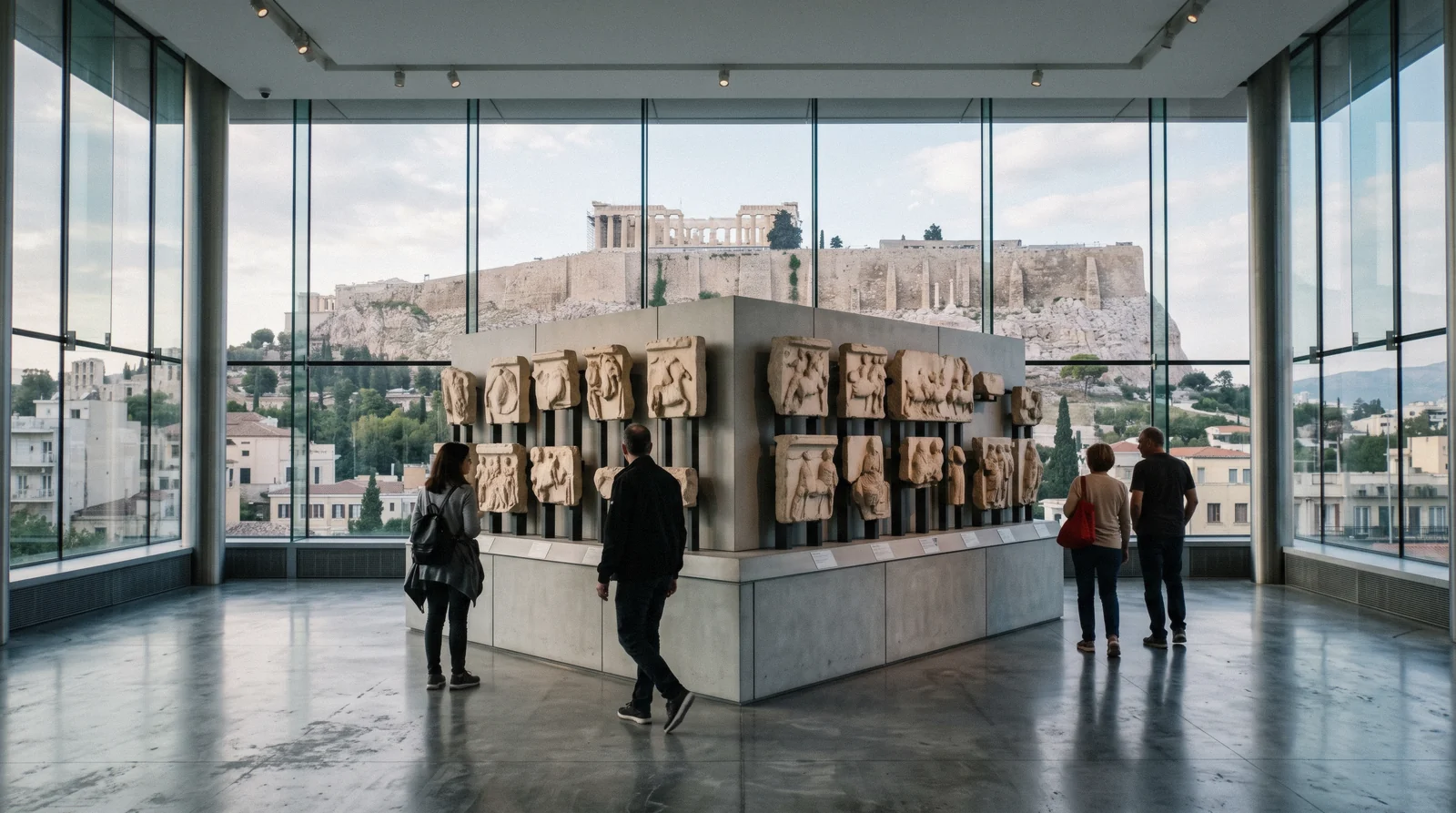
The Acropolis Museum
The Acropolis Museum stands at Dionysiou Areopagitou 15, ten minutes downhill from the rock, and it is where the originals went — the Caryatids, the Parthenon frieze, the Athena Nike parapet. It is run by its own organisation, not by the state platform that sells the site, so its hours, its free days and its ticket are all separate. This page covers what is inside and when to come as checked in Q3 2026; the ticket itself is on the Acropolis Museum ticket page, and the rock is on the Acropolis page. For the wider plan, see top attractions in Athens.
Quick answer Before or after the rock, and the one evening worth planning around
The Acropolis Museum costs €20, needs no timed slot, and takes about two hours. It opens at 09:00 every day and stays open until 22:00 on Fridays, all year.
Key takeaways
- Go after the rock, not before: the top floor is laid out to face the real building through the glass, and it makes sense once you have stood in it — the Parthenon gallery explains how.
- Friday evening is the quietest good hour in Athens, and the second-floor restaurant runs to midnight on Fridays and Saturdays. The hours section has every band.
- Reduced tickets are sold at the desk only, never online — the ticket page sets out who qualifies.
- The ticket also covers the excavated Athenian street under the building, reached from the entrance courtyard. Most visitors walk over it and never go down.
- This museum's free days are 6 and 25 March, 18 May and 28 October — a different list from the state sites, as the free-entry page sets out side by side.
- Ramps at every entrance, lifts on every floor and wheelchairs on loan — accessible Athens.
Key facts
Opening hours
| 1 Nov – 31 Mar, Monday–Thursday | 09:00–17:00 |
|---|---|
| 1 Nov – 31 Mar, Friday | 09:00–22:00 |
| 1 Nov – 31 Mar, Saturday–Sunday | 09:00–20:00 |
| 1 Apr – 31 Oct, Monday | 09:00–17:00 |
| 1 Apr – 31 Oct, Tuesday–Sunday | 09:00–20:00 |
| 1 Apr – 31 Oct, Friday | 09:00–22:00 |
Closed 1 January, Orthodox Easter Sunday, 1 May, 25 and 26 December; 09:00–15:00 on 24 and 31 December
Admission
- Adult
- €20
- Reduced
- €10, issued at the museum desk only
- Free
- 6 March, 25 March, 18 May and 28 October — the museum's own list, not the state one
Planning it
- Time needed
- Not stated by the museum; our routing: 2 hours for the three floors and the excavation
- Book ahead
- Recommended — a few days
- Address
- Dionysiou Areopagitou 15, 117 42 Athens
The ways in, priced from the museum's own page and GetYourGuide on 1 September 2026. The full comparison is on the ticket page.
There is no timed entry here, so the question is not when but whether you want the ticket alone or a guide with it — and whether you are also buying the rock in the same transaction.
| Option | Price | Includes | Cancel | Book |
|---|---|---|---|---|
| Official general admissionEveryone without a document to show at the desk; it covers all floors and the excavation | €20 | All galleries and the excavation below | Per the museum's terms | Official site |
| Official reducedStudents, under-25s and the other qualifying categories — bring the paperwork, it is never sold online | €10 | The same, desk only with documents | Not sold online | Official site |
| Entry with optional audio guideFor a booking held in advance, or for the audio track the museum does not sell itself | Listed at €26 | Entry, choice of audio track | Per listing | Check Availability |
| Rock and museum togetherFor handling both tickets in one purchase; the museum half is valid any day, so nothing is locked | Listed at €63 | Acropolis slot plus museum entry | Per listing | Check Availability |
| Small-group guided, three hoursFor anyone who wants the Parthenon sculpture explained above and below in a single run | From €49 | Rock, Parthenon and museum with a guide | Per listing | Check Availability |
No official ticket covers both the museum and the rock; the combination cards are reseller products. Why that is has the history.
Acropolis Museum entry options compared
The cards behind the table, with the operator's own rating and review count.
 from €26
Athens: Acropolis Museum Ticket with optional Audio Guide
Entry to the Acropolis Museum with optional audio guide. The official price is €20; reduced tickets are only issued at the museum desk, never online.
Check Availability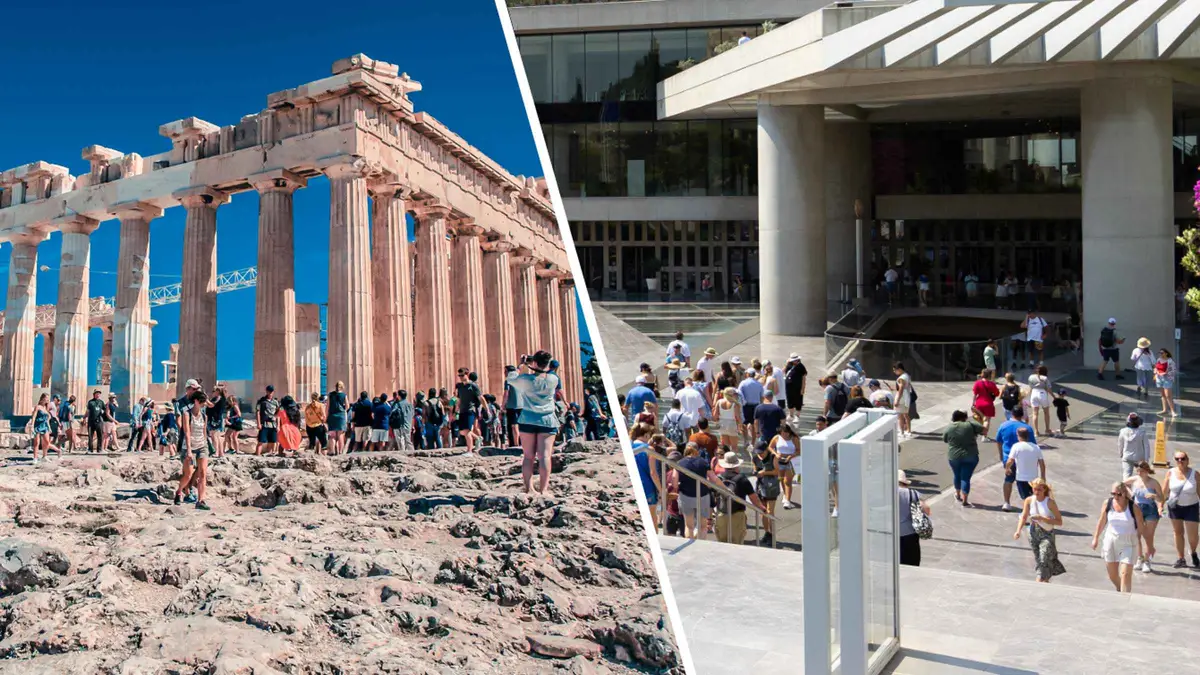 from €63
Combo: Acropolis & Acropolis Museum with Optional Tours
Both tickets in one purchase — a timed slot for the rock and an any-day ticket for the museum. No official pass covers both, so this is the reseller's convenience.
Check Availability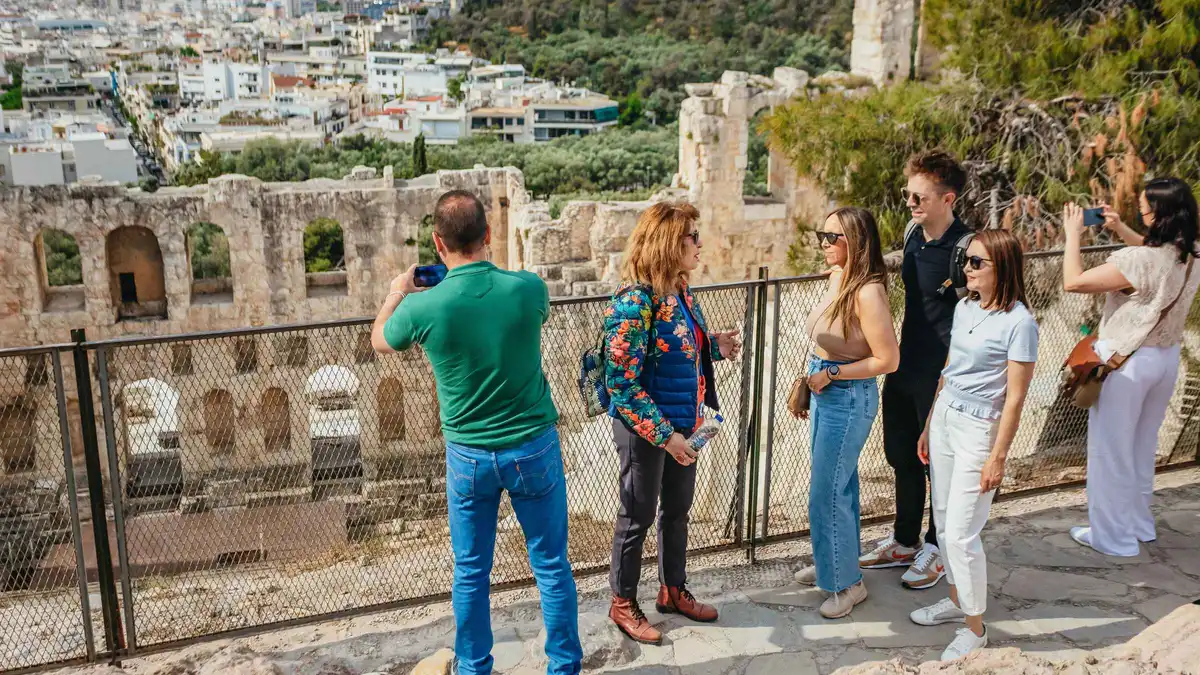 from €49
Athens: Parthenon, Acropolis and Museum Small Group Tour
Three hours in a small group with pre-reserved tickets, covering the Acropolis, the Parthenon and the museum below it in one run.
Check AvailabilityPrices, ratings and details are the platform's own. Euro figures are the listed prices. The platform bills in your account's currency.
What is inside, floor by floor
Bernard Tschumi's building is organised as a climb, and it repays being walked in order rather than wandered.
Under the building: the excavation
Before you go up, go down. A whole block of ancient Athens — houses, workshops, drains, a bath — was excavated on the site and left in place, and the museum was built on pillars above it. It is reached from the entrance courtyard and included in the ticket, and it is the part most visitors skip because the glass floor makes it look like decoration.
It has its own opening hours, which match the museum's in summer and run 09:00 to 17:00 daily in winter.
Ground floor: the slopes
The sloping gallery reproduces the climb up to the rock. Finds from the sanctuaries and houses on the Acropolis slopes are arranged along it, the ordinary objects of people who lived under the sanctuary rather than in it. The building itself sits on the Makriyianni plot over an excavated ancient Athenian neighbourhood, which you can see through the glass floor at the entrance, and that excavation is included in your ticket.
Bernard Tschumi designed the museum with Michalis Photiadis, and it opened on 20 June 2009. Start here and the ground you walk on becomes part of the exhibition. Allow time for this floor before you climb, because the galleries above assume you have seen the everyday material first and the sequence rewards it.
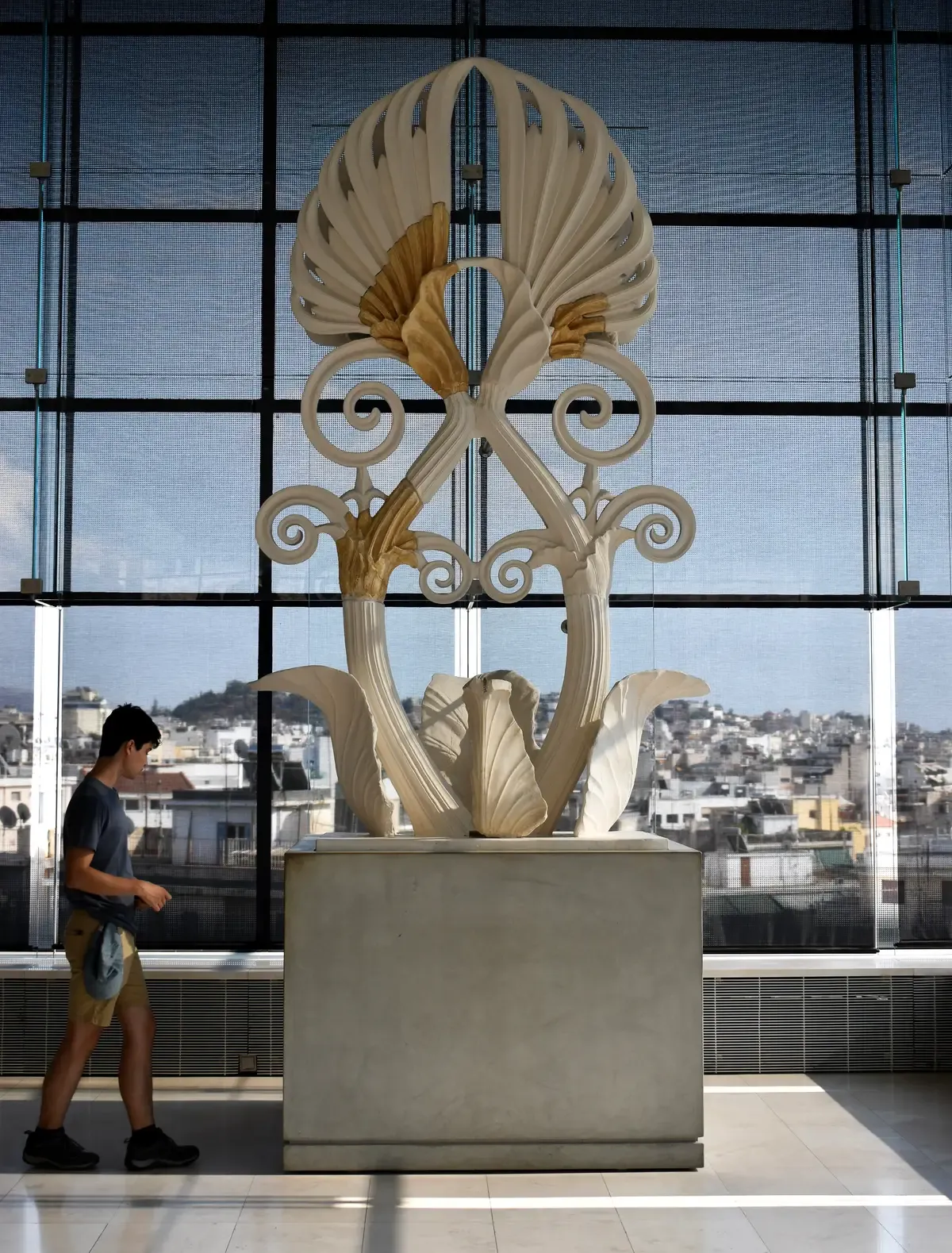
Photo: Julian Lupyan, CC0, via Wikimedia Commons
First floor: the Archaic gallery and the Caryatids
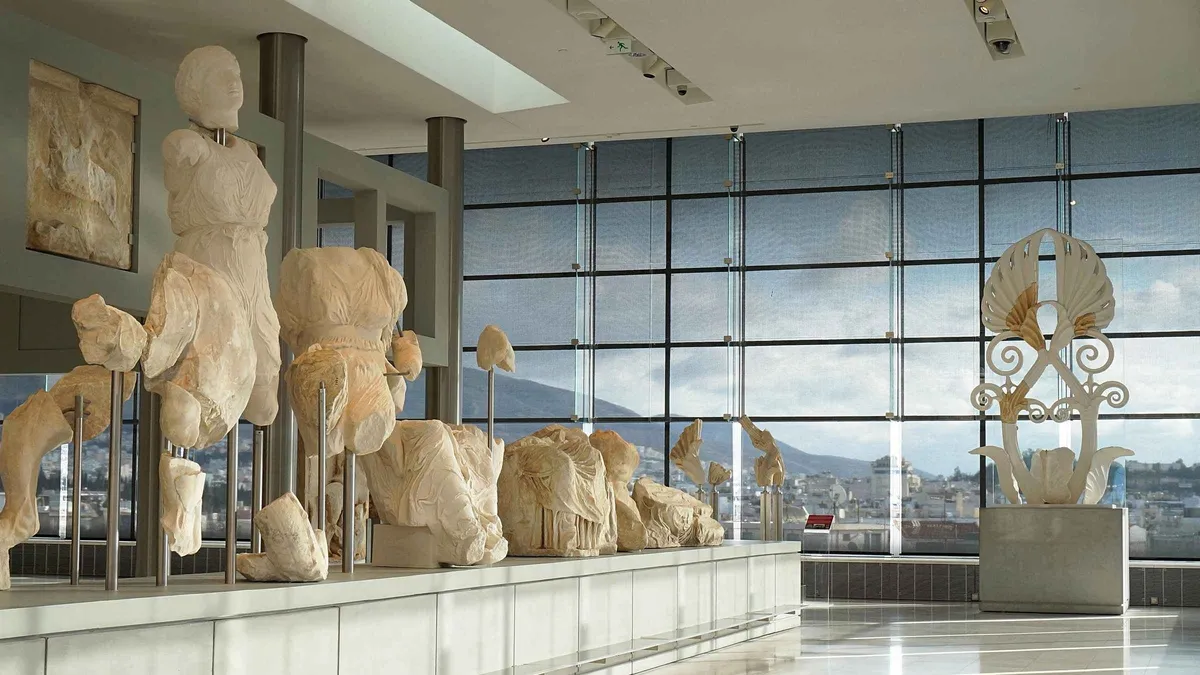
The open hall of Archaic sculpture, standing free so you can walk round each figure rather than facing a wall of them — the korai with their traces of paint, the Moschophoros, the pedimental beasts. Five of the six original Caryatids from the Erechtheion stand here on a balcony, with a visible gap where the sixth should be: it was removed by Lord Elgin and is in the British Museum.
Top floor: the Parthenon gallery
A rectangular concrete core the exact dimensions of the Parthenon's cella, turned to the same compass alignment as the building itself, wrapped in the frieze at eye level and glazed on all four sides so the real temple is in view through the glass. The surviving original blocks are set beside plaster casts of the ones in London, and the difference in colour is the argument the museum is making without a word of text.
The shop, the café and the restaurant
The ground-floor shop and café need no ticket at all, so you can walk in off the street. The second-floor shop and restaurant do need one, but the desk issues a free admission ticket for that purpose, so ask rather than pay full price for a coffee. The restaurant has a terrace facing the rock and stays open until midnight on Fridays and Saturdays, which lines up with the museum's late Friday hours and gives you the lit Parthenon from above street level.
It is a separate legal entity from the state sites, with its own shop, hours and free days, so rules here do not match the Acropolis next door. Keep the restaurant ticket if you plan to come back down to the galleries afterwards.
The Acropolis Museum In Ten Dates
Two and a half centuries of trying to put the finds somewhere, from a hollow in the ground beside the Parthenon to the building on Dionysiou Areopagitou. Every line is from the museum's own account.
-
1863
A site is chosen on the rock
After thirty years of gathering antiquities off the Acropolis, the decision is taken to build a museum in a hollow in the ground southeast of the Parthenon.
-
1865–1874
The first Acropolis Museum
Founded in 1865 and completed in 1874, it holds the finds of the earliest excavations on the rock.
-
1888
A second small building
The excavations keep producing more than the first museum can hold, so a second building goes up beside it.
-
After 1945
The museum that lasted to 2007
A radical post-war refurbishment produces a new building on the rock, and that is the museum visitors used for the next sixty years.
-
1975
ESMA is formed
The Committee for the Conservation of the Acropolis Monuments is established to study the dangers to the monuments; it starts with the Erechtheion.
-
1979
The Caryatids come indoors
The figures are lifted off the Erechtheion porch to stop outdoor weathering and moved to the museum on the rock — which promptly runs out of space again.
-
2000–2001
The competition, and Tschumi
An architectural competition selects Bernard Tschumi with the Athens architect Michael Photiadis. The museum's own pages date the competition to 2000 and to spring 2001 respectively.
-
2007–2008
Built, then moved into
Construction is completed in September 2007 and the artefacts are transferred from the rock between October 2007 and September 2008. Total budget €130 million, co-financed by the Hellenic Republic and the European Regional Development Fund.
-
20 June 2009
The building opens
Three main levels and two intermediate ones on 43 columns, 14,000 square metres of exhibition space, and a top-floor gallery of 39 by 84 metres turned to the Parthenon's own alignment.
-
2019, then 2024
The excavation opens, and gets its own museum
The ancient neighbourhood under the building is opened to visitors in June 2019, and the small Museum of the Excavation at its southern edge is inaugurated in June 2024.
Sources: Museum History, The Museum Building and the archaeological excavation, all the museum's own pages. Where its history and building pages disagree on the competition and foundation dates, both readings are printed above rather than one chosen.
Hours, and the Friday that changes the plan
Read on theacropolismuseum.gr on 1 September 2026. The museum keeps its own calendar, not the state one.
Summer, 1 April to 31 October
Monday 09:00 to 17:00, Tuesday to Sunday 09:00 to 20:00, and Friday 09:00 to 22:00. Last entry is thirty minutes before closing and the galleries are cleared fifteen minutes before it, so a 19:45 arrival in July is not a visit but a walk through the foyer. Friday is the day to plan around, because the extra two hours in the evening carry cooler air and a lit view of the rock from the second floor and the restaurant terrace.
Full admission is €20 and the reduced €10 ticket is sold only at the desk, so reductions cannot be arranged online. During official heatwaves the ministry has closed open-air sites through the hottest hours, sometimes announced a day ahead, and the museum's air-conditioned galleries then become the sensible morning substitute.
Winter, 1 November to 31 March
Monday to Thursday 09:00 to 17:00, Friday 09:00 to 22:00, and Saturday and Sunday 09:00 to 20:00. The weekend is longer than the working week in winter, which is the opposite of what most visitors assume from the summer pattern. Friday again runs to 22:00, so a winter short break that includes a Friday can put the second-floor view of the lit rock on the itinerary without costing an evening elsewhere.
Note the contrast with the state sites in the same months, because the Olympieion, Roman Agora, Kerameikos and Aristotle's Lyceum all close at 15:00 from 1 November while this museum keeps going. Tickets are €20 full and €10 reduced, with the reduced ticket available only at the desk. Check the exact Orthodox Easter dates before you build a spring week.
Closed and short days
The museum closes on 1 January, Orthodox Easter Sunday, 1 May, and 25 and 26 December. It does not close on 25 March, which the Acropolis and other state sites do, so that national holiday is a working day here and a closed one next door. Short days are worth writing down.
Hours run 09:00 to 15:00 on 24 and 31 December, 12:00 to 18:00 on Orthodox Good Friday, and 09:00 to 15:00 on Orthodox Holy Saturday. The Orthodox dates move every year, so match them to the calendar for your trip before booking anything around them. All of the city's closures sit together on the opening-hours page, which also covers the state sites whose schedule differs from this museum on several of these dates.
Free admission days
The museum's own free days are 6 March, 25 March, 18 May and 28 October. That list does not match the state sites' calendar, and the differences catch people out. There are no free Sundays here, while the state sites open free on the first and third Sunday of each month from 1 November to 31 March, along with the last weekend of September.
On 25 March the museum is free while the Acropolis itself is closed, which makes it a useful fallback for that particular holiday. The state sites also have 6 March, 18 April, 18 May and 28 October free, so two of the museum's four dates overlap. The free-entry page puts the two calendars side by side, which is quicker than reconstructing them yourself.
How Much Time To Give The Acropolis Museum
The museum publishes no visit length, so these are our three routings against its own hours: 09:00 open, last entry thirty minutes before closing, galleries cleared fifteen minutes before it. Door-to-door figures assume the walk from Syntagma or the ten minutes downhill from the rock.
The building is designed as a climb and the top floor is the reason to be here, so the short routing is not a smaller version of the long one — it is the same ending with the first two floors skipped.
| Routing | Inside | Door to door from the Acropolis exit | What you skip |
|---|---|---|---|
| The Parthenon gallery only | 45 min | About 1 h 15 | The excavation below the building, the slopes gallery and the Archaic hall with the Caryatids |
| The full climb, excavation included | 2 h | About 2 h 30 | Nothing; this is the page's own routing, and it starts underground rather than upstairs |
| With a guide | 3 h including the rock | 3 h from the meeting point | Your own pace — the small-group version covers the Parthenon above and below in one run |
The one routing worth planning a day around is Friday: the museum runs to 22:00 all year, the last two hours are the quietest good hours in Athens, and the second-floor restaurant stays open to midnight on Friday and Saturday. The hours section has every band.
Getting there, groups and the practical rules
A short walk from the rock, and a few rules that catch groups in particular.
How to get there
Akropoli station on Line 2 is at the door, and the museum's own directions name it as the nearest station. Lines 2 and 3 opened on 28 January 2000, and the digging turned up enough archaeology that Syntagma station keeps a free display in its concourse if you change there. On foot it is ten minutes downhill from the Acropolis south entrance along Dionysiou Areopagitou, which was pedestrianised in 2003 as part of the Unification of the Archaeological Sites programme and runs the whole way.
The nearest bus stop is Makrigianni, and trolley lines 1, 5 and 15 stop there too. There are bike racks at the main entrance and at the metro. A single ticket costs €1.20 and covers 90 minutes, which is enough from most central stops.
Groups need a booking, and it is enforced
A group is sixteen to forty people, and a reservation is mandatory. The museum warns that groups without one may not be admitted on busy days, and that even booked groups can wait, so build slack into any tight schedule. Bookings go through [email protected] or +30 210 9000903 on weekdays, so a weekend arrival with an unbooked group has no same-day route to a fix.
School groups have their own address and their own warning about arriving unbooked, which suggests the enforcement bites there too. The practical pattern is to book well ahead, carry the confirmation, and have the group leader hold the paperwork at the validation machines rather than distributing it. Individual visitors need none of this and can buy a €20 ticket at the desk.
Inside the building
Everyone passes through validation machines on the ground floor before entering the galleries, so keep tickets reachable rather than packed away. Lifts are reserved as a priority for visitors with mobility difficulties and for ticket-holders heading to the second-floor restaurant, which is one reason to take the free admission ticket the desk issues for that purpose. The museum offers a digital guide, and licensed human guides are arranged through the Tour Guide Association rather than at the door, so book a guide before you arrive if you want one.
Remember that white plaster casts stand in the Parthenon gallery where the original blocks are in London, removed by Lord Elgin in the 19th century, and the museum's own labelling makes that point plainly. The full ticket is €20, reduced €10.
Dos And Don'ts At The Acropolis Museum
The short version of everything above, for the afternoon you come down off the rock.
Do
- Come after the Acropolis, not before: the top floor faces the real building through the glass and only makes its argument once you have stood in it
- Go down to the excavation first, from the entrance courtyard — it is on your ticket and most people walk over it on the glass and never descend
- Take Friday evening if the week allows it: open to 22:00 all year, and the quietest good hours in the city
- Bring documents if you qualify for the reduced rate — it is issued at the desk, never sold online
- Book ahead if you are a party of sixteen to forty; groups without a reservation may not be admitted on a busy day
Don't
- Don't arrive at 19:45 in summer expecting a visit: last entry is thirty minutes before closing and the galleries are cleared fifteen minutes before it
- Don't come looking for a ticket that also covers the rock — no official one exists, and the combined-ticket page explains why
- Don't buy a ticket just to use the ground-floor shop or café; both are open off the street, and the second-floor restaurant needs only a free admission ticket from the desk
- Don't head for the lifts by default — they are reserved as a priority for visitors with mobility difficulties, and for restaurant traffic
- Don't assume this museum shares the state calendar: its free days are 6 and 25 March, 18 May and 28 October, and they do not match
Acropolis Museum map: the door and what is around it
The entrance, the metro, and the four things within ten minutes on foot.
Five Things Most Visitors Do Not Know About The Acropolis Museum
Facts about the building rather than the sculpture, each with where it comes from.
- It cost €130 million, and Europe paid part of it. The construction was co-financed by the Hellenic Republic and the European Regional Development Fund. (Acropolis Museum, The Museum Building) - The top floor is a scale model you can stand in. The Parthenon Gallery measures 39 by 84 metres and is turned to the same compass alignment as the temple outside the glass, so the frieze runs around you in the order it ran around the building. (Acropolis Museum, The Museum Building) - The whole building stands on 43 columns. They were placed in collaboration with the archaeologists so the foundations would miss the ancient neighbourhood underneath, which is why the plan looks irregular from below.
There are 1,302 square metres of glass above them. (Acropolis Museum, The Museum Building) - The neighbourhood under your feet was destroyed by a Germanic tribe. The Herulians ravaged Athens in AD 267 and wrecked the site; the houses were rebuilt, acquired colonnaded courtyards and private baths, and were still occupied into the sixth century. Human activity on the plot starts somewhere between 3500 and 3000 BC.
(Acropolis Museum, the archaeological excavation) - The excavation only opened ten years after the museum did. Visitors could not walk the ancient streets until June 2019, and the small Museum of the Excavation at the southern edge was inaugurated in June 2024. (Acropolis Museum, the archaeological excavation)
Eating At The Museum
This is the one major sight in Athens where the food is worth planning around, mostly because of what it looks at.
There are two places to eat and they work differently. The ground-floor café and shop need no ticket at all — you can walk in off Dionysiou Areopagitou, which makes them a useful stop for anyone waiting out the middle of a hot afternoon. The second-floor restaurant does need a ticket, but the desk issues a free admission ticket for that purpose, so a meal there costs the meal and nothing else.
It has a terrace facing the rock and stays open until midnight on Friday and Saturday, which is the best view in Athens that carries no admission charge. The museum does not publish its menu prices, so we do not print a figure; for the alternative, Koukaki and Makrygianni start two minutes away and charge ordinary neighbourhood prices.
Next stop from the Acropolis Museum
Walk minutes are our estimates from the GPS distances.
The Acropolis
Uphill on the pedestrian avenue. €30 on a separate ticket, with a declared entry hour — the Acropolis has the hours and the gates.
10 min walkTemple of Olympian Zeus
East along the avenue, past Hadrian's Arch which costs nothing to look at. The Olympieion shuts at 15:00 in winter.
8 min walkPlaka
North into the old lanes. Plaka is the postcard and the most expensive dinner in the city; Psyri is ten minutes further and cheaper.
9 min walkAcropolis Museum questions
Is the Acropolis Museum worth going into?
If you are going up the rock, yes — the originals are here and the rock has casts. The top-floor gallery is built to the Parthenon's own dimensions and alignment with the real building in the window, which is a piece of argument you cannot get anywhere else. Two hours covers it; what is inside sets out the floors.
Should I visit the museum before or after the Acropolis?
After. The Parthenon gallery is laid out to be read against the building you have just walked through, and the difference between the original blocks and the casts of the ones in London only lands once you have seen the empty frieze in place. The one argument for going first is heat: in July the museum is air-conditioned and the rock is not.
What is the most famous thing in the Acropolis Museum?
Five of the six original Caryatids from the Erechtheion, on the first floor, with the gap where the sixth should be. After them, the Parthenon frieze on the top floor and the Athena Nike parapet relief of the figure adjusting her sandal.
Do I need to book Acropolis Museum tickets in advance?
No — there is no timed entry, and general admission is sold at the desk as well as online. Booking online saves a queue on a summer afternoon, nothing more. Reduced and free tickets can only be issued at the desk. The ticket page has who qualifies.
Can I eat at the museum without a ticket?
On the ground floor, yes: the shop and café there are outside the ticket line. The second-floor restaurant with the terrace facing the rock needs a ticket, but the desk issues a free admission ticket for it. On Friday and Saturday it serves until midnight.
Is the excavation under the museum included?
Yes, in the same ticket, and it is reached from the entrance courtyard rather than from inside the galleries. In winter it runs 09:00 to 17:00 daily even when the museum upstairs keeps different hours.
Acropolis Museum on Video
Three filmed visits that show the distances, the surfaces and the pace — the things a written page cannot carry. Every id was checked against YouTube on 2 September 2026.
The Acropolis Museum : Part 1 - The Only Guided Acropolis Museum Tour on YouTube
A guided walk of the lower floors, filmed slowly enough to judge how long the rooms will take you.
Video: The Museum GuideACROPOLIS MUSEUM : How to avoid the HUGE LINES
The queue problem at the museum specifically, and the hours that avoid it.
Video: Greece ExplainedParthenon Gallery in Athens and More (The Only Acropolis Museum Tour on YouTube!)
The top floor, where the Parthenon frieze is laid out at its true dimensions with casts standing in for the pieces in London.
Video: The Museum GuidePrices, hours and terms are set by the venue or operator and confirmed at checkout.
We may earn a commission if you book through one of our links, at no extra cost to you. Full affiliate disclosure