 Visit Athens Guide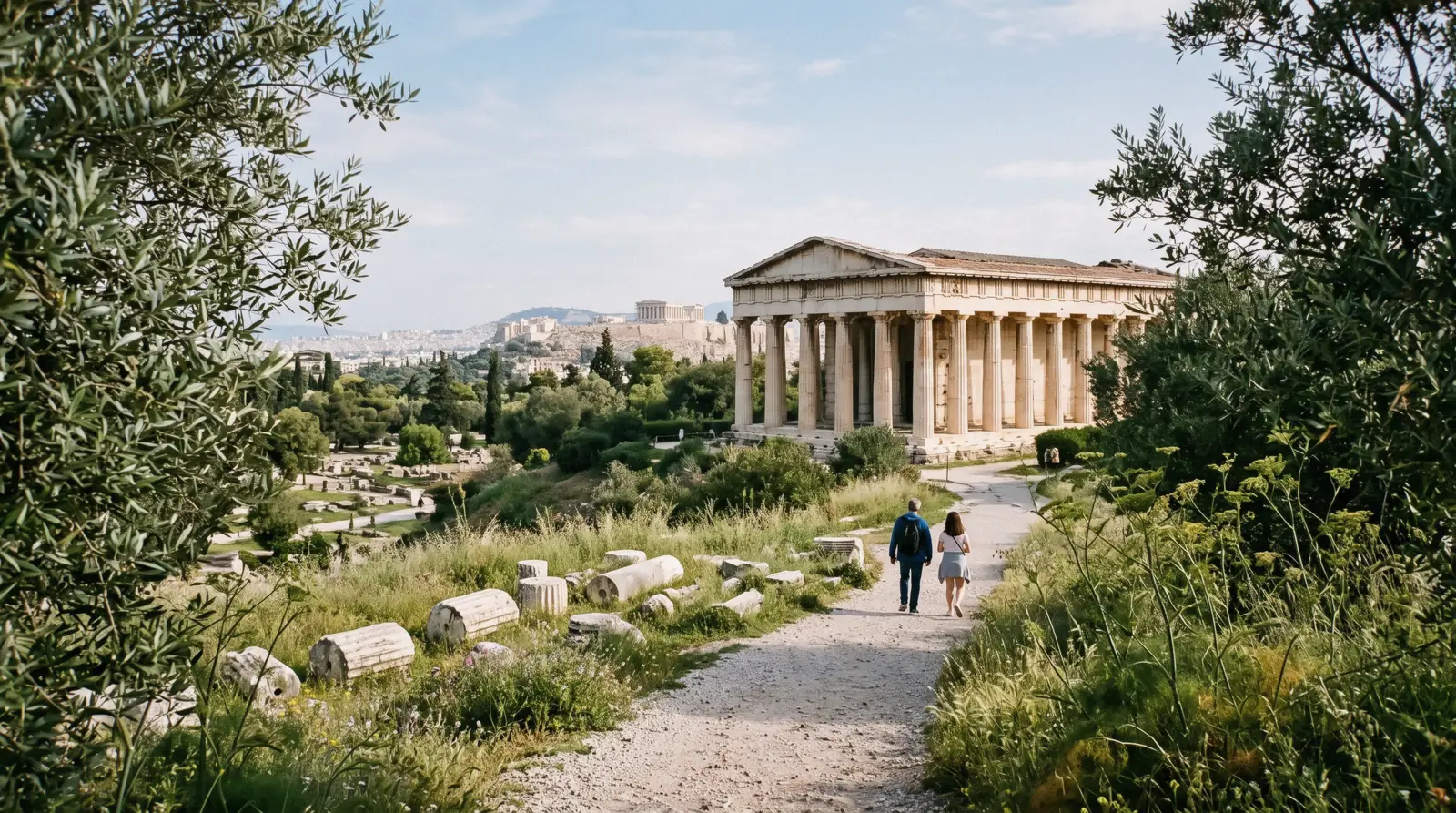
The Ancient Agora of Athens
The Ancient Agora of Athens is the open square below the north-west slope of the Acropolis where the city actually governed itself: law courts, council house, market, the colonnades men argued in. Above it stands the Temple of Hephaestus, the most completely preserved Doric temple anywhere, roof included. This page has the hours, the gates and what to look for as checked in Q3 2026. The rock above it is on the Acropolis page, and the wider plan on what to see in Athens Greece.
Quick answer Whether it is worth it, and the closing time that catches people
The Ancient Agora costs €20 full and €10 reduced, needs no timed slot, and takes about seventy-five minutes including the museum in the Stoa of Attalos. It is the second site most first-time visitors add after the Acropolis.
Key takeaways
- It shuts before the rock: 19:30 against 20:00 in high summer, and it steps down earlier through the autumn — the hours has all six bands.
- The Temple of Hephaestus is the reason to come. It kept its roof because it spent centuries as a church, and what to look for explains what that means for the building.
- The ticket includes the museum inside the reconstructed Stoa of Attalos, which most people walk past on the way to the exit.
- Two gates, and they are not equivalent — the entrances says which one to use from Monastiraki and which from Thiseio.
- Doing three or more sites? Whether a bundle pays works out when it beats buying each gate.
Key facts
Opening hours
| 1 April – 31 August, daily | 08:00–19:30 |
|---|---|
| 1–15 September, daily | 08:00–19:00 |
| 16–30 September, daily | 08:00–18:30 |
| 1–15 October, daily | 08:00–18:00 |
| 16–31 October, daily | 08:00–17:30 |
| 1 November – 31 March, daily | 08:00–17:00 |
Closed 1 January, 25 March, 1 May, Orthodox Easter Sunday, 25 and 26 December
Admission
- Adult
- €20
- Reduced
- €10
- Free
- 6 March, 18 April, 18 May, the last weekend of September, 28 October, and the first and third Sunday from 1 November to 31 March
Planning it
- Time needed
- Not stated by the site; our routing: 75 minutes including the Stoa museum
- Book ahead
- Recommended — a few days
- Address
- Adrianou 24, 105 55 Athens (Monastiraki side); second gate on Apostolou Pavlou, Thiseio
The ways in, priced from hh.gr and GetYourGuide on 1 September 2026. The Agora is one of the seven sites the abolished combination ticket used to cover — what replaced it has that arithmetic.
The one question is how many other ancient sites you intend to enter. Alone this gate is $23.20 (€20); inside a bundle it is close to free.
| Option | Price | Includes | Cancel | Book |
|---|---|---|---|---|
| Official ticketAnyone visiting this site and nothing else; it covers the Stoa of Attalos museum too | €20 full / €10 reduced | The site and the Stoa of Attalos museum | Per the platform's terms | Official site |
| Both Agoras with audioFor pairing it with the Roman Agora, the only product that sells the two as one | Listed at €46 | Time-slotted entry to this and the Roman Agora, two audio tours | Per listing | Check Availability |
| Acropolis plus up to five sitesFor anyone doing three or more central sites — the arithmetic is on the combined-ticket page | Listed at €36 | This site among them, with the rock | Per listing | Check Availability |
| Acropolis and Agora guidedFor four guided hours across the rock and this square with every entrance already paid | From €107 | Four hours, licensed guide, all entrances included | Per listing | Check Availability |
At €20 for one gate, the multi-site bundles start to make sense here rather than at the Acropolis: three central sites at official prices are already €60. The two-Agora card is the only product that pairs this site with the Roman Agora, which is a fifteen-minute walk away.
Ancient Agora entry options
The cards behind the table, with the operator's own rating and review count.
 from €44
Athens: Roman Agora & Ancient Agora E-ticket & 2 Audio Tours
Time-slotted e-tickets for both Agoras with two smartphone audio tours, which is the only bundle of the two sold as one product.
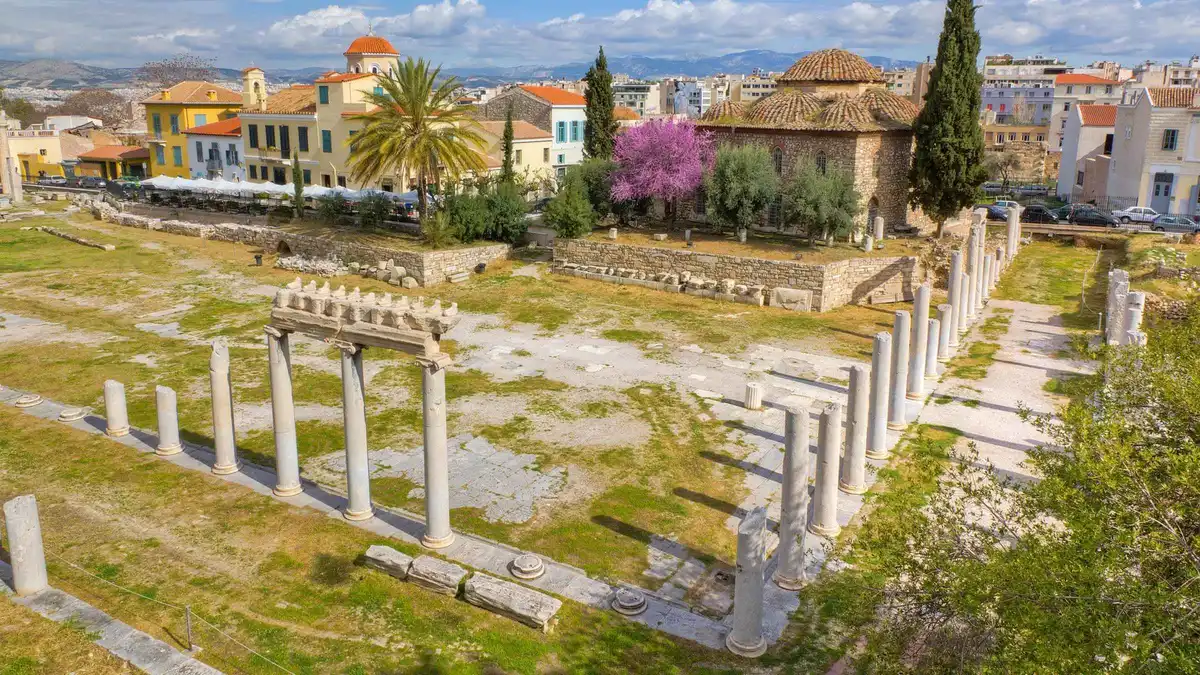
Check Availability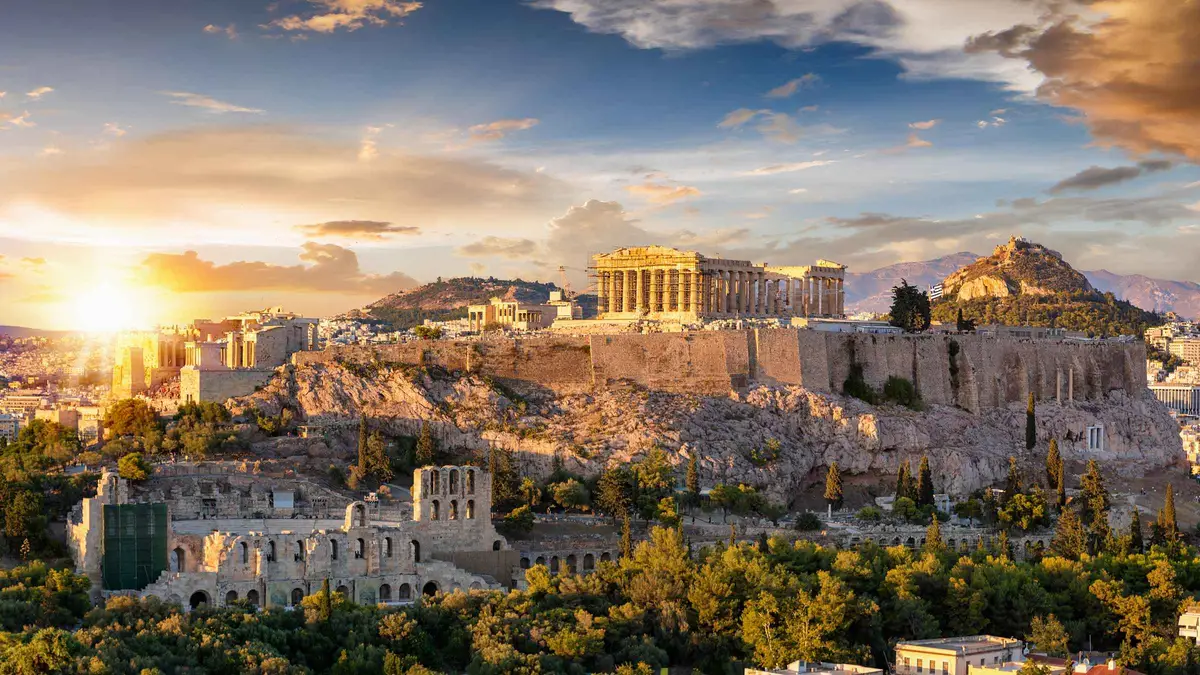 from €36
Athens: Acropolis Ticket & Heritage Sites + Acropolis Audio
The bundle the official shop does not sell: the Acropolis slot plus entry to up to five more archaeological sites, including both Agoras and the Temple of Olympian Zeus.
Check Availability from €107
Acropolis & Ancient Agora Guided tour included all Entrances
Four hours with a licensed guide across the Acropolis and the Ancient Agora with every entrance fee included, so nothing is bought at a gate.
Check AvailabilityPrices, ratings and details are the platform's own. Euro figures are the listed prices. The platform bills in your account's currency.
What to look for, in walking order
The site reads as a field of foundations until you know what three of them are.
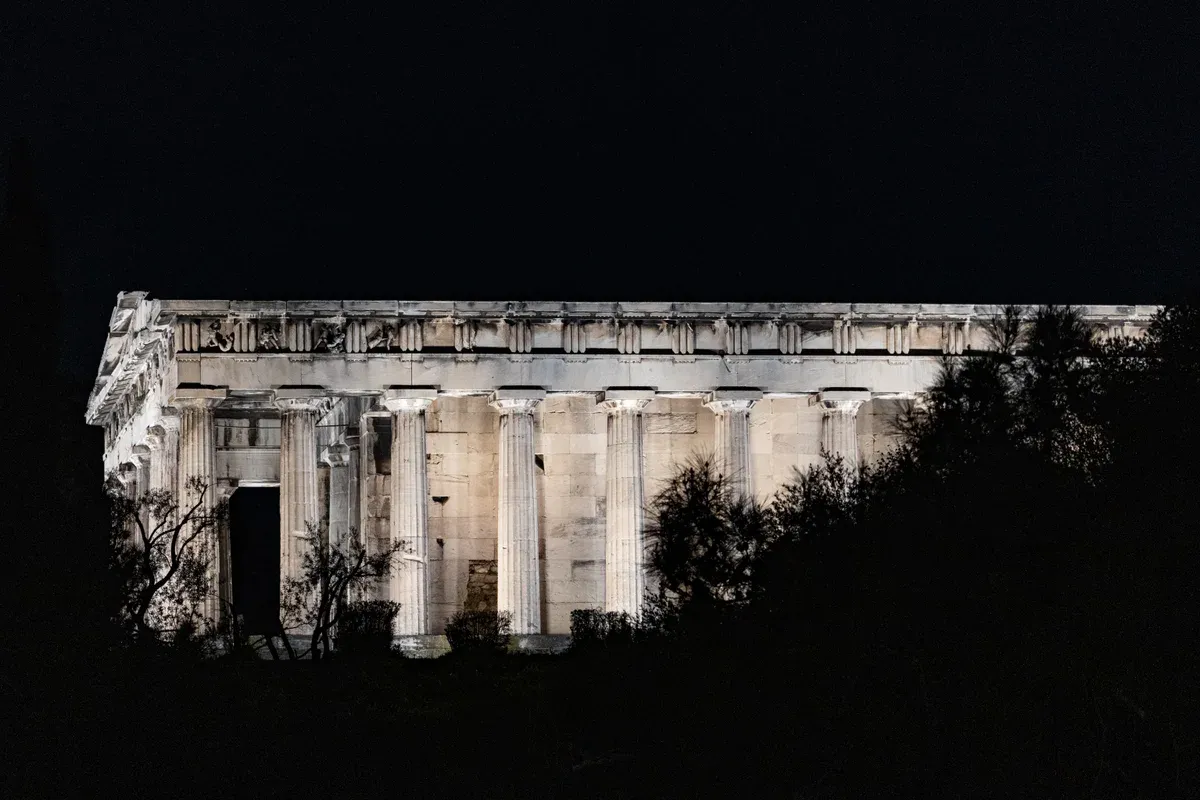
Photo: Aneza Palaiou, CC BY-SA 4.0, via Wikimedia Commons
The Temple of Hephaestus
On the low hill along the west side — the Agoraios Kolonos — and the best-preserved Doric temple in the Greek world, with its roof, its colonnade and most of its entablature still up. It was dedicated jointly to Hephaestus and Athena Ergane, the gods of the smiths and potters whose workshops filled this quarter. It survived because it was converted into the church of Saint George and stayed in use for something like fourteen centuries; the Parthenon's fate was the exception, not the rule.
The Stoa of Attalos
The long two-storey colonnade along the east side, rebuilt from the ground up in the 1950s on its own foundations and with its own materials where they survived. It is a full-scale answer to the question of what these buildings actually felt like — shaded, cool, deep — and the museum inside it, included in your ticket, holds the ordinary objects of Athenian public life: jurors' ballots, a klepsydra water clock for timing speeches, ostraka scratched with the names of men proposed for exile.
The foundations in the middle
Between the two, at ground level, are the buildings that made the democracy work: the Bouleuterion where the council met, the Tholos where its standing committee ate and slept, the law courts, the Royal Stoa where the archon sat. Little stands above knee height. The value of the site is that you can see the whole apparatus of a working city-state laid out in one enclosure, with the Parthenon on the skyline above it.
The church in the middle of the field
Holy Apostles is an eleventh-century Byzantine church, and it is the only post-classical building the American excavators kept when they cleared the site in the 1930s. Everything else here was a neighbourhood of houses, and it was demolished for the dig. The church is small and domed, with fragments of fresco inside.
It stands in the Agora, the ground where the assembly's business, the courts and the market of classical Athens all sat. The best-preserved building on the site is the Temple of Hephaestus, built between 449 and 415 BC, and it survives almost complete for a practical reason. From the 7th century until 1834 it served as the Greek Orthodox church of Saint George Akamates, so nobody quarried it away.
Give both buildings time, not just the temple. For the full context of these layers of temple, church and marketplace, the best tours in Athens often begin right here in the Agora, so browsing athens guided tours is a sensible next step.
Hours, and the half-hour that catches people
Read on the official page on 1 September 2026.
The seasonal bands
The site opens daily at 08:00 all year. Closing moves through five bands: 19:30 from 1 April to 31 August, 19:00 to mid-September, 18:30 to the end of September, 18:00 to mid-October, 17:30 to the end of October, then 17:00 from 1 November to 31 March. Last admission is twenty minutes before closing, so if the sign says the site shuts at 17:00 you must be through the gate by 16:40 or you will be turned away.
People miss this most in the autumn, when the closing time drops several times inside a month. Admission runs €20 full and €10 reduced. Winter visitors get an extra margin elsewhere in the city, since from 1 November the Acropolis itself runs only to 17:00, so an Agora afternoon is not a bad plan in the colder months.
Why that matters next to the Acropolis
The two sites do not keep the same hours. The rock closes at 20:00 in high summer and the Agora at 19:30, and the gap widens through the autumn until both close earlier. So the natural plan, the Acropolis late in the day and then down the west side into the Agora, does not work.
By the time you have come off the rock, photographed the Parthenon and walked down past the Areopagus, the Agora gate has shut behind you. Do the pair in the other order, arriving at the Agora with hours to spare, or split them across two days. If you are here on a reduced budget, the Agora runs €20 full and €10 reduced. The opening-hours page lines up every site in the city side by side, which saves you guessing.
Closed days and free days
Closed on 1 January, 25 March, 1 May, Orthodox Easter Sunday, 25 and 26 December. Free on 6 March, 18 April, 18 May, the last weekend of September, 28 October, and the first and third Sunday from 1 November to 31 March — and a free winter Sunday here is a good morning, because the site is large, open-air and never crowded in January. The free-entry days weighs each date.
The two gates
Both scan the same ticket; the walk to each is different.
Adrianou, from Monastiraki
The main entrance sits on the Monastiraki side, about five minutes from Monastiraki station on Lines 1 and 3, along the café strip of Adrianou. This is the gate most people use, and it is the one nearest the Stoa of Attalos, which holds the site museum. That matters for how you shape the visit.
Come in this way and the museum sits at the start of your route rather than the end, when your feet and attention are gone. The Agora costs €20 full and €10 reduced. Adrianou itself is worth the walk in, a pedestrian street lined with tables in the shadow of the Acropolis north wall.
Just remember the closing time drops through the autumn, so do not assume a summer schedule still applies.
Apostolou Pavlou, from Thiseio
The second gate lies on the pedestrian avenue below Thiseio station on Line 1. It opens at the temple end of the site, which changes the shape of your visit. You climb first to the Hephaisteion, the temple built between 449 and 415 BC and one of the most complete ancient buildings anywhere, then come down into the square past Holy Apostles and the excavated houses.
That is a better sequence if you are walking round from the Acropolis west side, since you arrive from the hill and end in the shade rather than climbing at the end of the day. Tickets run €20 full and €10 reduced. The gate is also calmer than Adrianou, because most organised groups use the Monastiraki side.
Getting there
Metro Lines 1 and 3 serve Monastiraki, and Line 1 serves Thiseio, so the site is easy from either the harbour line or the airport line. Buses 025 and 026 stop at Monastiraki. On foot it is about sixteen minutes from Syntagma, or twelve downhill from the Acropolis west gate past the Areopagus, which makes it a natural second stop after the rock if you start early enough.
A single metro ticket costs €1.20 and covers 90 minutes of travel, so the ride from Syntagma or the airport connection is cheap. If you arrive at Thiseio you get the Temple of Hephaestus first. If you arrive at Monastiraki you get the Stoa of Attalos museum first.
Both work, just pick the sequence before you buy the €20 ticket.
Ancient Agora map: gates, temple and what is next
The two entrances, the buildings worth finding, and the sites within ten minutes.
Next stop from the Ancient Agora
Walk minutes are our estimates from the GPS distances.
Roman Agora
East along Adrianou. €10, and the Tower of the Winds is inside the fence — the Roman Agora closes at 15:00 in winter.
6 min walkThe Acropolis
Up the west side past the Areopagus to the smaller gate. The Acropolis is €30 with a declared entry hour.
12 min walkMonastiraki
The flea market, two metro lines and the grill streets. Monastiraki is where to eat after the site.
5 min walkAncient Agora questions
Is the Ancient Agora worth seeing?
If you have more than a day, yes — it is the one site where the machinery of Athenian democracy is legible on the ground, and the Temple of Hephaestus is better preserved than anything on the rock. If you have a single day, the Acropolis and its museum come first; the one-day plan sets the order.
How long do you need at the Ancient Agora?
About seventy-five minutes including the museum in the Stoa of Attalos, longer if you read the labels. The site is large and open, so allow for the walking between the temple and the stoa in summer heat.
Do you need tickets for the Ancient Agora?
Yes — €20 full, €10 reduced, sold on the official platform and at the gate. There is no timed entry. It is free on the state free-entry days, which the free-entry page lists.
How does this square differ from the Roman one nearby?
Different sites, six minutes apart, different tickets. This one is the Greek civic centre from the sixth century BC onwards, where the democracy met. The Roman Agora is a smaller Augustan market square built five centuries later, and it costs €10.
Is the Temple of Hephaestus included?
Yes, it is inside the fence and on the same ticket, along with the Stoa of Attalos museum and the church of the Holy Apostles. What to look for has the walking order.
Which gate should I use?
Adrianou from Monastiraki if you want the museum first; Apostolou Pavlou from Thiseio if you are coming round from the Acropolis and would rather start at the temple. The two gates has the walking times.
Ancient Agora on Video
Three filmed visits that show the distances, the surfaces and the pace — the things a written page cannot carry. Every id was checked against YouTube on 2 September 2026.
The Best Way to Visit the Acropolis & Ancient Agora in 2026
How the rock and the Agora fit together in one morning, filmed on the current ticket rules.
Video: Greece ExplainedTravel to the Ancient Agora, Athens
A quiet walk through the Agora with the Hephaisteion at the end of it.
Video: The Road Less TraveledANCIENT AGORA OF ATHENS | History & Tour | ATHENS, GREECE 🇬🇷
A walkthrough with the history narrated as the camera moves, which suits a site where almost nothing is labelled.
Video: Zaharoula BPrices, hours and terms are set by the venue or operator and confirmed at checkout.
We may earn a commission if you book through one of our links, at no extra cost to you. Full affiliate disclosure