 Visit Athens Guide
Is the Acropolis Worth It in August? Yes, at One Hour of the Day
Is the Acropolis worth it in August? Yes, at 08:00, and much less so at any other hour. The daily mean in August is close to 28°C, the rock has no shade whatsoever, and the marble reflects heat back at you by mid-morning — which in practice turns a ninety-minute visit into a fifty-minute one. This post is about what the month actually costs you and how to buy most of it back. Temperatures are ten-year ERA5 means; hours and rules were read on the official pages in Q3 2026. The wider summer picture is on Athens in the heat, and for the city see what to see in Athens greece.
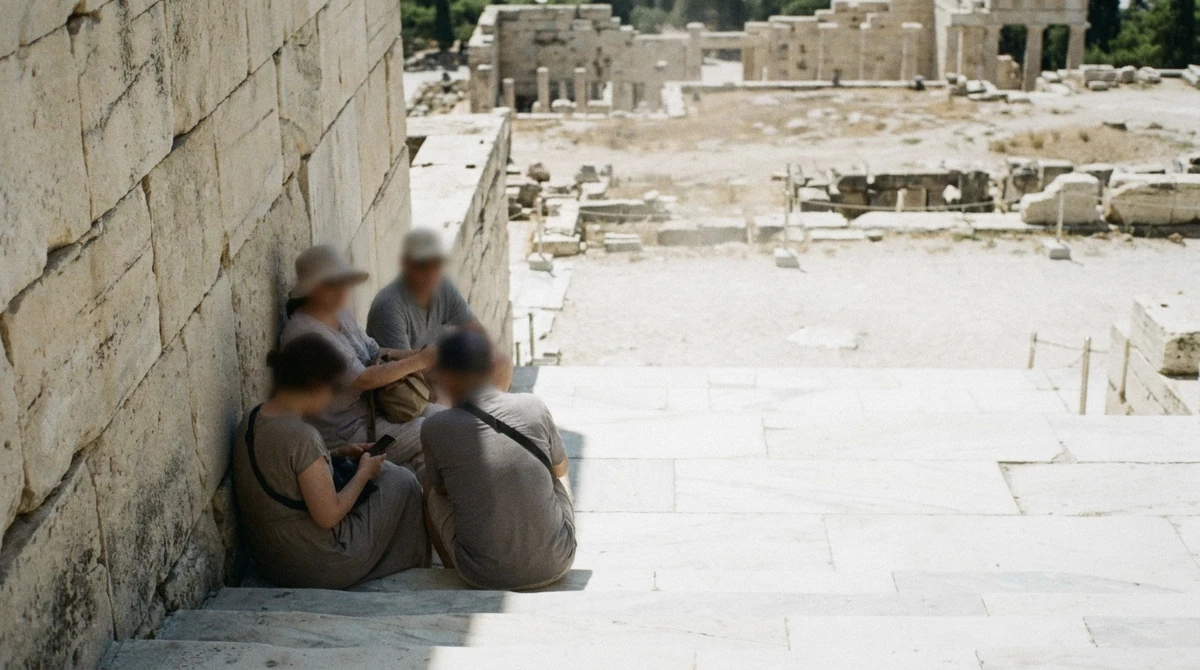
Quick answer The honest answer, in two sentences
Yes — if you take the 08:00 hour. The site opens at 08:00 and closes at 20:00 in August, and the first two hours are the only comfortable ones; by eleven the summit is hot, crowded and a shorter visit than you planned.
Key takeaways
- What August actually costs is about forty minutes of visit, not the whole experience.
- The site can close at midday in an official heatwave — what happens then explains the notice and the ticket rule.
- How to buy it back is four things, and the first one is free.
- The evening slot is the underrated option: closing is 20:00 and the light after seven is the best of the day.
- If your dates are flexible, April, May, September and October are the four months the city is built for.
What August actually costs you
Temperatures are ten-year ERA5 daily means for the city centre; the rest is what happens on the rock. Compare the same visit in October.
| August | October | What changes | |
|---|---|---|---|
| Mean daily temperature | 27.9°C | 18.9°C | Nine degrees, and no shade on either |
| Realistic time on the summit | about 50 min | 90 min | Heat, not crowds, sets the ceiling |
| Best hours | 08:00–10:00 only | 08:00–10:00 and 16:00–18:00 | Autumn gives you two windows |
| Site closing | 20:00 | 18:00 to 18:30 | August's long evening is its one advantage |
| Risk of midday closure | Real, in a heatwave | None | Announced a day or less ahead |
| Ticket price | €30 | €30 | Unchanged — the season does not move the price |
The second row is the honest answer to the headline. August does not spoil the Acropolis; it shortens it. You will see the Parthenon, the Erechtheion and the Propylaea, and you will not linger, walk the perimeter twice or sit down anywhere — because there is nowhere shaded to sit.
Why the rock is harder than the rest of the city
Three things specific to this site rather than to Greek summers generally.
There is no shade at all
Not a tree, not an awning, not a colonnade you may stand under. The pines are on the approach paths below the Propylaea and above the gateway there is nothing. That is a conservation decision rather than an oversight and it is not going to change.
The rock has carried buildings since the Mycenaean palace of the Bronze Age, and the Parthenon of 447-432 BC stands on bedrock that excavation would damage, so planting on the summit is out of the question. The practical consequence is that your only shade on the whole site is whatever shadow the walls and columns throw, which shortens fast after mid morning. Plan your water for the top, not the ticket gate.
There is nowhere to buy anything once you are through.
The marble radiates
The summit is polished stone and worn marble, and by late morning it is throwing heat upward as well as down. It is measurably hotter on the rock than on the street below, which is why people who are fine in Plaka at noon are not fine on the Acropolis at noon. The marble is part of the problem.
The Parthenon was built in Pentelic marble between 447 and 432 BC and the surviving surface absorbs and re-emits heat all afternoon. The 1687 Venetian shell that ignited Ottoman gunpowder inside the temple left the loose, broken blocks you walk past, and rubble holds heat badly. In summer carry more water than you think you need and wear a hat with a brim.
Keep the Plaka comparison in mind when you choose your slot.
And it is a climb
Twenty minutes of steady ascent from the south gate before you are through the Propylaea. In April that is a pleasant walk, in August it is the part that decides how long you last on top. Take the south-slope route, which at least passes the two theatres in partial shade.
It follows the line of the old approach, past the Theatre of Dionysos at the foot of the south slope and the Odeon of Herodes Atticus just below the gateway. There are steps but no railings on the steeper sections and the marble is worn smooth in the middle of the path. Sensible shoes matter more than fitness.
Go slowly, stop where the slope offers a wall of shade, and remember the climb is repeated in reverse when you leave.
When the site closes for heat
Not hypothetical, and the ticket rule is what matters.
What has happened
During official heatwaves the culture ministry has repeatedly closed the Acropolis and other open-air archaeological sites through the hottest hours, typically midday to about five in the afternoon, announced a day or less in advance. It is a protective measure for visitors and staff and it has happened in successive summers. Outdoor work is restricted by ministerial decision during the same windows and municipalities open air-conditioned rooms, which tells you how seriously the state treats the heat on exposed sites.
The Acropolis is the most exposed of all of them, since the summit has no shade and the marble throws heat upward after late morning. If you hold an afternoon slot in July or August, assume it can be moved on you and know your ticket options before you buy.
What it does to your ticket
Hellenic Heritage tickets are non-refundable by their own terms. What you have is the change rule: two changes per ticket, up to two hours before the slot, through the ticket manager on the official shop, and the ticket page walks through it. If a closure is announced for tomorrow afternoon and you hold a 13:00 slot, move it tonight.
The same terms apply to the other state-site tickets, so the rule follows you to the Ancient Agora at €20 (€10 reduced) or the Olympieion at €20 (€10 reduced) as well. Note that the reduced Acropolis Museum ticket is sold only at the desk, which is a separate system with its own terms. The two free changes are the whole of your protection against a heat closure, so use them early rather than waiting to see.
How you hear about it
Ministry announcements reach Greek media quickly. There is no single English feed. The habit that covers it is checking on the morning of a very hot day before setting out, the same habit the strikes page recommends for a different reason.
The mechanics are similar too. State sites are staffed by ministry employees, so a public-sector strike can shut the Acropolis exactly as a heat decision can, and both land with little warning. Law 1264/1982 requires unions to give four days notice where a public service is involved, but no official English calendar of strike dates exists. apergia.gr lists them in Greek and OASA posts service notices.
A closure announced after you have bought your ticket is not a reason for panic, it is a reason to know the change rule.
Which is another argument for 08:00
A morning slot is finished before any midday closure begins. That is a second, quieter reason the first hour is worth reorganising a day around in July and August. The first reason is the heat itself, since the polished marble of the summit throws heat upward by late morning and there is no shade above the Propylaea.
The third is the crowds, because the coach groups arrive with the day and the narrow climb from the south gate slows to a shuffle. The entry from 08:00 gives you roughly four usable hours before the ministry's midday closure window opens, which is enough for the whole rock at a humane pace. Winter makes this easier, from 1 November the site runs to 17:00 rather than the summer evening hours.
How to buy the visit back
If you can choose your hour
take 08:00 and be at the gate by 07:45. It is free, it is the whole difference, and in August it books out days ahead. How early to arrive has the detail.
If the morning is gone
take the last two hours instead. Closing is 20:00 in August, the coaches have left by six and the light after seven is the best of the day.
If you want the commentary without the standing about
an early-access guided tour starts before the general crowd and moves at a pace that suits the heat.
If you are stuck with a midday slot
water, hat, flat soles, do the south-slope theatres on the way up for their partial shade, and accept fifty minutes on top rather than ninety.
If you have children with you
08:00 and plan for forty-five minutes. Athens with kids is honest about the climb.
If the forecast is 40°C
check for a closure announcement before you set out, and consider moving the slot to the following morning yourself.
What to do with the rest of an August day
The rock is a morning. Here is what the other hours are for.
The middle of the day is indoors
The Acropolis Museum is ten minutes downhill and air-conditioned, and the excavated ancient neighbourhood beneath it is cooler again. It opened in 2009 to designs by Bernard Tschumi with Michalis Photiadis, stands on the Makriyianni plot over those ruins, and the glass floor at the entrance is included in the ticket. In the Parthenon gallery the original blocks sit in London, so white plaster casts stand where the sculpture should be.
Tickets are €20 or €10 reduced, the reduced ticket sold only at the desk, and it is a separate legal entity from the state sites with its own hours and free days. The National Archaeological Museum is open to 20:00 from May to October, which makes half a day there the single best use of August heat in the city.
Shade that is free
The National Garden is 15.5 hectares of dense old planting and several degrees cooler than the pavement. Queen Amalia commissioned it in 1838, the agronomist Friedrich Schmidt designed it and imported over 500 plant species along with peacocks, ducks and turtles, and entry costs nothing. The pines on Philopappos are the second option, and the paths there were laid by the architect Dimitris Pikionis in 1954-57 out of broken marble and stone salvaged from demolished Athenian houses.
The third is the Ancient Agora, where the Temple of Hephaestus of 449-415 BC stands almost complete because it served as the church of Saint George Akamates from the 7th century until 1834. Agora entry is €20 or €10 reduced. All three are walkable from the centre in well under half an hour.
Anyone planning an August visit to the Acropolis can find athens walking tours that fit it alongside these cooler sites in a single early morning.
The evening is the reward
Sunset from Philopappos at about half past eight, then dinner in Psyri after nine when the city cools and fills. In August that rhythm is not a compromise, it is how Athens actually works, and it is the argument for coming despite the heat. The hill is an easy climb on the Pikionis paths of 1954-57 and the summit carries the tomb of Gaius Julius Antiochus Epiphanes Philopappos, an exiled prince of Commagene who became an Athenian citizen and a Roman consul.
The city built it of Pentelic marble in AD 114-116, 12 m high on two storeys, facing the Acropolis. Psyri was the rough quarter of 19th-century Athens, ground of the knife-carrying koutsavakides, and its squares now fill with tables as the temperature drops. Eat late and walk home.
Or leave town for the evening
Cape Sounion is four hours from central Athens and the site closes at sunset, which in August is around half past eight. A late afternoon on the coast with a swim on the way is the best August day trip there is, because the sea keeps the afternoon tolerable and you arrive at the temple in the cool of the evening. The Temple of Poseidon was built in 444 BC, the same year as the Parthenon, from marble quarried at nearby Agrilesa, and 15 of its 34 columns stand.
Byron's name is among those carved in the marble, cut on a visit in 1810. Carving names is now illegal, and the standard Athens day ticket will not cover you here, so check entry separately before you set out.
What to book for an August visit
Early access, indoor alternatives and an evening on the coast.
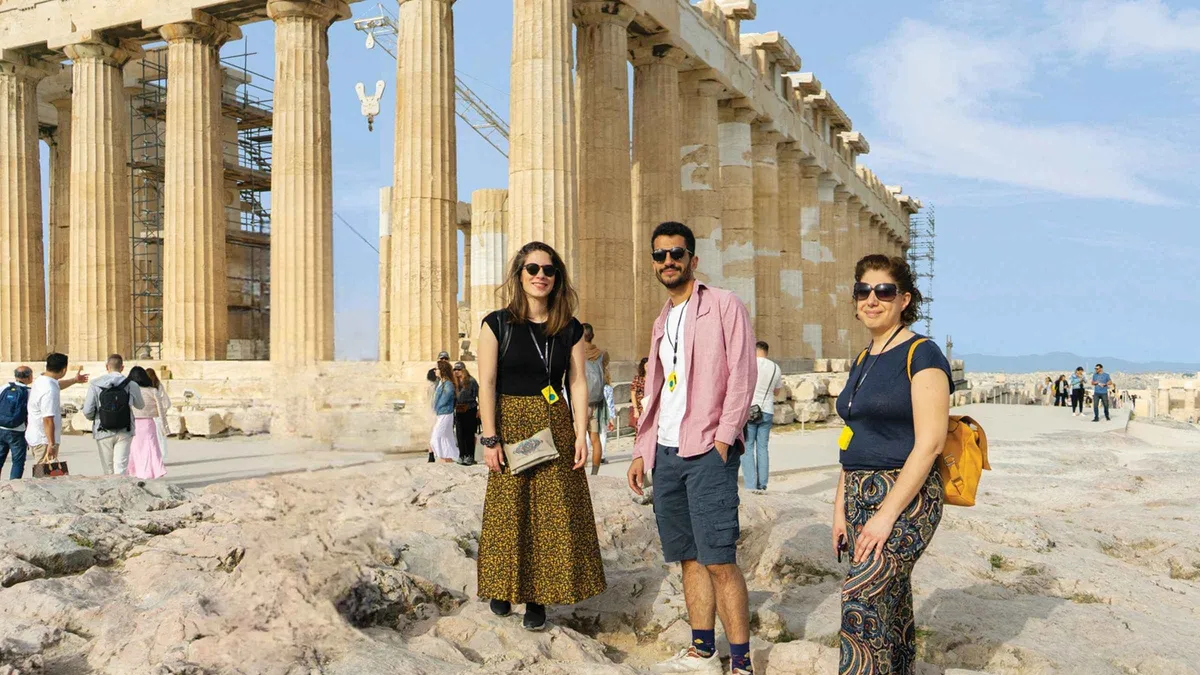 from €27
Athens: First Access Acropolis and Parthenon Guided Tour
An early-morning guided walk that goes to the Parthenon before the coach groups, then the Theatre of Dionysus on the south slope. Two to four hours depending on the option.
Check Availability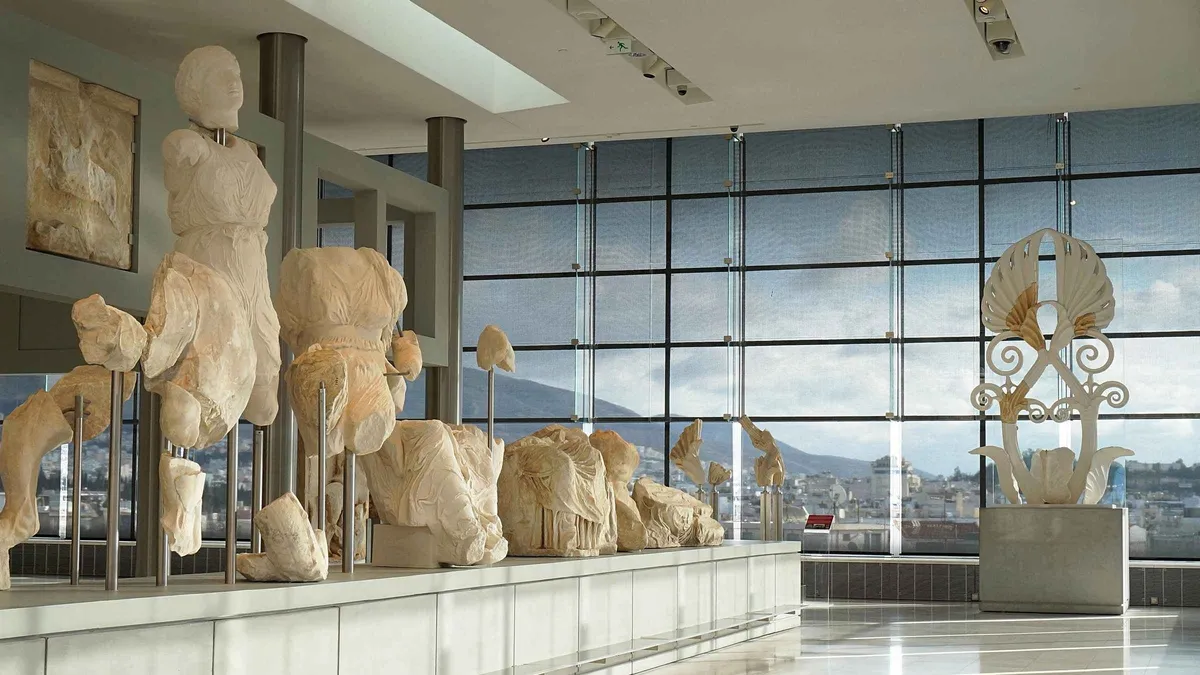 from €26
Athens: Acropolis Museum Ticket with optional Audio Guide
Entry to the Acropolis Museum with optional audio guide. The official price is €20; reduced tickets are only issued at the museum desk, never online.
Check Availability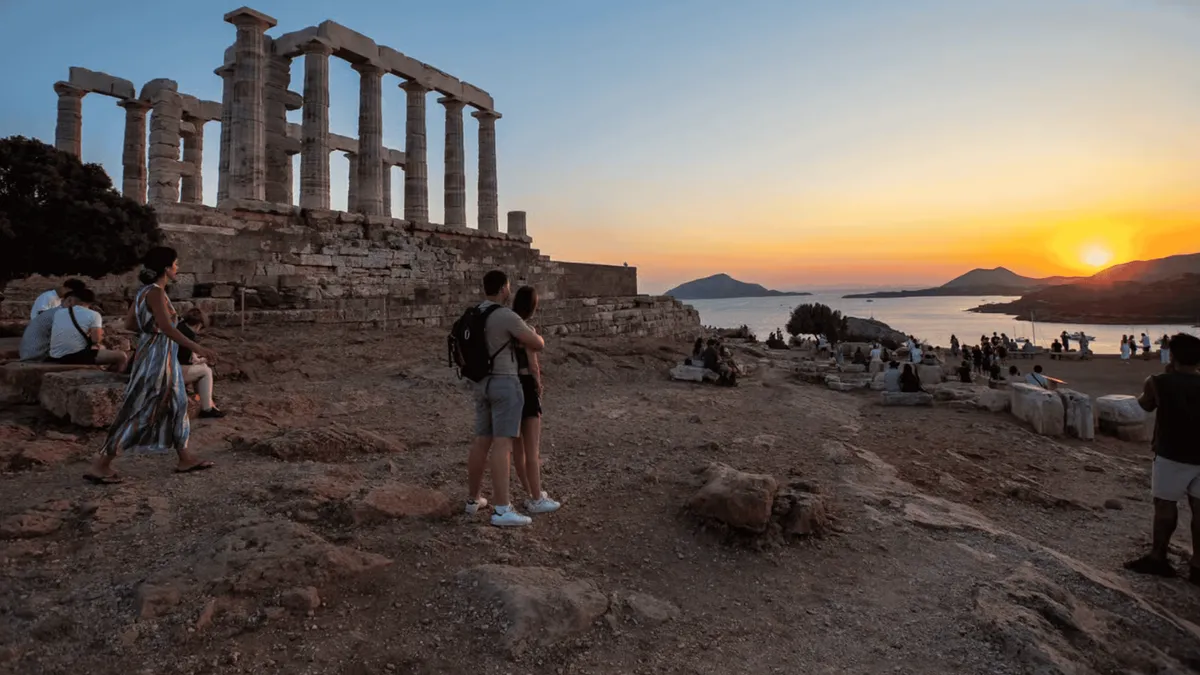 from €28
Athens: Cape Sounion & Temple of Poseidon Sunset Experience
A four-hour evening run down the coast to the Temple of Poseidon for sunset. The site itself opens at 09:30 and closes at sunset year-round.
Check Availability from €59
Athens: Street Food Tasting Tour
Three hours of Athenian street food with beer or wine, moving between the counters locals use rather than the ones on the tourist lanes.
Check AvailabilityPrices, ratings and details are the platform's own. Euro figures are the listed prices. The platform bills in your account's currency.
August questions
Is the Acropolis worth visiting in August?
Yes, at 08:00. At other hours it is a shorter and less pleasant visit rather than a bad one — what August costs puts the same visit against October.
How hot is Athens in August?
The ten-year daily mean is about 27.9°C, with July slightly hotter at 28.7°C. Both months are effectively rainless. It is hotter on the rock than in the street.
Does the Acropolis close because of heat?
It can. During official heatwaves the ministry has closed it through the hottest hours with a day or less of notice. Your ticket is non-refundable but changeable twice up to two hours before — when the site closes for heat has the mechanism.
What time is best in summer?
08:00, or the last two hours before the 20:00 close. The middle of the day belongs to the museums. How to buy the visit back covers the alternatives.
Is there anywhere to sit in the shade up there?
No. There is no shade on the summit at all — the pines are below the Propylaea. Take water and fill up at the fountain by the entrance, because there is none on top.
Should I come to Athens in August at all?
If your dates are fixed, yes, with the right shape to the day. If they are not, April, May, late September and October are materially better and cost the same.