 Visit Athens Guide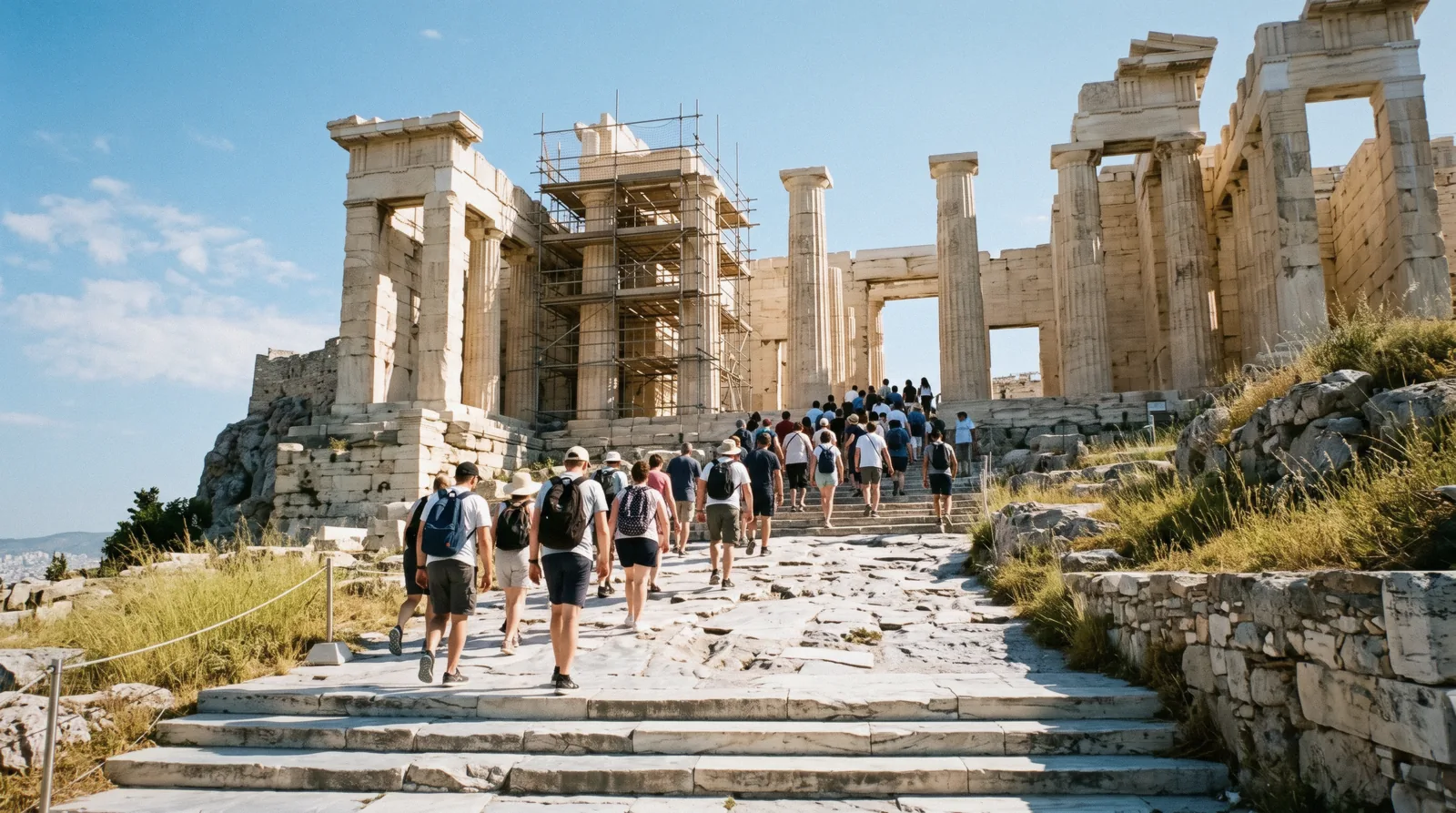
The Acropolis of Athens
The Acropolis of Athens is the limestone rock above the city, 156 metres over the sea, and everything on top of it — the Parthenon, the Erechtheion with its Caryatid porch, the Temple of Athena Nike, the Propylaea gateway — belongs to one archaeological site with one fence and one ticket. This page covers the hours, the two entrances, what stands where and how long the visit takes as checked in Q3 2026; the money questions live on the Acropolis ticket page. For the wider plan, see what to do in Athens.
Quick answer When to go up, which gate, and how long it takes
The Acropolis opens at 08:00 every day of the year and closes at 20:00 from 1 April to 31 August and at 17:00 from 1 November to 31 March. Ninety minutes covers the rock without hurrying; two hours with the south slope.
Key takeaways
- Go at opening. The rock has no shade, the marble is polished slick, and the season chart shows why an August afternoon is not a plan.
- Two ways in: the main south entrance on Dionysiou Areopagitou and the smaller west gate below the Propylaea — which gate to use explains when the second one saves time.
- One ticket covers everything inside the fence, including the theatres on the south slope; what €30 buys has the rules.
- The Caryatids on the rock are copies. The originals are ten minutes downhill in the Acropolis Museum, five of the six of them.
- Best photograph of the rock is not on the rock: it is from Philopappos Hill, free, an hour before sunset.
- The scaffolding on the west front has been there since June 2017 — why the cranes are undoing an earlier repair.
- A lift reaches the plateau from the north side, about 300 m from the exit — the accessible routes.
Key facts
Opening hours
| 1 April – 31 August, daily | 08:00–20:00 |
|---|---|
| 1–15 September, daily | 08:00–19:30 |
| 16–30 September, daily | 08:00–19:00 |
| 1–15 October, daily | 08:00–18:30 |
| 16–31 October, daily | 08:00–18:00 |
| 1 November – 31 March, daily | 08:00–17:00 |
Closed 1 January, 25 March, 1 May, Orthodox Easter Sunday, 25 and 26 December
Admission
- Adult
- €30
- Reduced
- €15
- Free
- 6 March, 18 April, 18 May, the last weekend of September, 28 October, and the first and third Sunday from 1 November to 31 March
Planning it
- Time needed
- Not stated by the site; our routing: 90 minutes on the rock, 2 hours with the south slope
- Book ahead
- Essential — weeks ahead
- Address
- Acropolis of Athens, 105 58 Athens (south entrance on Dionysiou Areopagitou)
The ways in, priced from hh.gr and GetYourGuide on 1 September 2026. The full comparison, the refund rules and the free days are on the Acropolis ticket page.
One question decides the row: are you buying entry, or are you buying a guide and the hour you arrive? The gate sells entry for $34.90 (€30); everything below it is guiding, company or convenience.
| Option | Price | Includes | Cancel | Book |
|---|---|---|---|---|
| Official timed ticketThe cheapest way onto the rock, and the right one if you are happy to read the Digital Guide app yourself | €30 full / €15 reduced | Entry with a declared hour, Digital Guide app | Non-refundable; two changes to 2h before | Official site |
| Entry with audio optionsFor a card the official checkout refuses, or for the audio track — there is no queue to skip, only a slot to hold | Listed at €36 | Timed entry, audio or live-guide option | Per listing | Check Availability |
| First-access guided tourThe right choice for a first visit: through the Propylaea before the coach groups land at 09:30 | From €27 | Early entry, licensed guide, south slope | Free up to 24 hours before | Check Availability |
| Acropolis and mythology walkFor a first day on foot that also takes in the Olympieion and the Ancient Agora | From €45 | The rock plus the Olympieion and the Ancient Agora | Per listing | Check Availability |
| Rock and museum with a guideFor anyone who wants the frieze explained where it stood and then where it hangs | From €34 | Both, with an archaeologist | Per listing | Check Availability |
The official ticket is the cheapest way onto the rock and the only one with no cancellation at all. Guided cards that list below €30 do not include the entrance — check the inclusions before you read a lower number as a saving.
Acropolis entry options compared
The cards behind the table, with the operator's own rating and review count.
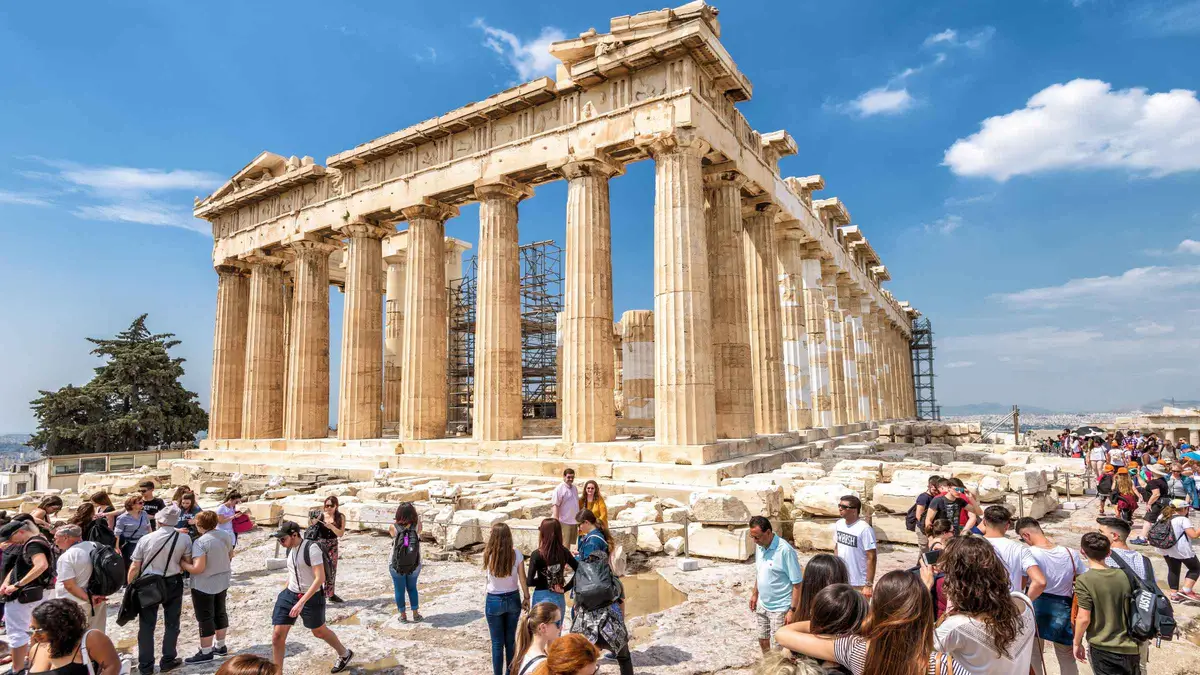 from €36
Athens: Acropolis Ticket with Optional Audio or Live Guide
Pre-booked Acropolis entry sent to your phone, with two audio-guide options and no fixed guide to keep up with. The official price is €30; this is the reseller version of the same timed slot.
Check Availability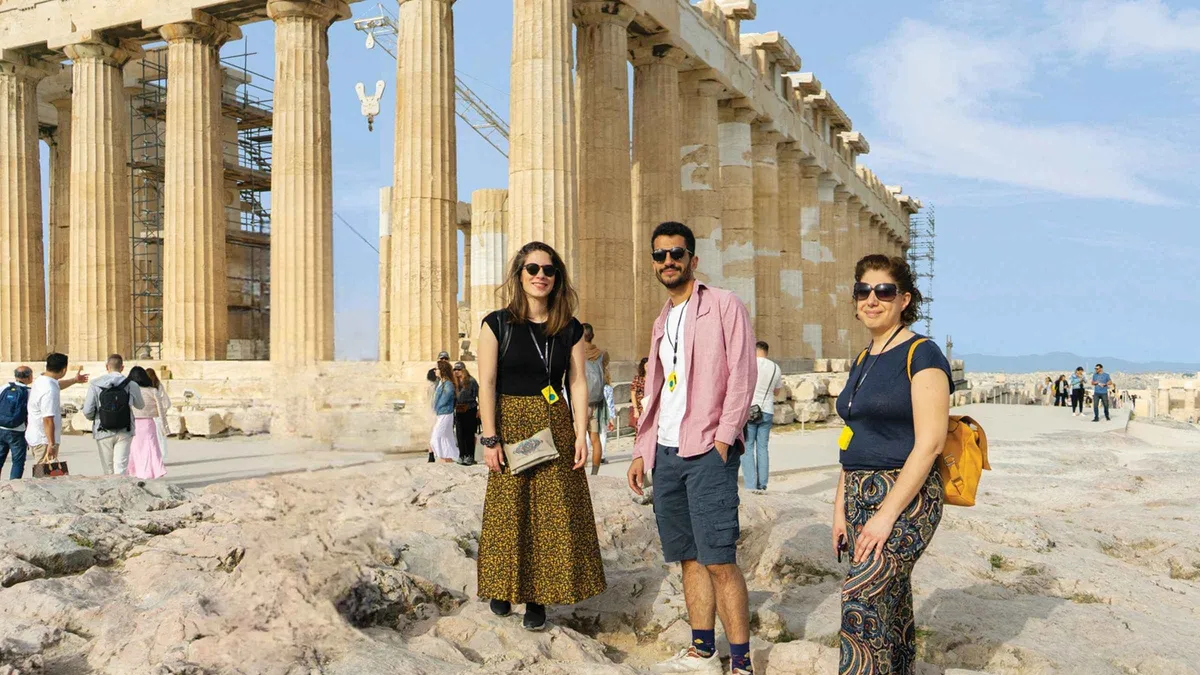 from €27
Athens: First Access Acropolis and Parthenon Guided Tour
An early-morning guided walk that goes to the Parthenon before the coach groups, then the Theatre of Dionysus on the south slope. Two to four hours depending on the option.
Check Availability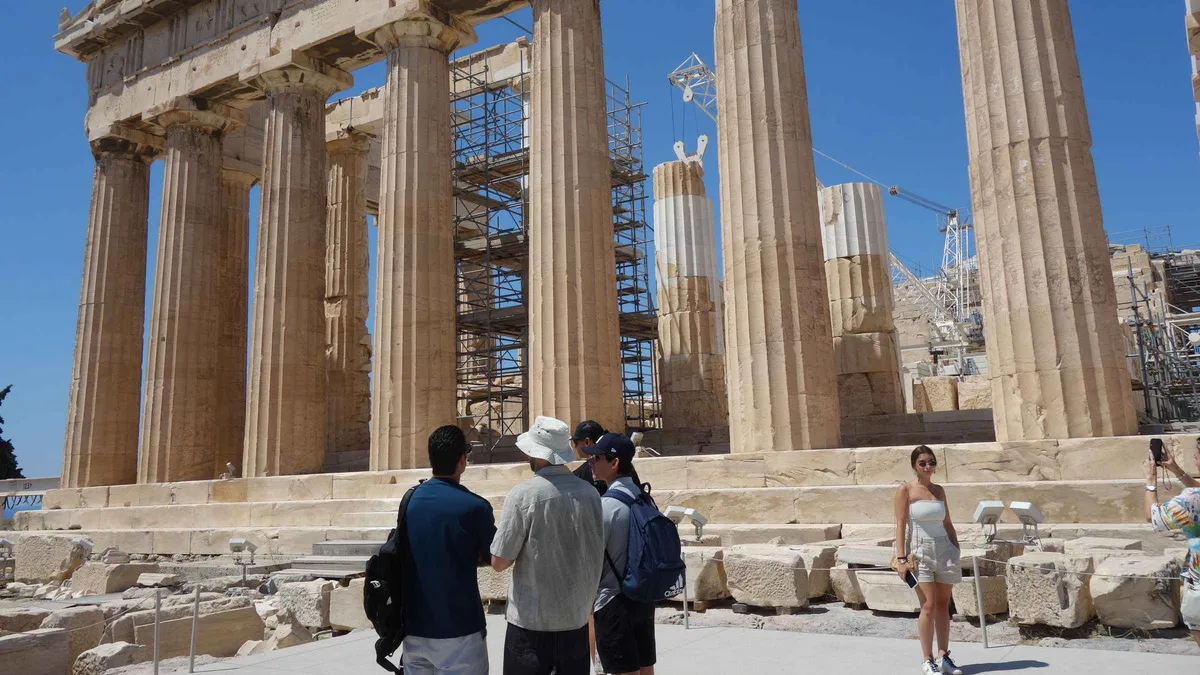 from €32.03
Athens: Acropolis Small Group (max: 8) Guided Tour
Maximum eight people with a licensed local guide across the Acropolis and the Parthenon, about two hours on the rock.
Check Availability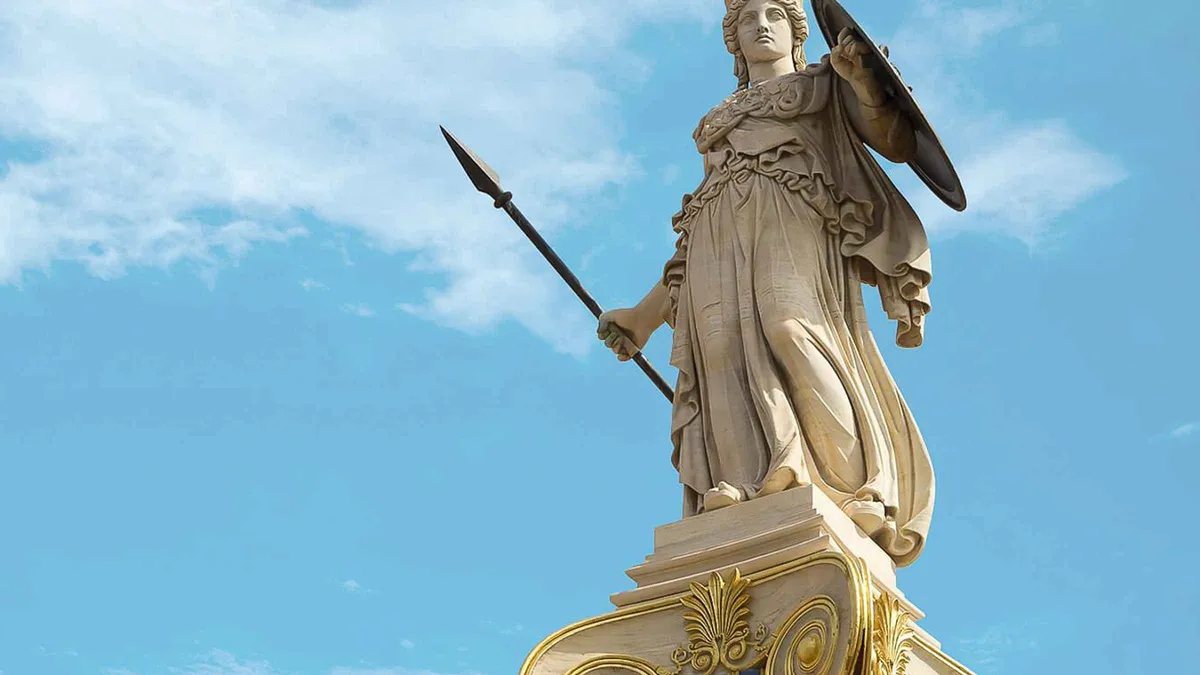 from €45
Athens: Acropolis and Mythology Highlights Small Group Tour
The rock plus the Temple of Olympian Zeus and the Ancient Agora, told through the myths attached to each: a comprehensive first day on foot.
Check Availability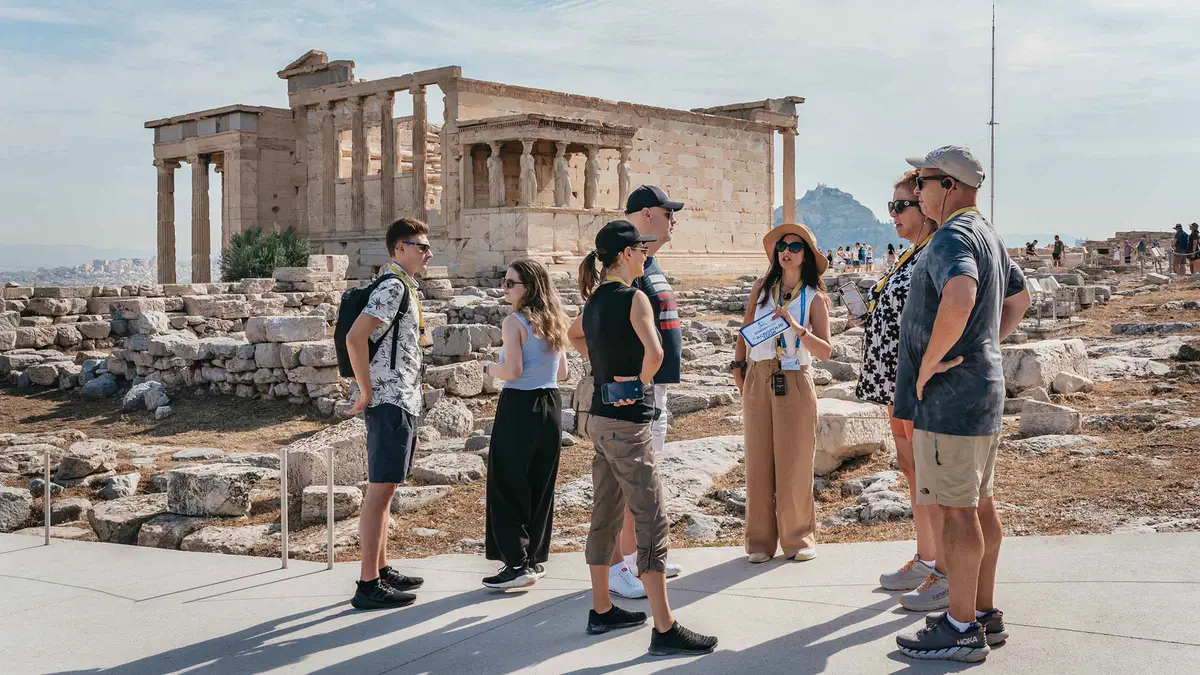 from €34
Athens: Acropolis, Parthenon & Acropolis Museum Guided Tour
An archaeologist takes the monuments on the rock and then the Parthenon gallery in the Acropolis Museum, where the frieze sits at eye level.
Check AvailabilityPrices, ratings and details are the platform's own. Euro figures are the listed prices. The platform bills in your account's currency.
What stands on the rock
Five things matter up there, and they were all built inside about forty years in the fifth century BC, on a hill that had been inhabited since the third millennium.
The Propylaea
The gateway is the only way onto the rock, because the Acropolis is steep and inaccessible on every side but the west. Mnesicles built it as a threshold, and the Parthenon does not reveal itself until you are through. The Ottomans stored gunpowder inside the buildings on the rock, and when Venetian shells hit the Parthenon's store in 1687 the explosion turned the temple into a ruin.
The Propylaea survived that blast, which is why the entrance still reads as the ancients intended it. Practically, give yourself a few minutes here rather than hurrying through. The marble underfoot has been polished by generations of visitors and is genuinely slippery when wet, so watch your step on the central ramp, especially after rain or early in the morning.
It is also the narrowest point on the site, so queues form here at opening.
The Parthenon
Iktinos and Kallikrates designed it, Phidias made the sculpture, and Pericles paid for it out of a building programme that also existed to put Athenians to work at a drachma a day. Inside stood a colossal gold-and-ivory Athena that has been lost since antiquity. Half the surviving sculptural decoration was removed by Lord Elgin and is in the British Museum; what remains in Greece is downhill in the Acropolis Museum. The Parthenon page goes into the building itself.
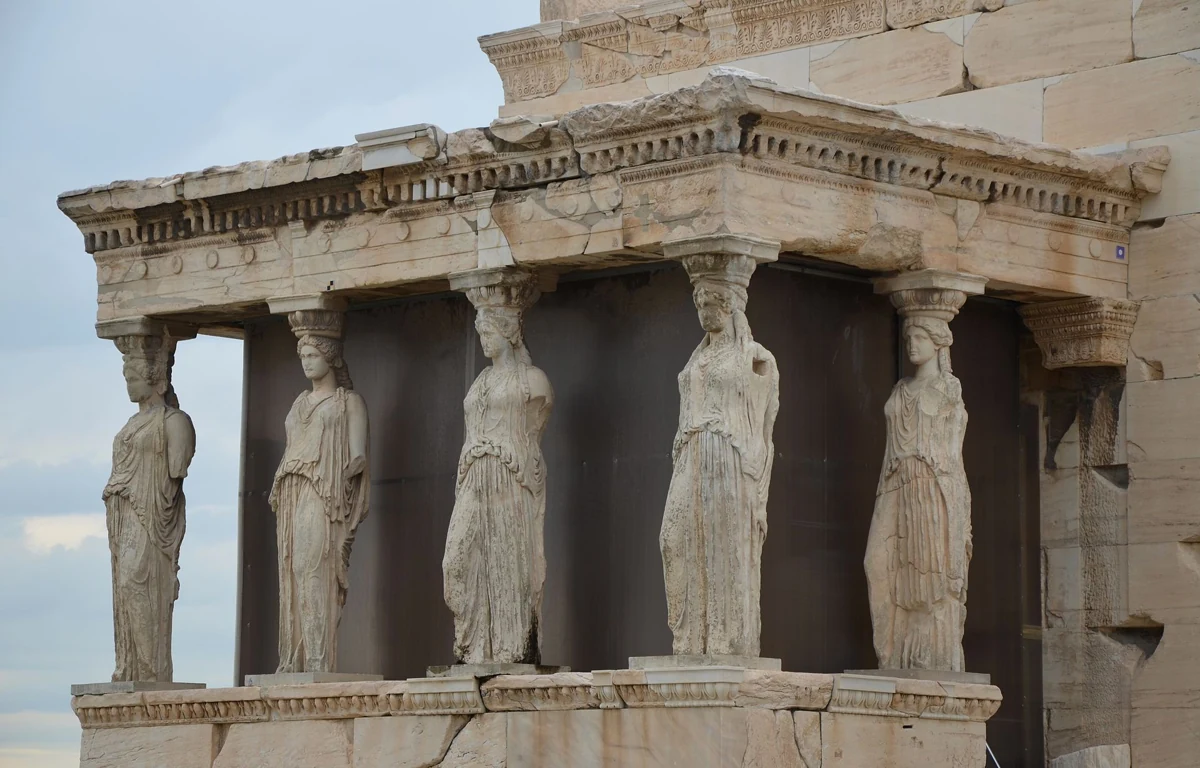
Photo: Carole Raddato from FRANKFURT, Germany, CC BY-SA 2.0, via Wikimedia Commons (https://creativecommons.org/licenses/by-sa/2.0)
The Erechtheion and the Caryatids
This irregular temple stands on the north side of the hill, built over the oldest cults on the Acropolis, including that of Athena Polias and the spot where Poseidon's trident was said to have struck. Its south porch is carried by six draped female figures, and this is the most photographed corner on the rock after the Parthenon itself. Know what you are looking at: the figures on site are casts.
Five originals went to the Acropolis Museum when it opened in 2009, and the sixth was taken to London in the 19th century, part of the removals by Lord Elgin that also took 15 metopes and 56 frieze blocks from the Parthenon. The white plaster casts elsewhere in the museum mark where those London blocks should sit. Plan the museum visit for after the summit, when the casts will mean more.
The Temple of Athena Nike
Small, Ionic, and easy to walk past. It stands on the bastion to the right of the Propylaea as you climb, and most visitors queue for the gateway without turning their heads. The temple has been taken apart and rebuilt more than once, most recently in the 2000s, so what you see is a careful reassembly rather than an untouched survivor.
The pieces were dismantled and put back as conservation work on the Acropolis has proceeded block by block. The famous parapet relief, including the figure of Nike adjusting her sandal, is not here at all but in the Acropolis Museum, so do not search the bastion for it. The viewpoint from the bastion over the entrance below is one of the better ones on the site, and it takes no extra time since you pass it anyway on the way up.
The south slope: two theatres
Both theatres sit inside the same fence and on the same ticket, and people skip them because they come down the west side after the Parthenon. Enter or leave through the south instead. The Theatre of Dionysus is where Athenian tragedy was first performed, which makes it the birthplace of a form the whole world still watches.
The Odeon of Herodes Atticus is the steep Roman semicircle you see from below, on Dionysiou Areopagitou, the avenue pedestrianised in 2003 before the 2004 Games. In summer the Odeon is closed to daytime visitors because it hosts concerts, so see it early or from the fence. If your visit falls on a heatwave day, note that the ministry has repeatedly closed open-air sites through the hottest hours. The Odeon page covers the performance season.
The Acropolis In Ten Dates
The rock's own chronology rather than the Parthenon's, from the first settlement to the rules that govern a visit today. Everything before the Roman period is approximate to within a generation.
-
3rd millennium BC
The hill is settled
Steep and inaccessible on every side but the west, with spring water running off its slopes — a natural fortress before it was ever a sanctuary.
-
8th century BC
It becomes exclusively sacred
The cult of Athena Polias is established and the rock stops being a place people live on.
-
mid-6th century BC
Peisistratos builds the Hekatompedon
The tyrant's temple, a predecessor of the Parthenon, stands where the great one later would.
-
490–480 BC
Begun, then burned
After Marathon the Athenians start a far larger temple, the Pre-Parthenon. In 480 BC the Persians take Attica, plunder the Acropolis and burn its monuments.
-
447–432 BC
The Periclean building programme
The Parthenon, the Propylaea, the Erechtheion and the Temple of Athena Nike all go up inside about forty years, worked by Athenians, foreigners, free men and slaves at a drachma a day.
-
1460s
Church, then mosque
Athens falls to the Ottomans in 1460 and within a few decades the Parthenon, long a church, is converted to a mosque with its stairway as the minaret.
-
1645 and 1687
Two gunpowder explosions
Lightning ignites powder stored in the Propylaea in 1645 and wrecks it. In 1687 a Venetian shell reaches the powder inside the Parthenon and turns the temple into the ruin you photograph.
-
From 1801
Elgin's firman
Britain's ambassador to Constantinople secures permission to investigate the Acropolis, and his team removes much of the Parthenon sculpture, one Erechtheion Caryatid and four frieze blocks from the Temple of Athena Nike.
-
1833–1834
An archaeological site
The Ottoman garrison withdraws for good in 1833; the new Greek state proclaims the rock an archaeological site the following year and the work of gathering its scattered antiquities begins.
-
1975, 1979 and 1987
Restoration, rescue, recognition
The Committee for the Conservation of the Acropolis Monuments is formed in 1975 and starts with the Erechtheion; the Caryatids come indoors in 1979; UNESCO inscribes the site in 1987 as a property of 3.04 hectares inside a 116.71-hectare buffer zone.
Sources: Hellenic Heritage on the Acropolis, the Acropolis Restoration Service on the Parthenon, the Acropolis Museum's own history and the UNESCO listing.
Hours, closed days and the hour to pick
Six seasonal bands, read on the official page on 1 September 2026.
The seasonal timetable
Daily 08:00 to 20:00 from 1 April to 31 August; 08:00 to 19:30 from 1 to 15 September; 08:00 to 19:00 from 16 to 30 September; 08:00 to 18:30 from 1 to 15 October; 08:00 to 18:00 from 16 to 31 October; and 08:00 to 17:00 from 1 November to 31 March. Last admission is twenty minutes before closing in every band — a 16:40 arrival in December is an arrival at a closed gate. Every seasonal table in the city sits together on the opening-hours page.
Closed days
The site shuts on 1 January, 25 March, 1 May, Orthodox Easter Sunday, and 25 and 26 December. Orthodox Easter moves each year and rarely coincides with the Western date, so check the calendar for the year you travel rather than assuming the weekends line up. Two other dates work differently.
On the free-admission days, which include 6 March, 18 April, 18 May, 28 October and the last weekend of September, the site opens but the queues are longer because everyone else has had the same idea. The Acropolis Museum keeps its own list, free on 6 March, 25 March, 18 May and 28 October, because it is a separate legal entity from the state sites with its own hours. Winter brings shorter opening too, with the Acropolis running to 17:00 from 1 November.
Which hour to book
The first hour, in any month you can. In summer the sun is on the rock by nine and there is nowhere to stand out of it; by noon the marble reflects heat back at you. The other good window is the last ninety minutes before closing in April, May, September and October, when the light is low and the coaches have gone — but not in winter, when closing is 17:00 and the site empties fast.
Coach groups arrive between about 09:30 and 11:30.
How long it takes
Ninety minutes on the rock at a normal pace, including the climb and the time people actually spend photographing the Parthenon. That figure holds only if you arrive at a quiet hour, because the narrow Propylaea funnels every visitor through one gateway and the crowds slow everything down. Add half an hour for the two theatres on the south slope, which are on the same ticket and shamefully easy to skip.
Add another two hours if you go straight on to the Acropolis Museum, which is where the originals of many summit pieces now live, including five of the six Caryatids. Build in slack for summer heat, since the ministry has closed open-air sites from around midday to 17:00 during official heatwaves, announced at short notice. Anyone planning a single day should read the one-day plan before fixing the hour.
How Much Time To Give The Acropolis
Hellenic Heritage publishes no visit length, so these are our three routings against the gate hours: 08:00 open, last admission twenty minutes before closing. Door-to-door figures assume the twenty-minute walk from Syntagma and the same walk back.
The climb from the south gate to the Propylaea is about twenty minutes on its own, so no honest version of this visit is under ninety minutes. What separates the three routings is the south slope and what you do afterwards.
| Routing | On the rock | Door to door from Syntagma | What you skip |
|---|---|---|---|
| The summit only | 90 min | About 2 h 30 | The Theatre of Dionysus and the Odeon on the south slope, both already paid for by your ticket |
| The summit and the south slope | 2 h | About 3 h | Nothing inside the fence; this is the page's own routing |
| With a guide | 2–4 h | 3 to 5 h | Your own pace — and the museum, unless you take the version that continues into it |
Whichever you pick, the ten-minute walk downhill to the Acropolis Museum adds about two more hours and is the natural second half of the morning. Doing both in one push is a four-and-a-half-hour outing before lunch, which is why the one-day plan puts the rock at 08:00 and nothing else before noon.
The two entrances, and which to use
Both scan the same ticket. They are ten minutes apart on foot and not equivalent.
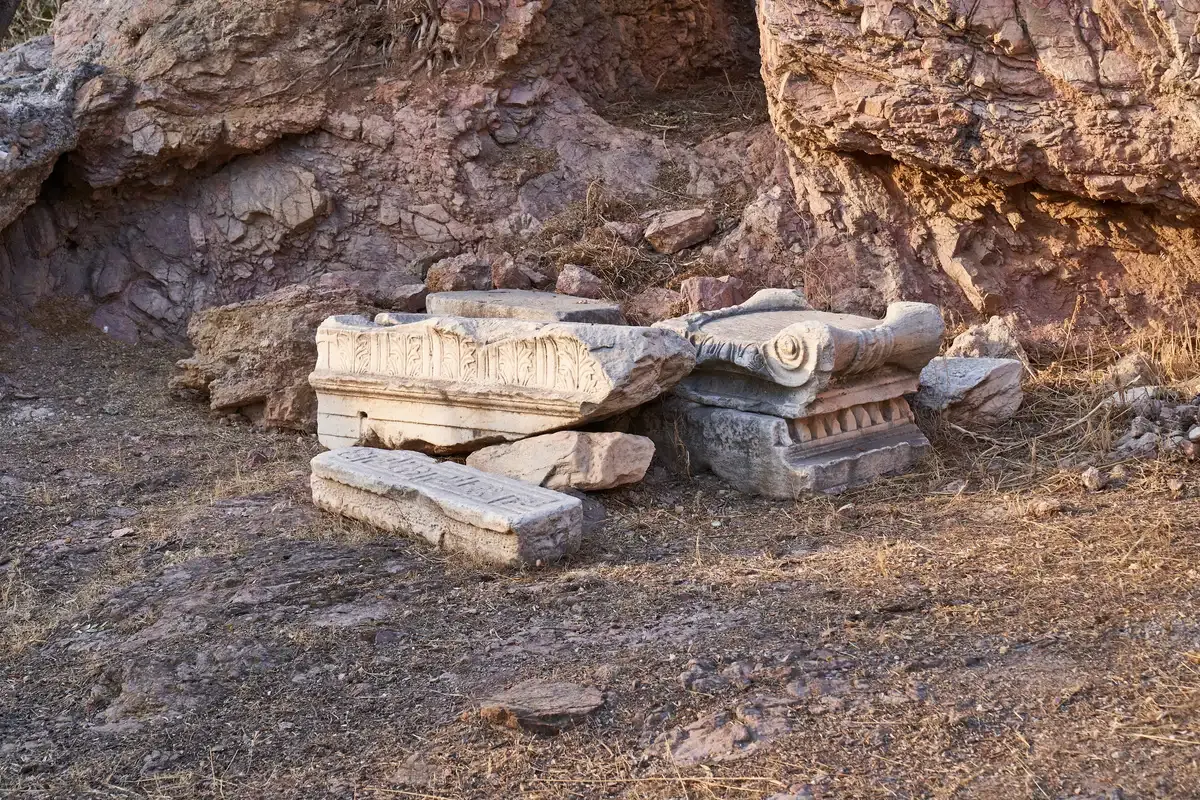
Photo: George E. Koronaios, CC BY-SA 4.0, via Wikimedia Commons
South entrance, Dionysiou Areopagitou
The main gate sits on the pedestrian avenue below the Odeon of Herodes Atticus, about twelve minutes on foot from Akropoli metro station on Line 2. It takes most of the traffic, it has the ticket office and the shop, and it sets you on the south-slope path, so you pass the Theatre of Dionysus and the Odeon on the way up rather than leaving them for a tired return trip. This is the default for first-time visitors.
The avenue itself dates from the 2003 pedestrianisation under the Unification of the Archaeological Sites programme, the scheme Melina Mercouri pushed as culture minister, finished before the 2004 Games. One warning: this entrance carries the queues, so at opening time the line here can be long. The ticket office means you can buy on the spot, but pre-booking saves the wait.
West entrance, below the Propylaea
The smaller gate at the top of the ramp on the west side, reached from Thiseio or Monastiraki past the Areopagus rock. It is a shorter climb from the top of the ramp and it is usually quieter, but the walk to it is uphill and there is no ticket office worth queuing at. Use it if you are coming from the Ancient Agora side, or if the south gate is backed up.
Step-free access
A lift on the north face carries visitors with reduced mobility to the summit, approached from the west side. The official page lists accessibility among the site's amenities, but plan the visit around two realities. The surface on top is uneven ancient rock and marble whatever route you take, so a companion helps on the summit paths, and wheelchair users should expect rough ground between the monuments.
The lift is machinery on a 2,500-year-old rock, and it does not run in every condition. Confirm it is in service on the day by calling the site guardhouse on +30 210 3214172 before you travel, because there is no alternative way up for anyone who cannot manage the climb. During official heatwaves the ministry has closed open-air sites through the hottest hours, roughly midday to 17:00, which applies to lift visitors as much as anyone.
What you cannot bring in
Large luggage, food, and professional photography or filming equipment are all turned away at the gate. There is no cloakroom, so a big bag is a genuine problem rather than an inconvenience, and the nearest solution is the bag you leave at your hotel. Pack light.
Do bring water, because a fountain stands near the entrance and there is nothing on the summit, where the sun hits bare rock with no shade. On heatwave days the ministry has closed the site through the hottest hours, roughly midday to 17:00, so go early and carry more water than you think you need. Wear flat shoes with grip, because the polished marble underfoot is the most common cause of a fall up there, and it is worse in the wet.
Tripods count as professional equipment, so leave them behind.
Dos And Don'ts On The Acropolis
The short version of everything above, for the morning you go up.
Do
- Book the 08:00 slot in any month you can; the coach groups land between 09:30 and 11:30 and there is no shade to retreat to
- Wear flat soles with grip — a century of visitors has polished the marble through the Propylaea, and it is the commonest cause of a fall up there
- Go in at the south gate and come out at the west, so the two theatres on the south slope fall on the way up rather than being missed
- Carry water. There is a fountain near the entrance and nothing at all on the summit
- Give the south slope its extra half hour — how long it takes sets the three routings side by side
Don't
- Don't arrive inside the last twenty minutes: admission stops twenty minutes before closing in every seasonal band — the timetable
- Don't photograph the Caryatids expecting originals; five of the six are downhill in the Acropolis Museum and the sixth is in London
- Don't bring large luggage, food or professional camera equipment. There is no cloakroom, and all three are prohibited
- Don't plan a photograph without scaffolding — the restoration has been running since 1975 and is deliberately slow
- Don't rely on the lift without phoning the guardhouse on +30 210 3214172 on the day — the accessible routes explain the approach
Acropolis map: gates, monuments and what is next
The two entrances, the monuments on top, and the four places within ten minutes on foot.
Five Things Most Visitors Do Not Know About The Acropolis
Facts that change how the rock reads, each with where it comes from.
- The famous explosion was the second one. Powder stored in the Propylaea was set off by lightning in 1645 and wrecked the gateway forty-two years before the Venetian shell reached the Parthenon in 1687. (Acropolis Museum, Museum History; ysma.gr) - The Temple of Athena Nike was demolished by its own garrison. In 1686, facing Morosini's army, the Ottomans took the temple apart and used the blocks to reinforce the walls and build a rampart in front of the Propylaea; what stands today was rebuilt from that material, most recently in the 2000s. (Acropolis Museum, Museum History) - The Caryatids stood outdoors until 1979. The Committee for the Conservation of the Acropolis Monuments began with the Erechtheion and pulled the figures off the porch to stop the weathering; the ones on the building have been casts ever since.
(Acropolis Museum, Museum History) - You can have the rock to yourself, at a price. ODAP itself sells an out-of-hours Acropolis Experience at $5,811 (€5,000) for a group of up to five, at 06:00 or 20:00 on Tuesdays, Fridays and Saturdays from 1 April to 31 October — four groups at a time, non-refundable. Anything advertised as a private after-hours Acropolis tour for less than that is not this product. (tickets.hh.gr, Acropolis Experience) - The Evzones come up here too. The Presidential Guard raises and lowers the flag on the Acropolis on Sundays and official holidays, a small ceremony almost nobody schedules for — the guard's own page has the Syntagma timings.
(presidency.gr)
Eating At The Gate
There is nothing to eat inside the fence, and that is a rule rather than an oversight.
Food is on the prohibited list at the entrance along with large luggage and professional camera gear, so the visit is water only — carry more of it than seems sensible in summer, because the fountain is near the gate and the summit has none. The nearest sit-down option is ten minutes downhill: the ground-floor café at the Acropolis Museum needs no ticket at all, so you can walk in off Dionysiou Areopagitou, and the second-floor restaurant, which faces the rock, needs only a free admission ticket from the desk. Otherwise the pedestrian avenue leads west into Koukaki and Makrygianni, where the tavernas charge ordinary prices, or east into Plaka, where the terraces charge for the view. Where to eat in Athens is blunt about the difference.
Next stop from the Acropolis
Walk minutes are our estimates from the GPS distances; the south exit puts you closest to the museum.
Acropolis Museum
Downhill on the pedestrian avenue. €20 on a separate ticket, and the place the originals went. The Acropolis Museum stays open to 22:00 on Fridays.
10 min walkAncient Agora
Down the west side past the Areopagus. €20, and it closes half an hour before the rock all summer — the Ancient Agora has the seasonal table.
12 min walkPhilopappos Hill
Free, no ticket, and the photograph everyone recognises. Philopappos is worth an hour before sunset, not at midday.
15 min walkAcropolis questions people ask on the way up
Is the rock the same thing as the temple on it?
No. The Acropolis is the rock and the whole walled site on it; the Parthenon is the temple of Athena at the top, the largest building up there. One ticket covers the rock and everything on it, including the Parthenon — there is no separate Parthenon ticket. The Parthenon page is about the building.
How difficult is the walk up the Acropolis?
It is a steady climb of about twenty minutes from the south gate, on paths and then worn marble steps through the Propylaea. There are no handrails on the historic surfaces and the marble is slippery — flat soles matter more than fitness. A lift on the north side serves visitors with reduced mobility; the entrances section has the detail.
What time does the Acropolis open?
08:00 every day it is open, all year. Closing moves with the season: 20:00 from 1 April to 31 August, stepping down through the autumn to 17:00 from 1 November to 31 March, with last admission twenty minutes earlier. The hours section has all six bands.
Is it worth going up in the middle of a summer day?
It is the least good hour. There is no shade at all on top, and July and August average close to 28°C. If a midday slot is all you can get, take water, take a hat, and expect to spend less time than you planned. The best time to visit sets out the months.
Are the Caryatids on the Acropolis real?
No — the six figures on the Erechtheion porch are casts. Five originals are in the Acropolis Museum ten minutes downhill, and the sixth was taken by Lord Elgin and is in the British Museum.
Can I visit the Acropolis at night?
Only through the ministry's own Acropolis Experience: a private two-hour visit at 06:00 or 20:00, Tuesdays, Fridays and Saturdays between April and October, at €5,000 for a group of up to five. It is sold on the official platform, and it is the only legal out-of-hours access — the ticket page has the terms.
The Acropolis on Video
Three filmed visits that show the distances, the surfaces and the pace — the things a written page cannot carry. Every id was checked against YouTube on 2 September 2026.
The Acropolis of Athens Explained with Reconstructions
Digital reconstructions set against the ruins, which is the fastest way to understand what you are actually looking at on top.
Video: Manuel BravoHistory Summarized: The Acropolis
The long history of the rock told briskly — useful before you go up, and it does not pretend the site was only ever a temple.
Video: Overly Sarcastic ProductionsThe ACROPOLIS of Athens : Everything you need to know
A practical run-through of the site from a channel that films Athens constantly: entrances, order, and what people miss.
Video: Greece ExplainedPrices, hours and terms are set by the venue or operator and confirmed at checkout.
We may earn a commission if you book through one of our links, at no extra cost to you. Full affiliate disclosure