 Visit Athens Guide
Athens Safety, Scams and the Rules That Cost Money
Is Athens safe? For a visitor, overwhelmingly yes, and the things that actually go wrong here are not the ones people worry about. Violent crime is not the visitor's risk; a €100 fine for an unvalidated metro ticket is, and it is written into a 2026 ministerial decision that most guides have not caught up with. This page is about the rules and situations that separate visitors from money, each with its source and the date it was read in Q3 2026 — plus the one emergency number that works. It sits on the plan hub, part of our guide to Athens sightseeing.
Quick answer The number to save, and the fine nobody warns you about
Athens is a safe capital for visitors and the practical risks are ordinary: pickpocketing on a crowded metro, a taxi that ignores the flat fare from the airport, and — the expensive one — a €100 fine for travelling with an unvalidated ticket, which the inspector is legally obliged to impose. The emergency number is 112, free from any phone, anywhere in the EU.
Key takeaways
- The transport fine is €100, or €50 on a reduced fare, and it quadruples if it goes unpaid for sixty days.
- The airport taxi is a flat €40 by day and €55 between midnight and 05:00 — it is not negotiable and the meter is not the price.
- 112 is free from any phone, alerts every service at once and can locate you; it also sends the city's wildfire and heat alerts.
- Pickpocketing is concentrated at boarding moments on Lines 1, 2 and 3 and around Monastiraki.
- The petition and bracelet approaches are the two street routines you will actually meet.
The One That Costs Real Money
The metro and bus fine is the single most likely way a visitor loses a meaningful sum in Athens, and it is entirely avoidable.
€100, and the inspector has no discretion
OASA's own wording: for passengers without a valid transport ticket, "the Ticket Inspector is obliged to impose a fine of one hundred (100) euros for passengers required to hold a full-fare ticket, and fifty (50) euros for passengers entitled to a reduced-fare ticket". The authority is Joint Ministerial Decision No. 80212, Government Gazette B΄ 3005 of 28 May 2026. Note the word obliged: there is nothing to talk your way out of, and being a tourist is not a category in the decision.
How it can be halved, and how it quadruples
The fine drops by 50% if you buy and activate an unlimited travel card of at least thirty days within ten calendar days of the fine, provided you pay within sixty calendar days. Miss the sixty days and it goes to the offender's tax office to be assessed at four times the certified amount, under Law 5290/2026, Article 38, Gazette A΄ 47 of 30 March 2026. A €100 fine that is ignored becomes a €400 debt to the Greek tax authority.
What counts as valid, exactly
The ninety minutes of a €1.20 single run from the first validation, not from purchase, so a ticket bought at the airport machine and tapped in an hour later has already burned an hour of its life. Tap in at the metro gates. On buses, trolleys and trams there are validators near the doors, and you use them on every boarding, including a change onto a second vehicle mid-journey.
A ticket in your pocket that has never been validated is the same as no ticket, and inspectors treat it that way. Keep the ticket until you leave the system, because spot checks happen on platforms as well as on board. Fares and products, including the €4.10 day ticket and the €20 three-day tourist ticket, are on getting around.
If you are fined anyway
Metro and tram fines belong to STASY: the Fines Department answers on 214 414 1352, Monday to Friday 08:00–15:00, and at [email protected]. Payment is by the RF code printed in the red frame on the fine form, electronically, at partner banks or at Hellenic Post. Objections — requests for cancellation or reduction, including the two specific cases where the card reader failed to recognise a valid bank card or you did not have your personalised card on you — are filed through gov.gr.
The Airport Taxi Has a Fixed Price
The second most common way to overpay, and the fix is one sentence.
€40 and €55, by law, either direction
The flat fare between Athens International Airport and the city-centre inner ring is €40 from 05:00 to midnight and €55 from midnight to 05:00, in either direction. The airport publishes it, and it is a flat fare rather than a meter reading. The charge is determined by the time of arrival at the destination, not the time you got in — so a 23:50 pickup that lands at 00:10 is the night fare, correctly.
Greek law obliges the driver to issue a receipt. The full arithmetic against the metro and the bus is on from the airport.
So the only sentence you need
"Flat fare, forty euros, yes?" before the boot opens. The rank is at Exit 3 on the Arrivals level and runs 24 hours. A driver who wants to run the meter into the centre is not offering you a better deal.
Where Pickpocketing Actually Happens
Concentrated rather than general, which makes it easy to plan around.
The metro, at the doors
The risk is the boarding and alighting moment on a crowded carriage, not the ride — the crush at the doors, a bag on a shoulder facing away, and the whole thing takes three seconds. Line 1 to Piraeus, Line 3 from the airport with luggage, and the interchange at Monastiraki are the named hot spots in every police advisory Athens has issued. Front pocket, or a bag worn across the front, and nothing at all in a back pocket.
And the streets above it
Monastiraki square on a Sunday, when the flea market draws its densest crowd, is the classic case. The square holds the Tzistarakis mosque of 1759, built by an Ottoman governor who was said to have pulled down a column of the Olympieion to burn for its lime, and the market stalls around it pack the narrow approaches. The narrowest points of Ermou and the queue at the Acropolis west gate work the same way: people stand still, watch something else, and leave bags open behind them.
None of this is unique to Athens. It is the same list as Rome, Barcelona or Paris. Wear bags across the front, keep phones in a zipped pocket rather than a back pocket, and step out of the flow of the crowd before checking a map.
Areas, honestly
Around Omonia and parts of Vathis and Menandrou feel rougher at night than the rest of the centre and are worth avoiding after dark if you do not know them — that is a comfort judgement rather than a crime statistic, and it is the standard local advice. Exarchia, which has a reputation abroad it has largely outgrown, is a normal and lively neighbourhood with the cheapest good eating in the centre; the district page is honest about what it is.
The Two Street Routines
Athens has fewer of these than most Mediterranean capitals. Two are common enough to name.
The petition, and the bracelet
- The clipboard petition — someone asks you to sign for a charity, usually near Syntagma or Monastiraki. Signing is followed by a demand for a donation, and the clipboard occupies both your hands and your eyes while somebody else is at your bag.
- The friendship bracelet — a length of string is tied round your wrist before you have decided anything, then payment is requested for it. The tying is the transaction. "Όχι, ευχαριστώ" and keep walking.
And the bar invitation, which is rarer but expensive
A friendly stranger, often at the edge of the tourist streets, suggests a bar he knows. The drinks arrive, the company arrives, the bill is several hundred euros and the door is watched. It is uncommon in Athens and it is not a myth.
The rule that defeats it is simple and applies everywhere: choose the bar yourself.
What is not a scam
A taverna bringing bread and charging a small cover for it is normal and legal, and should be on the menu. A taxi from the airport charging €55 at one in the morning is the published fare. A museum selling you only a full-price ticket online is following its own rule — reduced and free tickets are issued at the desk on documents, as the tickets hub explains.
112, and What It Does
One number, free, and more capable than most visitors realise.
The number
112 is the single European emergency number. Greece's own service describes it as free of charge, reachable in Greece and across the EU, alerting simultaneously every service that needs to be involved, and able to locate the caller. It works from any phone, including one with no credit, and roaming customers are sent an SMS on arrival telling them so — that message is a legal requirement under the EU roaming rules covered on staying connected.
It also calls you
112 in Greece runs mass alerts: when a natural disaster or dangerous situation is expected or under way, phones in the affected area receive a warning with instructions. In Athens this is how wildfire and extreme-heat warnings arrive, and it is worth knowing that a loud unexpected alarm on your phone in August is the state doing its job rather than a fault. Athens in summer covers the heat side.
For a theft rather than an emergency
A stolen wallet is a police matter, not an emergency, and 112 is not the number for it. Ring 112 only when there is danger to a person or property in progress. For a theft you need a report from a police station, and insurers generally require it before they pay a claim.
Cancel your cards first and report second, because the report exists for the insurer rather than for recovery of the property. Ask your accommodation to point you to the nearest police station that handles such declarations, since not every station does, and ask them to help with the paperwork if your Greek is thin. Carry a photocopy or photo of your passport so the report can be written without a second trip.
The Three Situations Worth Handing to Somebody Else
Walking a city at night for the first time, working out which ticket to buy, and getting through a gate you have never seen. None of these is dangerous; all three are where visitors lose time or money. Prices are the operators' own, checked on 1 September 2026.
 from €18
Athens: Night Walking Tour with Local Guide
Two hours after dark through the historic centre, the Cathedral, Anafiotika, Monastiraki and Plaka, with a local guide and no museum entries.
Check Availability from €78.90
Athens: City Pass with Acropolis, Museums, HoHo & Transport
The Acropolis, the Acropolis Museum and a 48-hour hop-on hop-off bus in one pass, with public transport and an island cruise as options.
Check Availability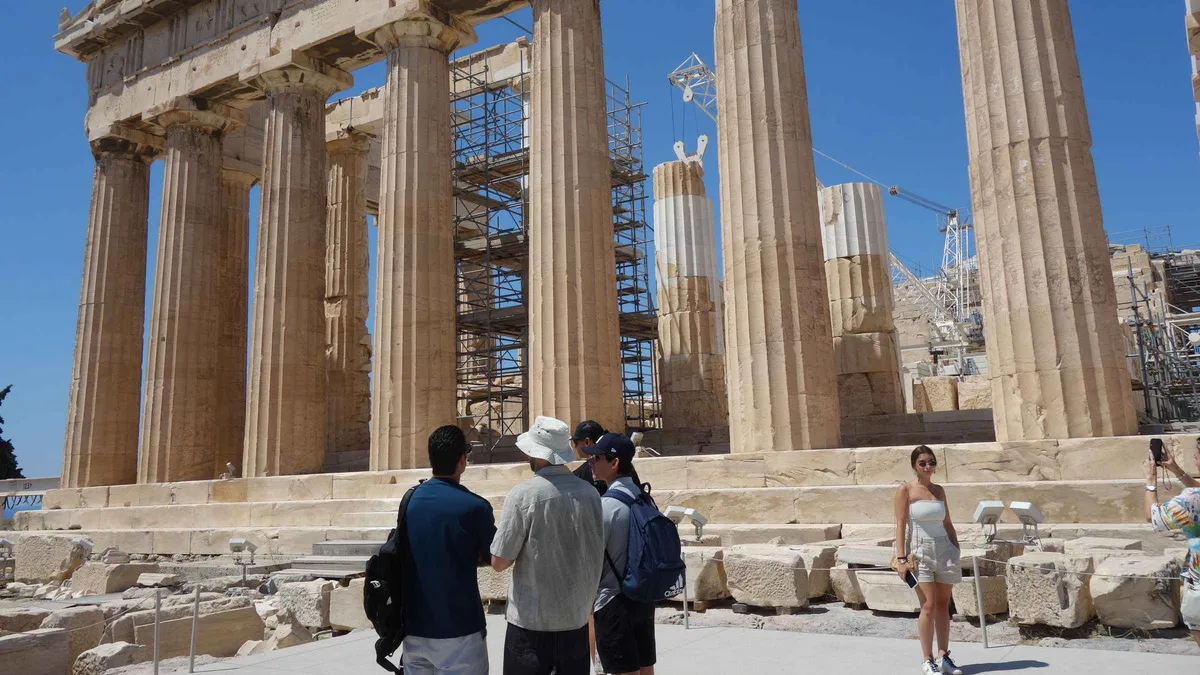 from €32.03
Athens: Acropolis Small Group (max: 8) Guided Tour
Maximum eight people with a licensed local guide across the Acropolis and the Parthenon, about two hours on the rock.
Check AvailabilityPrices, ratings and details are the platform's own. Euro figures are the listed prices. The platform bills in your account's currency.
Safety Questions
Is Athens safe for tourists?
Yes, on the ordinary measure of a European capital. The realistic risks are pickpocketing in crowds and overpaying, not violence. The most expensive single thing that happens to visitors is the €100 fine for an unvalidated transport ticket.
What is the fine for not validating a ticket in Athens?
€100 for a full-fare passenger and €50 for someone entitled to a reduced fare, and the inspector is obliged to impose it (Joint Ministerial Decision 80212, Gazette B΄ 3005 of 28 May 2026). It halves if you buy and activate a 30-day card within ten days and pay within sixty; unpaid after sixty days it is assessed at four times the amount.
What is the emergency number in Greece?
112, free from any phone and the same across the EU. It alerts all the relevant services at once and can locate the caller, and it is also the channel Greece uses for wildfire and hazard alerts to phones.
How much should a taxi from Athens airport cost?
A flat €40 between 05:00 and midnight, and €55 between midnight and 05:00, in either direction, decided by the time you arrive at the destination. The driver must issue a receipt. From the airport compares it with the metro and the bus.
Is Exarchia dangerous?
No, on any ordinary reading. It has a reputation abroad that its streets no longer support, and it holds some of the cheapest good eating in central Athens. The district page is honest about what it is and is not.
Where to go from here
Safety & Scams on Video
One film on the same subject.
Athens : How not to get ROBBED by PICKPOCKETS
Where pickpocketing actually happens in Athens, filmed in those places.
Video: Greece ExplainedWe may earn a commission if you book through one of our links, at no extra cost to you. Full affiliate disclosure