 Visit Athens Guide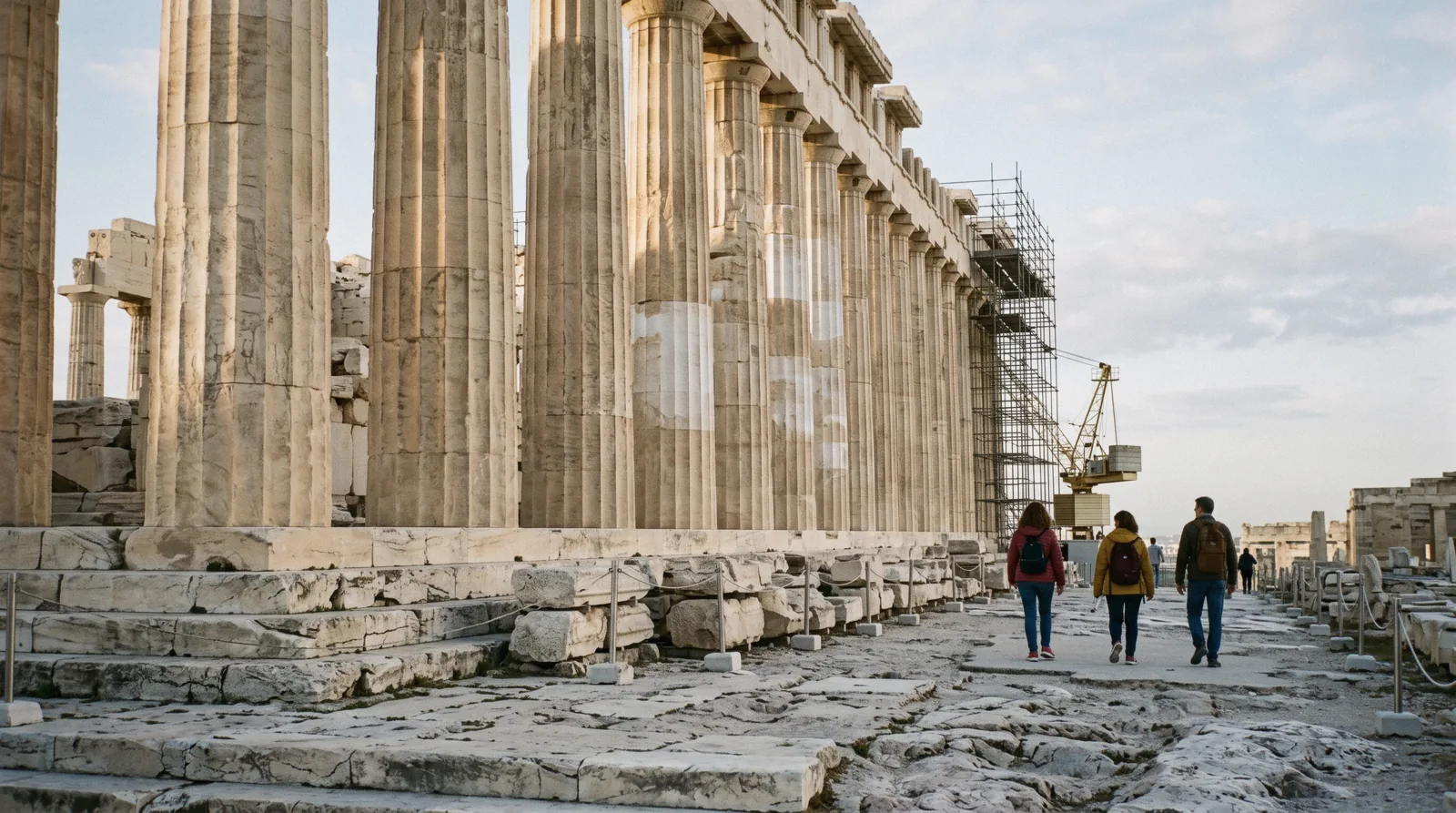
The Parthenon
The Parthenon is the temple of Athena at the top of the Acropolis, begun in 447 BC and finished in about fifteen years. It is not a separate site and has no ticket of its own: it stands inside the Acropolis fence, on the €30 entry that covers the whole rock. This page is about the building — what it was for, what happened to it, what the cranes are doing and how to look at it — as checked in Q3 2026. The practical visit is on the Acropolis page, the ticket on the Acropolis ticket page, and the wider plan on things to do in Athens.
Quick answer What it was for, and why half of it is in London
The Parthenon is a temple to Athena, built under Pericles from 447 BC and designed by Iktinos with Kallikrates, with sculpture by Phidias. It housed a colossal gold-and-ivory statue of the goddess that has been lost since antiquity.
Key takeaways
- There is no Parthenon ticket. It is inside the Acropolis fence on the €30 site entry — how the ticket works has the rules.
- About half the surviving sculpture is in the British Museum, taken by Lord Elgin; the rest is in the Acropolis Museum, arranged to face the real building.
- The building was largely intact until 1687, when a Venetian shell hit the Ottoman powder store inside it — what happened to it is a shorter story than most people expect.
- The cranes are not a delay. The restoration has been running since 1975 and is designed to correct a botched earlier one.
- Best view of it is from off the rock: Philopappos Hill, free, an hour before sunset.
- It stood almost whole until 1687: what actually ruined it was an explosion, Elgin, and a restoration that used iron.
Key facts
Opening hours
| 1 April – 31 August, daily | 08:00–20:00 |
|---|---|
| 1–15 September, daily | 08:00–19:30 |
| 16–30 September, daily | 08:00–19:00 |
| 1–15 October, daily | 08:00–18:30 |
| 16–31 October, daily | 08:00–18:00 |
| 1 November – 31 March, daily | 08:00–17:00 |
Closed 1 January, 25 March, 1 May, Orthodox Easter Sunday, 25 and 26 December
Admission
- Adult
- €30 for the Acropolis, which includes the Parthenon
- Reduced
- €15
- Free
- 6 March, 18 April, 18 May, the last weekend of September, 28 October, and the first and third Sunday from 1 November to 31 March
Planning it
- Time needed
- Not stated; our routing: 30 minutes at the temple itself, 90 for the rock
- Book ahead
- Essential — weeks ahead
- Address
- Acropolis of Athens, 105 58 Athens
The Parthenon has no ticket of its own; these are the ways onto the rock it stands on, priced from hh.gr and GetYourGuide on 1 September 2026. The full comparison is on the Acropolis ticket page.
There is no Parthenon ticket. The question is only whether you want to be told what you are looking at, and how early you want to be standing in front of it.
| Option | Price | Includes | Cancel | Book |
|---|---|---|---|---|
| Official Acropolis ticketEveryone; one ticket covers the whole rock and this temple is inside it | €30 full / €15 reduced | The whole rock, this temple included | Non-refundable; two changes to 2h before | Official site |
| Entry with audio optionsFor a booking on your phone with an audio track, at about about six euros over the gate | Listed at €36 | Timed entry, audio or live-guide option | Per listing | Check Availability |
| First-access guided tourFor a first morning, with the temple reached before the coach parties | From €27 | Early entry, licensed guide, the temple first | Free up to 24 hours before | Check Availability |
| Rock and museum with a guideFor the sculpture followed downhill into the gallery built to hold it | From €34 | The temple and the frieze in one morning | Per listing | Check Availability |
If the sculpture matters to you, pair the rock with the museum: the frieze that is missing from the building is ten minutes downhill in the Acropolis Museum, and no official ticket covers both.
Ways to see the Parthenon
The cards behind the table, with the operator's own rating and review count.
 from €36
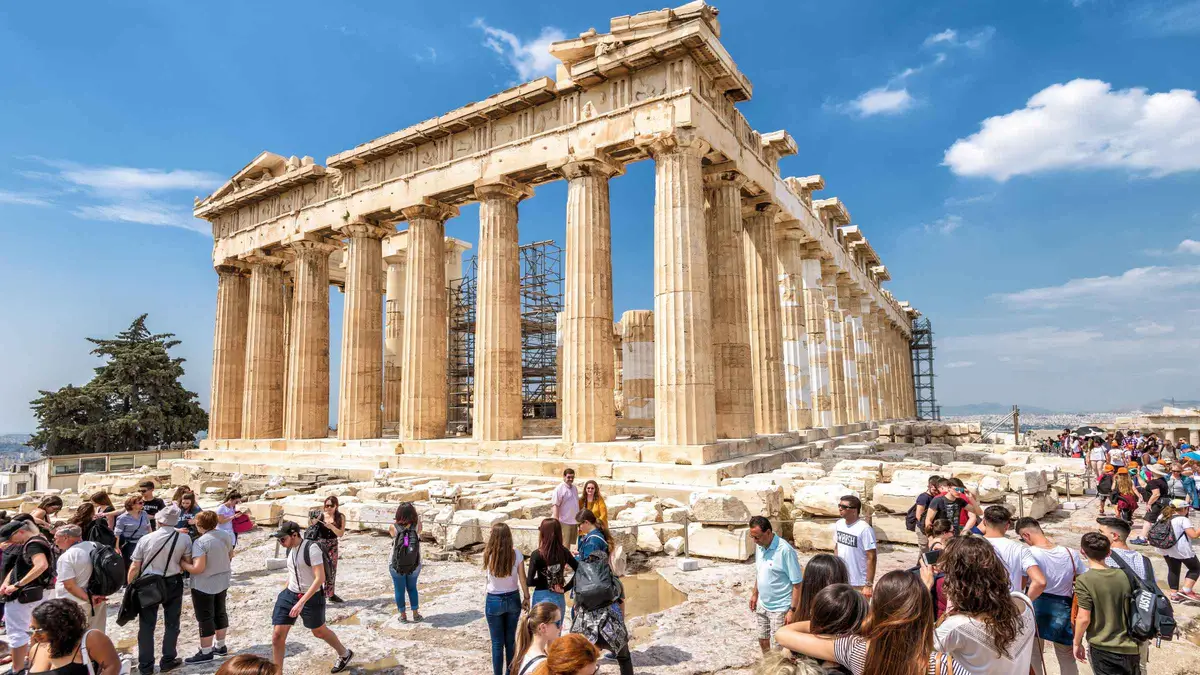
Athens: Acropolis Ticket with Optional Audio or Live Guide
Pre-booked Acropolis entry sent to your phone, with two audio-guide options and no fixed guide to keep up with. The official price is €30; this is the reseller version of the same timed slot.
Check Availability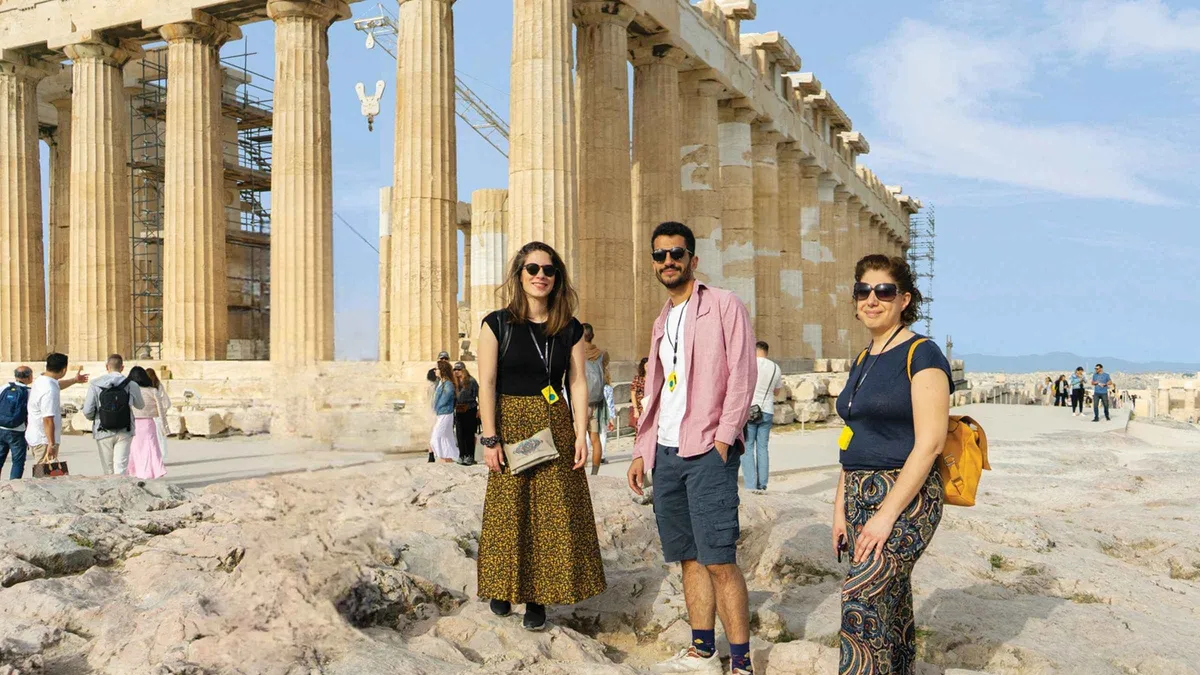 from €27
Athens: First Access Acropolis and Parthenon Guided Tour
An early-morning guided walk that goes to the Parthenon before the coach groups, then the Theatre of Dionysus on the south slope. Two to four hours depending on the option.
Check Availability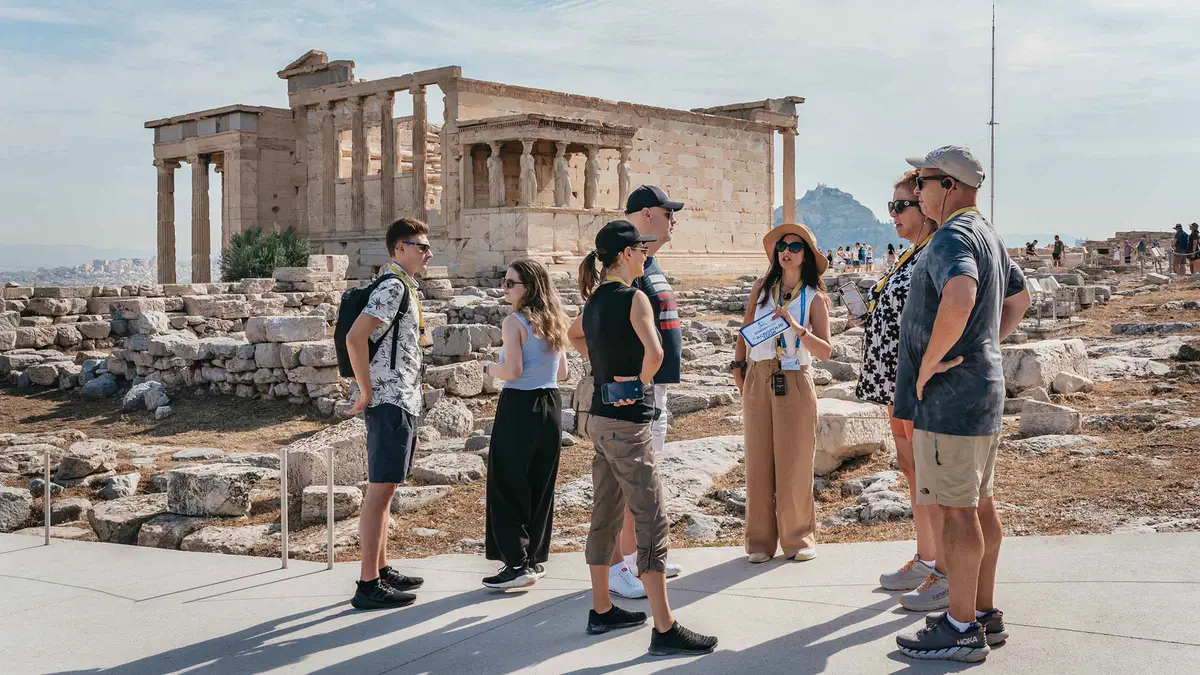 from €34
Athens: Acropolis, Parthenon & Acropolis Museum Guided Tour
An archaeologist takes the monuments on the rock and then the Parthenon gallery in the Acropolis Museum, where the frieze sits at eye level.
Check Availability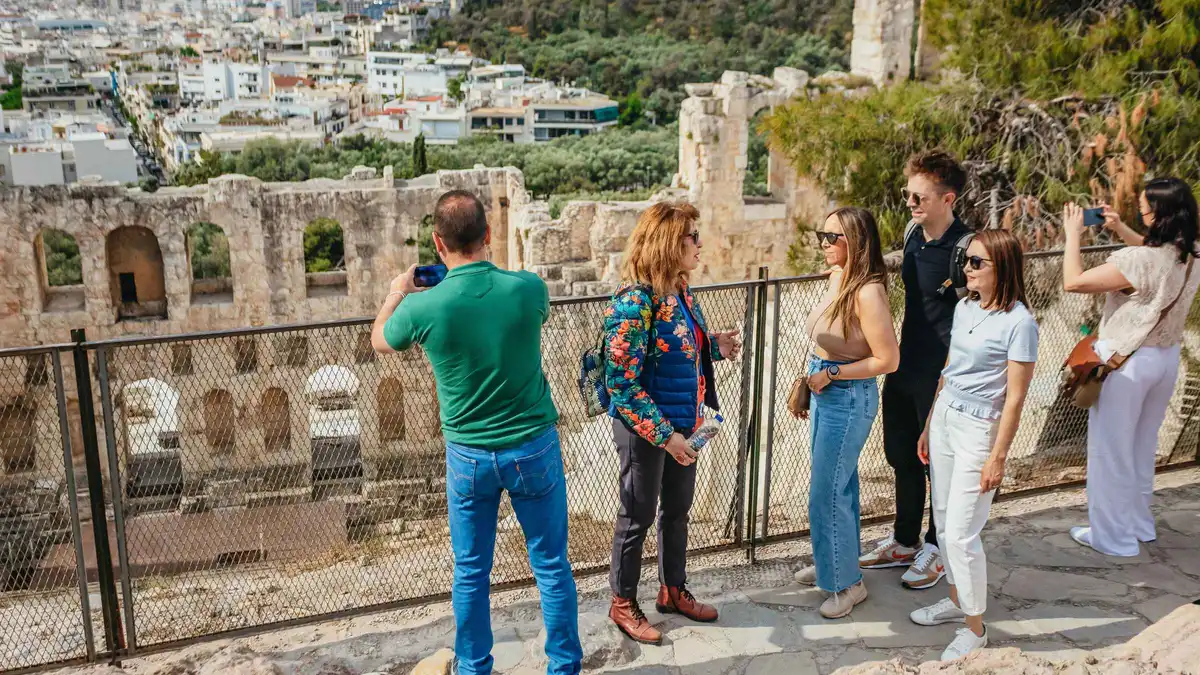 from €49
Athens: Parthenon, Acropolis and Museum Small Group Tour
Three hours in a small group with pre-reserved tickets, covering the Acropolis, the Parthenon and the museum below it in one run.
Check AvailabilityPrices, ratings and details are the platform's own. Euro figures are the listed prices. The platform bills in your account's currency.
What the Parthenon was for
A treasury as much as a temple, and a political statement before either.
A temple to Athena Parthenos
The name comes from parthenos, maiden — the epithet of the goddess whose statue stood inside. That statue, made by Phidias in gold and ivory over a wooden core, was about twelve metres high and was the point of the building: the Parthenon was designed around it. It disappeared from the record in late antiquity and no fragment survives; every image of it is a reconstruction from Roman copies and descriptions.
And a treasury
The rear chamber held the treasure of the Delian League, the alliance Athens led and then dominated. The building programme that produced the Parthenon was paid for out of that common fund, which is why the temple was as much an argument about Athenian power as an act of piety. Pericles also defended the spending as employment: the ancient sources describe Athenians, foreigners, free men and slaves working on the site at a drachma a day.
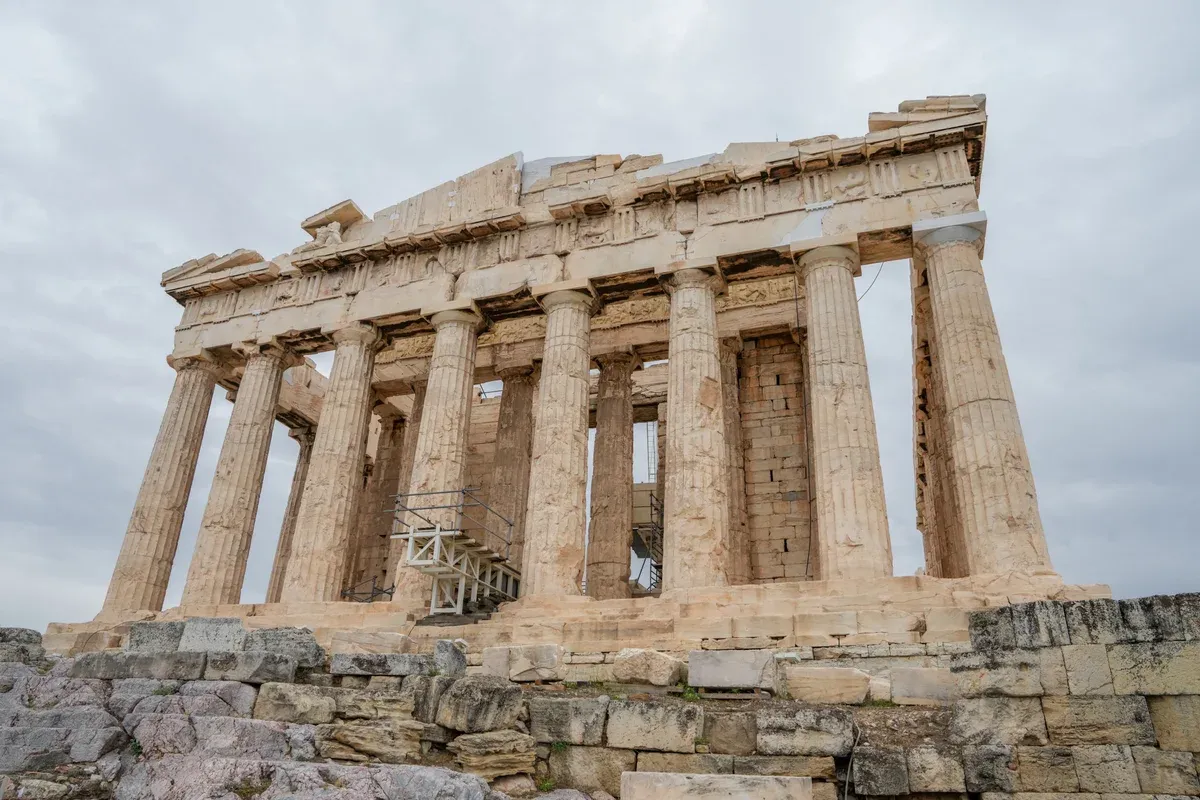
Photo: Giles Laurent, CC BY-SA 4.0, via Wikimedia Commons
Built fast, by hand, on a burnt site
The Persians sacked the Acropolis in 480 BC and burned what stood there, including an unfinished predecessor of the temple. Work on the Parthenon began in 447 BC and the building was substantially done within about fifteen years, an extraordinary pace for roughly 100,000 tonnes of Pentelic marble. Every block was cut in the quarry, carted eighteen kilometres to the top of the rock and fitted without mortar.
The practical consequence for you is that there is no shade up there and no roof, so the same scale that impresses also punishes. A full ticket costs €30 and the reduced one €15. Start early, carry water, and remember that in an official heatwave the site has repeatedly closed through the hottest hours, announced only a day or less ahead.
The refinements
Almost nothing in the Parthenon is straight. The stylobate curves upward slightly toward the centre, the columns lean inward and swell at mid-height, and the corner columns are thicker and closer to their neighbours. The usual explanation is optical — that the corrections make the building read as regular from a distance — though the ancient sources do not say so, and modern scholars argue about it.
What is not in dispute is that the deviations were deliberate and cut into the stone.
What happened to it
Twenty-three centuries as a working building, and one afternoon that ended it.
Church, then mosque
The Parthenon was converted to a Christian church of the Holy Mother of Athens in 1205, and after the Ottoman capture of the city in 1460 it became a mosque, with the stairway doubling as a minaret. Each conversion changed the fabric, but both kept the building roofed and in daily use, which is why it survived so nearly whole into the seventeenth century. The ruin you see today dates from 1687, when the Venetians besieged the Acropolis and a shell hit the gunpowder the Ottomans had stored inside the temple.
The explosion turned the Parthenon into a ruin. Two centuries later Lord Elgin removed 18 pedimental statues, 15 metopes and 56 blocks of the Ionic frieze, so what stands now is a building repeatedly repurposed and repeatedly stripped.
26 September 1687
The Ottoman garrison used the Parthenon to store gunpowder during the Venetian siege of Athens. A Venetian mortar shell fired from the Hill of the Muses reached it, the powder went up, and the centre of the building was destroyed in a moment: the roof, most of the cella walls and a large part of the colonnade. Everything you see standing today was either left by that explosion or re-erected since.
Lord Elgin, from 1801
Thomas Bruce, Earl of Elgin, then British ambassador to the Ottoman court, had a large part of the surviving sculpture removed and shipped to Britain — roughly half of what was left of the frieze, along with metopes, pedimental figures and one of the Erechtheion Caryatids. Part of the shipment sank off Kythira and was recovered. The material has been in the British Museum since 1816 and its return is a live diplomatic argument.
The Acropolis Museum's top floor is built to make that argument without a word: original blocks are set beside plaster casts of the ones in London, and the colours do not match.
The cranes, and why they are permanent
The scaffolding is the most misunderstood thing on the rock.
An earlier restoration made it worse
Between 1898 and 1933 Nikolaos Balanos re-erected large parts of the Parthenon, pulling fallen columns and blocks back into position and fixing them with iron clamps set into the marble. At the time this read as rescue. Iron rusts, rust expands, and expanding iron splits stone from the inside, so the very members he had saved began to crack along their repaired joints.
By the 1970s the earlier repair had itself become the main threat to the building. This is why the scaffolding you see is not cosmetic. The teams on the rock are undoing a restoration that failed, and the work runs through the same columns your ticket at €30 or €15 admits you to.
Give the marked conservation areas a wide berth and stay behind the barriers.
What is happening now
The current restoration programme has been running since 1975. It dismantles the Balanos work, replaces the rusting iron with titanium, which does not corrode, cleans and consolidates the original marble, and returns each block to its own place. New marble from the same Pentelic quarry is added only where a member cannot stand without it.
The work is slow, unglamorous and open-ended, so expect cranes in your photographs for the foreseeable future. It matters for planning too. A public-sector strike can shut the Acropolis outright, because state sites are staffed by ministry employees.
Heritage tickets are non-refundable, and the defence is two changes per ticket up to two hours before your slot. If a strike is announced, move your entry rather than writing off the €30. Because the restoration work and the strike rules change how the site reads, comparing athens guided tours helps you pick a guide who can explain the scaffolding and help you rebook if a strike hits.
What that means for a visit
You will not see the Parthenon without scaffolding, and no season or hour avoids it, so do not organise your trip around empty cranes. What changes with the hour is the light on the columns. Early morning and the last hour before closing in spring and autumn are when the Pentelic marble goes gold and the cranes matter least.
Those windows also spare you the worst of the heat, which matters because the site has repeatedly closed through the hottest hours during official heatwaves, announced a day or less in advance. Full entry costs €30 and the reduced ticket €15. The climb from the entrance is uphill and the marble is polished, so wear shoes with a grip. The Acropolis page has the closing times by season.
Seeing it properly
Three places to look at the Parthenon from, in ascending order of how good the photograph is.
The Acropolis itself
Close enough to read the flutes and the drill holes. €30 with a declared hour — the Acropolis has the gates and the hours.
On the rockAcropolis Museum
The top floor is the Parthenon's own dimensions with the frieze at eye level and the real building in the window. The museum is €20 and open to 22:00 on Fridays.
10 min walkPhilopappos Hill
The profile view across the saddle, free and open at all hours. Philopappos is where the photograph everyone recognises is taken.
15 min walkWhere the Parthenon stands, and where to look at it from
The temple on the rock, the two gates that reach it, and the two best places to see it from.
Parthenon questions
Are the Parthenon and the Acropolis the same?
No. The Acropolis is the rock and the whole fenced site on it; the Parthenon is the largest temple standing on that site. One ticket covers both, because the temple is inside the fence. The Acropolis page covers the visit.
What does Parthenon mean?
From parthenos, Greek for maiden — an epithet of Athena, whose colossal statue by Phidias stood inside the building. What it was for has the rest.
Why was the Parthenon destroyed?
By a single explosion. In 1687 the Ottoman garrison stored gunpowder inside it during a Venetian siege; a shell reached the store and blew out the centre of the building. Before that afternoon it had stood nearly intact for more than two thousand years as a temple, a church and a mosque.
What is the difference between the Parthenon and the Pantheon?
Different buildings, different cities, seven centuries apart. The Parthenon is a Greek Doric temple to Athena on the Acropolis of Athens, from the 440s BC. The Pantheon is a Roman domed temple to all the gods, in Rome, rebuilt under Hadrian in the AD 120s. The similarity is only in the name.
Where are the Parthenon marbles?
Split. About half the surviving sculpture is in the British Museum, removed by Lord Elgin from 1801; the rest is in the Acropolis Museum in Athens, where the top-floor gallery sets the originals beside casts of the London pieces.
Will the scaffolding ever come down?
Not soon. The restoration has been running since 1975, undoing an earlier repair whose iron clamps were splitting the marble, and it is deliberately slow. The restoration section explains what is being done.
The Parthenon on Video
Three filmed visits that show the distances, the surfaces and the pace — the things a written page cannot carry. Every id was checked against YouTube on 2 September 2026.
The UnXplained: The DIVINE Perfection of the Parthenon (Season 5) | History
A television documentary on the building's proportions. Watch it for the argument about the refinements, not for the visitor detail.
Video: HISTORYAcropolis & Parthenon - Complete Travel Guide & Tips - How to Visit Athens’ Most Iconic Landmark
A full visit filmed end to end, including the approach and the queue, which is the part the ticket page cannot show you.
Video: Ultimate Bucket ListAcropolis walking tour - Enjoy Acropolis, Parthenon with a licensed tour guide
A licensed guide's walk of the rock, which shows what the commentary on a guided ticket actually sounds like.
Video: Athens Walks Tour CompanyPrices, hours and terms are set by the venue or operator and confirmed at checkout.
We may earn a commission if you book through one of our links, at no extra cost to you. Full affiliate disclosure