 Visit Athens Guide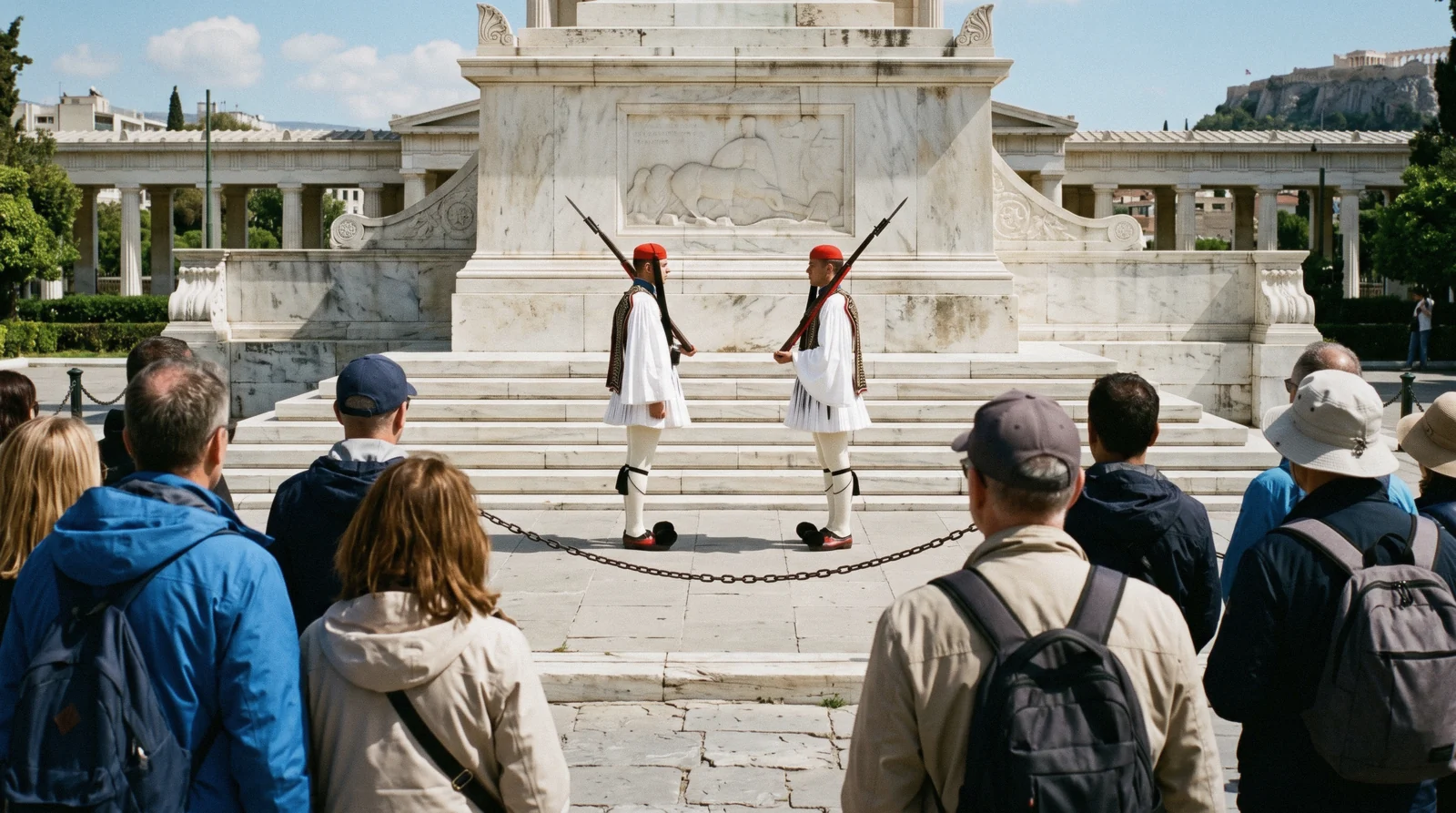
The Changing of the Guard at Syntagma
The changing of the guard Athens visitors queue for happens at the Tomb of the Unknown Soldier below Parliament on Syntagma Square, and it happens more often than most people realise: the Evzone pairs change every hour, on the hour, all day and all night. The full ceremony, with a large contingent and a military band, is on Sunday at 11:00. It costs nothing. This page has the times, where to stand and what the uniform means, all read on the Presidency's own pages as checked in Q3 2026. The wider plan is on things to do in Athens.
Quick answer The times, the Sunday, and where to stand
The guard changes every hour on the hour at the Tomb of the Unknown Soldier on Syntagma Square, day and night, in any weather. The full ceremony — a large contingent of Evzones with a military band marching from their camp — is every Sunday at 11:00. It is free.
Key takeaways
- Hourly is the thing most visitors miss: you do not have to plan for Sunday, you can walk past at any o'clock. The times has both versions.
- For the Sunday ceremony be in place by 10:40 — where to stand sets out the two positions worth having.
- The uniform is not decorative: the kilt has 400 pleats for 400 years of Ottoman rule, and each shoe weighs about three kilos.
- The same guard raises and lowers the flag on the Acropolis on Sundays and official holidays — a small ceremony almost nobody watches.
- Syntagma is twelve minutes from the Panathenaic Stadium through the National Garden, which makes an easy Sunday morning.
Key facts
Opening hours
| The hourly change, every day | on the hour–around the clock |
|---|---|
| The full ceremony with a band | Sunday 11:00–about 45 minutes |
| Best light for photographs | before 10:00–after 18:00 |
Closed None; the Tomb is guarded in all weather and at all hours
Planning it
- Time needed
- Not stated; our routing: 10 minutes for the hourly change, 45 for the Sunday ceremony
- Book ahead
- Optional — walk-up usually fine
- Address
- Tomb of the Unknown Soldier, Syntagma Square, 105 63 Athens
What it costs, and what is sold around it
Nothing at all, which is worth saying because tours are sold that include it. Prices for the walks that pass this way, listed on 1 September 2026.
Both ceremonies are free and neither is ticketed, so the only question is whether you want the ten-minute version on the hour or the Sunday one with the band.
| Option | Price | What you get | When | Book |
|---|---|---|---|---|
| Watching the hourly changeAnyone passing Syntagma at any o'clock, day or night, in any weather | Free | The pair change at the Tomb, about ten minutes | Every hour, on the hour | Official site |
| The Sunday ceremonyAnyone who can be in place by 10:40 on a Sunday morning | Free | Full contingent, military band, march from the camp | Sunday 11:00 | Official site |
| Philosophy and democracy walkAnyone who wants the ancient centre explained on the same morning | From €41 | Three and a half hours through the ancient centre | Daytime | Check Availability |
| Night walking tourAn arrival evening, when the guard is still changing and everything else is shut | From €19 | Two hours through the centre after dark | Evenings | Check Availability |
No tour gets you closer to the Tomb than standing there yourself does; the guards perform to the square, not to a ticketed area. What a walking tour adds is everything either side of the ten minutes.
Walks that pass Syntagma
The cards behind the table, with the operator's own rating and review count.
 from €42
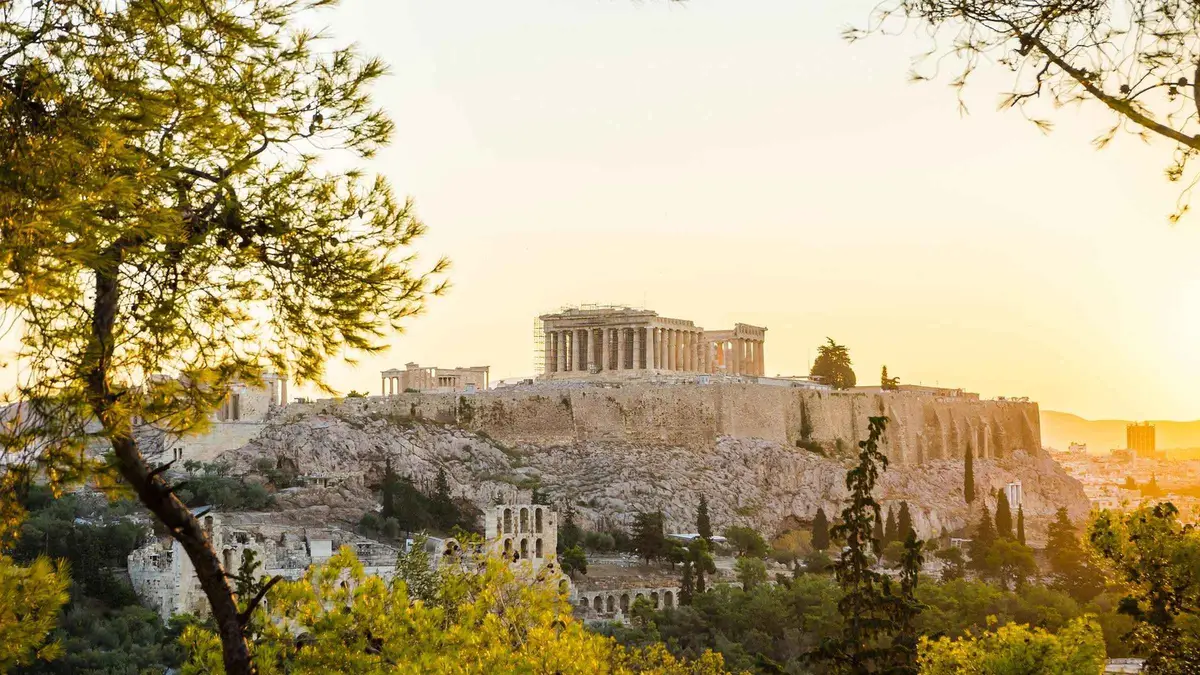
Athens: Philosophy and Democracy Walking Tour
Three and a half hours on foot through the places where philosophy and democracy actually happened, rather than the places they are commemorated.
Check Availability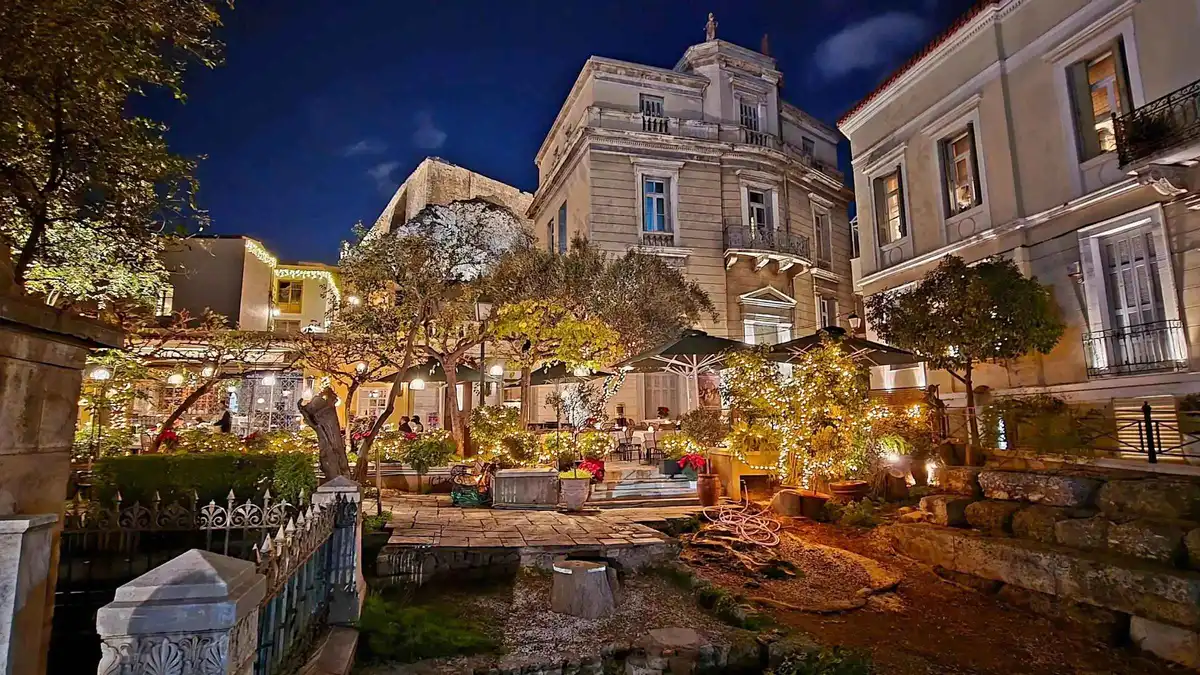 from €18
Athens: Night Walking Tour with Local Guide
Two hours after dark through the historic centre, the Cathedral, Anafiotika, Monastiraki and Plaka, with a local guide and no museum entries.
Check Availability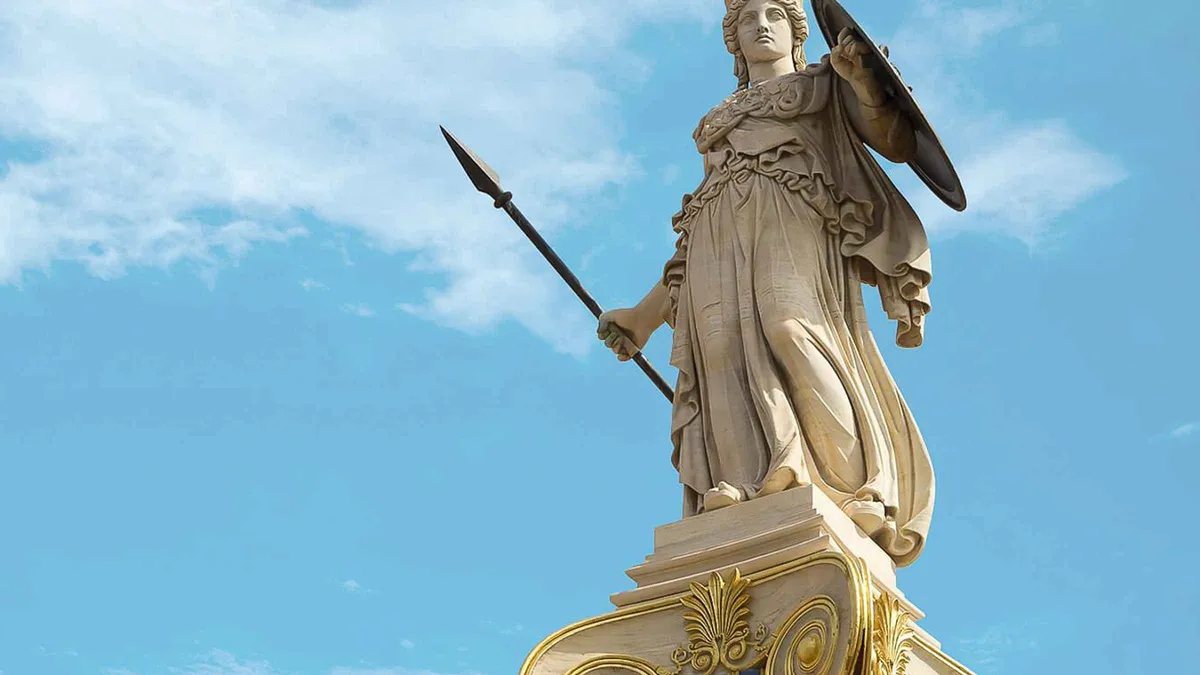 from €45
Athens: Acropolis and Mythology Highlights Small Group Tour
The rock plus the Temple of Olympian Zeus and the Ancient Agora, told through the myths attached to each: a comprehensive first day on foot.
Check AvailabilityPrices, ratings and details are the platform's own. Euro figures are the listed prices. The platform bills in your account's currency.
The times, and which version to see
Two quite different things share the name.
The hourly change
The Presidency's own page is unambiguous: the Evzones guard the Tomb of the Unknown Soldier around the clock and in any weather, and the pairs change every hour, on the hour. So there is no schedule to plan around — walk past Syntagma at any o'clock and you will see it. It takes about ten minutes, involves four men and no music, and the slow high-stepping march is the same as in the big version.
The Sunday ceremony at 11:00
Every Sunday at 11:00 a large contingent of Evzones, accompanied by a military band, marches from the Presidential Guard camp to the Tomb, and the official changing ceremony takes place there. This is the one with the crowd, the flags and the drums, and it runs about three-quarters of an hour from the first sound of the band. It is not cancelled for weather.
The unit is a volunteer body from the infantry that has guarded the Tomb since 1929, when the monument was begun and a company of Evzones took over the duty. Rain, heat or cold make no difference to the march, so dress for the season rather than for the forecast. Arrive early, because the Sunday version draws the biggest gathering of the week and latecomers end up well back from the steps.
And the one nobody watches
The same unit raises and lowers the flag on the Acropolis on Sundays and official holidays. It is a small detail of men walking up the rock in uniform, it is on the Presidency's list of the guard's duties, and if you have an early Sunday ticket for the Acropolis you may see it. Most visitors never do, because they arrive after midday or pick a weekday.
The unit has held ceremonial duties across the city since long before the current name, and guarding the national flag on the sacred rock sits alongside the Tomb in its list of posts. There is no crowd barrier and no band for this one, so you simply meet it on your way round. An early slot also helps in summer, before the midday closures announced during heatwaves.
Where to stand
Two positions, and one mistake.
For the hourly change: the low chain, front left
The Tomb faces the square from the terrace below Parliament, up a broad flight of steps. Stand at the chain on the left as you look up: the relieving pair comes in from that side, so you see the approach march as well as the change itself. At most hours of the day there will be a dozen people there and you can walk straight to the front.
The change happens on the hour and takes only a few minutes, so arrive five or ten early to settle your spot. The Evzones march in slow, deliberate movements whose stamp comes from the nailed clogs, and much of the interest is in the synchronised routine rather than the swap itself. Keep behind the chain and you will not be moved on.
For the Sunday ceremony: Amalias side, by 10:40
The contingent marches in along Vasilissis Sofias from the camp behind Parliament. For the march itself, stand on the pavement along that avenue. For the ceremony at the Tomb, be at the chain by twenty to eleven, because after about ten to the front two rows are gone and you will be photographing over heads.
The Sunday event runs roughly three-quarters of an hour from the first sound of the band, so decide early whether you want the parade or the formal change, since you cannot easily have both. The route down Vasilissis Sofias is the better pick for families with children, who can see over the kerb without pushing. Bring water in summer, as the ceremony goes ahead regardless of temperature.
The mistake
Standing directly behind the guards for a photograph and then reaching past the chain. There is a soldier on duty in ordinary uniform whose job is to keep the space clear, and he will move you. Photographs are entirely welcome, and the Evzones do not react, because not reacting is the whole discipline of the post.
The relief pair comes past the chain on the left of the terrace, so that is where the movement is, and the sentries at the two boxes stay fixed while the change runs. Do not step over the low chain for a closer shot, do not touch the uniforms, and keep bags off the terrace edge. The soldiers in the fustanella will hold their position through noise, flashes and silly poses.
The supervising soldier, not the ceremonial pair, handles anyone who crosses the line.
What the uniform means
Every element is a reference, and the Presidency publishes what each one refers to.
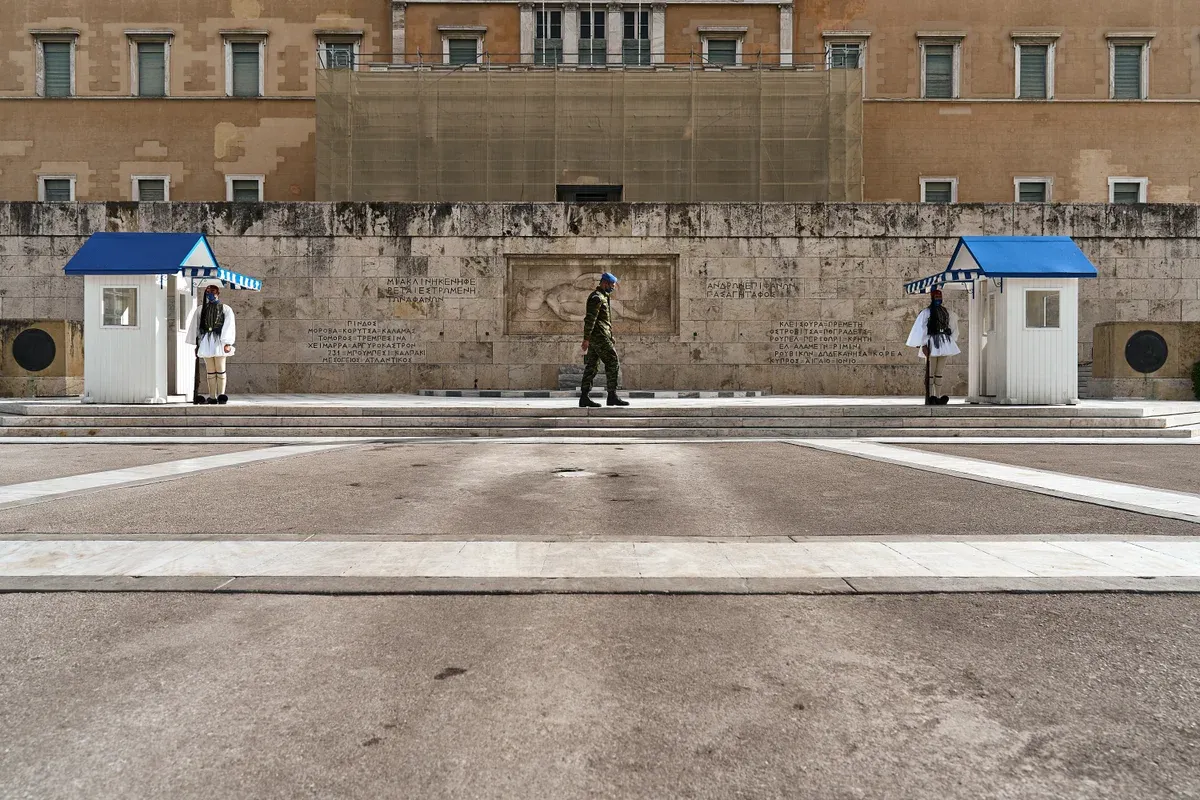
Photo: George E. Koronaios, CC BY-SA 4.0, via Wikimedia Commons
The fustanella and its 400 pleats
The white kilt is made from about thirty metres of cloth and carries 400 pleats, one for each year of Ottoman rule. It is white, like the shirt, for the purity of the independence struggle. The whole uniform is handmade, and the officers' version differs slightly from the privates'.
The pleats are the detail people remember once they hear the number, because the cloth is folded by hand and the count is deliberate rather than decorative. The fustanella was the field dress of Greek mountain fighters in the war of independence, which is why the ceremonial unit kept it after taking over guard duty in 1929. It comes out for Sundays and formal occasions.
On ordinary days you will see the plainer daily uniform instead, so do not assume a kilt-less guard means a cancelled ceremony.
The tsarouchi
The red leather clog with the black pompom weighs about three kilograms a pair and carries 120 nails in the sole, which is what makes the stamp audible across the square. Tradition has it that the large tassel concealed a blade for close combat. Each guard stamps the sole in the slow ceremonial rhythm, and the nailed heel is the reason you hear the change from the far side of Syntagma rather than only at the chain.
The weight matters for the wearer, since a full change involves marching in step with three kilos on each foot under a wool kilt in summer heat. The clogs are handmade like the rest of the kit. Watch the feet as well as the faces, because the precise, deliberate footwork is most of the show and photographs miss the sound entirely.
The rest of it
The red pharion cap carries the national emblem and stands for the blood of the liberation struggles. Its black silk tassel is mourning. The fermeli, the hand-embroidered waistcoat, is the hardest piece to make.
The blue and white fringes are the flag. The belt gives the unit its name, euzonos, well-girdled. Every element carries a meaning fixed in the unit's tradition, so the uniform reads as a page of history rather than stage costume.
The embroidery on the fermeli is the slowest work in the whole outfit, done by hand, which is why officers and privates wear versions that differ. If you watch the Sunday ceremony with the band, the full dress with all these pieces is on show. The colours also explain the photographs: white kilt, red cap, dark waistcoat, flag fringes.
The other uniforms
The fustanella is not worn every day. In winter the Evzones wear the navy-blue doulamas of the Macedonian struggle, and in summer the khaki doulamas of the Balkan Wars. If you see guards in plain dark or khaki overcoats rather than kilts, that is the daily uniform and not a lesser event.
The fustanella comes out for Sundays and ceremonies. The two doulamas are battle dress tied to particular campaigns, so the wardrobe itself is a short history of modern Greece. The changeover follows the season rather than the calendar of events, so a weekday visit in a cold month will show the blue version.
The hourly routine is identical whichever kit is worn, including the nailed clogs and the slow stamp. If the uniform matters to you, plan for a Sunday at 11:00.
Who they are
Volunteers from the Hellenic Army's infantry, in a unit that traces itself to 1868 and has guarded the Tomb since 1929. Its name has changed with every change of regime. Palace Guard, Royal Guard, Flag Guard, and since 1974 the Presidential Guard, with a purely ceremonial role.
The soldiers are volunteers, selected from the infantry, and the unit's duties have outlasted the monarchy, the dictatorships and the republics it served under different titles. Guarding the Tomb of the Unknown Soldier became its defining task when the monument was laid out in 1929. Since 1974 the role has been entirely ceremonial, with no operational function, so the men you see are serving soldiers on a formal posting rather than a police detail.
Every hour, all night and in all weather, the post is held. Because the Presidential Guard's ceremony is only one small piece of what Syntagma and the streets around it hold, Athens guided tours are the natural way to keep going from the Tomb of the Unknown Soldier into the rest of the square and the city beyond.
Syntagma map: the Tomb and what is around it
Where to stand, and what is within ten minutes on foot.
Next stop from Syntagma
Walk minutes are our estimates from the GPS distances.
National Garden
Straight behind Parliament, free and shaded. The National Garden is the way south in August.
3 min walkPanathenaic Stadium
Through the garden and past the Zappeion. €12 at the desk — the stadium has the rules.
12 min walkPlaka
West and downhill into the old lanes. Plaka is the postcard, and the priciest dinner in the city.
8 min walkChanging of the guard questions
What time is the changing of the guard in Athens?
Every hour, on the hour, all day and all night. The full ceremony with a military band is on Sunday at 11:00. Both are at the Tomb of the Unknown Soldier on Syntagma Square, and both are free. The times has the detail.
Where is the best place to watch it?
At the low chain in front of the Tomb, on the left as you look up at Parliament, because that is the side the relieving pair comes in from. For the Sunday ceremony, be there by 10:40 or stand along Vasilissis Sofias to watch the march in. Where to stand has both.
Why do the Greek guards have pompoms on their shoes?
The tsarouchi is traditional mountain footwear, and the Presidency's own account says the large black tassel was used to conceal a blade for close combat. Each pair weighs about three kilos and carries 120 nails, which is what you hear when they stamp.
How long does it last?
The hourly change takes about ten minutes. The Sunday ceremony runs about three-quarters of an hour from the first sound of the band as the contingent marches in.
Is it cancelled in bad weather?
No. The Presidency's page states that the Evzones guard the Tomb around the clock and under any weather conditions. In winter and summer they wear the doulamas overcoat rather than the fustanella for daily duty.
Can I take photographs with the guards?
Photographs, yes, and they are used to it — not reacting is the discipline of the post. Do not cross the chain or touch anything; there is an ordinary-uniformed soldier on duty whose job is to keep the space clear.
Changing of the Guard on Video
Three filmed visits that show the distances, the surfaces and the pace — the things a written page cannot carry. Every id was checked against YouTube on 2 September 2026.
Changing of Guards, Athens (2017)
The ceremony filmed straight through, without commentary.
Video: István MágaBest Thing to Do in Athens Greece | Changing of the Guard Ceremony | Living4theJourney
The ceremony with an explanation of what the movements are for.
Video: Living4theJourneyChanging of the Guard Athens| Complete Guide.Athens Greece:🏛️ | Syntagma Square Tour.
Where to stand and when to arrive, for the hourly change rather than the Sunday one.
Video: Innovation by JohannaPrices, hours and terms are set by the venue or operator and confirmed at checkout.
We may earn a commission if you book through one of our links, at no extra cost to you. Full affiliate disclosure