 Visit Athens Guide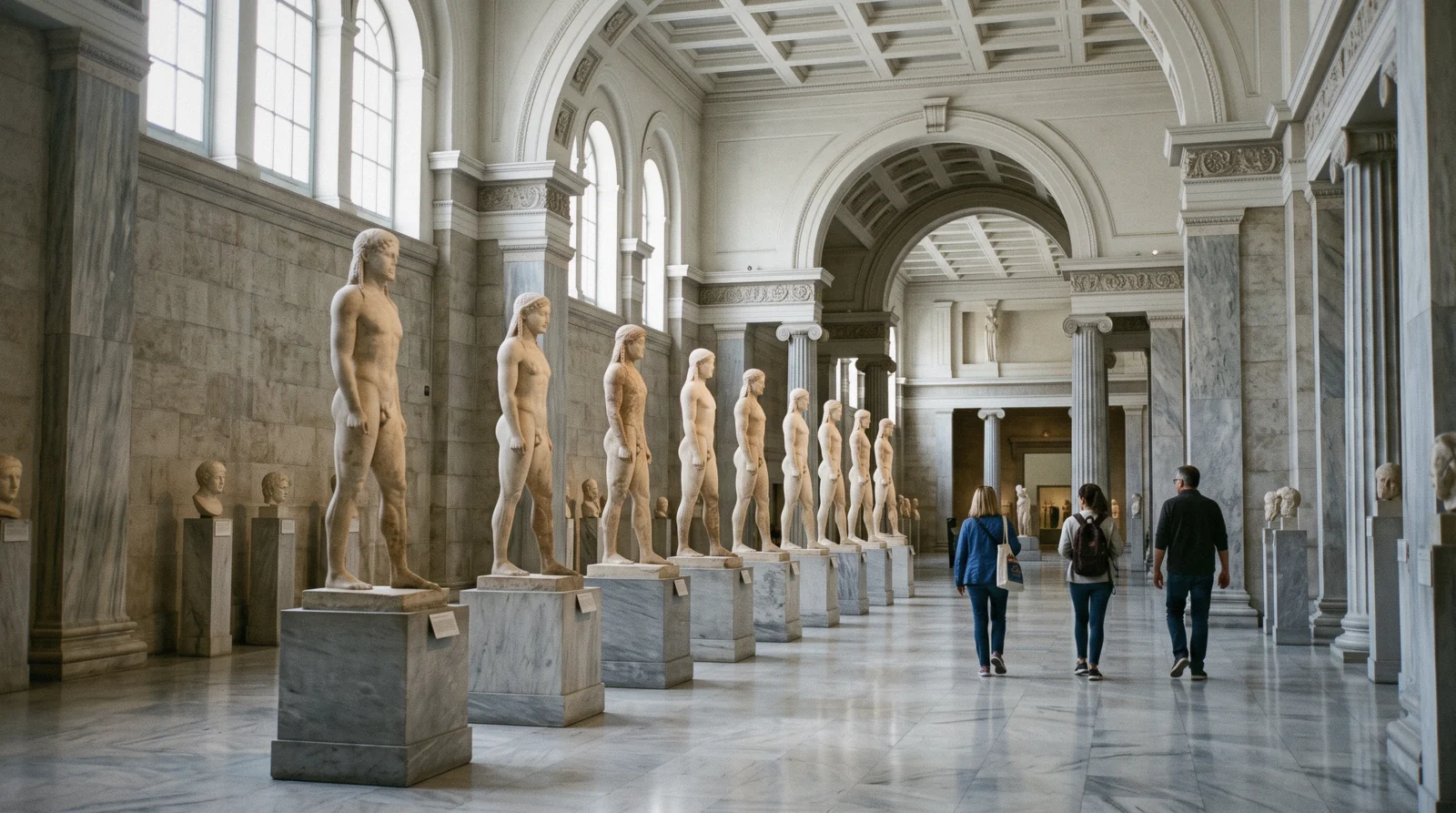
The National Archaeological Museum
The National Archaeological Museum Athens keeps at Patission 44 is the largest in Greece, and it holds the objects most people picture when they think of the ancient world: the gold of Mycenae, the Antikythera mechanism, the wall paintings lifted from under the ash at Akrotiri, eleven thousand things spanning 7000 BC to AD 500. It is twenty minutes north of the ancient centre, and it opens at 13:00 on Tuesdays. This page has the hours and the highlights as checked in Q3 2026; the wider plan of things to do in Athens is on the city guide.
Quick answer How long it takes, and the day that opens at one
The National Archaeological Museum costs €20 full and €10 reduced, needs no timed slot and takes about two hours for the highlights. It opens at 13:00 on Tuesdays, every week of the year.
Key takeaways
- Do not plan a Tuesday morning here. The hours has the full week; the Acropolis or an Agora fits that morning instead.
- Five things carry the visit: what to see routes them in the order the galleries run.
- It is a different museum from the Acropolis Museum in almost every way — national rather than local, older building, far bigger collection, twenty minutes further out.
- In summer it runs to 20:00 six days a week, so it is a good late-afternoon escape from the heat when the sites have closed.
- It is free on the state free-entry days, including two Sundays a month in winter — the free-entry page has the calendar.
Key facts
Opening hours
| 1 May – 31 Oct, Mon and Wed–Sun | 08:00–20:00 |
|---|---|
| 1 May – 31 Oct, Tuesday | 13:00–20:00 |
| 1–30 Apr and 1 Nov – 31 Mar, Mon and Wed–Sun | 08:30–15:30 |
| 1–30 Apr and 1 Nov – 31 Mar, Tuesday | 13:00–20:00 |
| Last admission | —–30 minutes before closing |
Closed 1 January, 25 March, 1 May, Orthodox Easter Sunday, 25 and 26 December
Admission
- Adult
- €20
- Reduced
- €10
- Free
- 6 March, 18 April, 18 May, the last weekend of September, 28 October, and the first and third Sunday from 1 November to 31 March
Planning it
- Time needed
- Not stated by the museum; our routing: 2 hours for the highlights, half a day for the whole thing
- Book ahead
- Recommended — a few days
- Address
- 28is Oktovriou (Patission) 44, 106 82 Athens
The ways in, priced from hh.gr and GetYourGuide on 1 September 2026. The museum is state-run, so it uses the same platform and the same free-entry calendar as the archaeological sites.
Nothing here needs booking, so the question is whether the museum comes inside a bundle you are buying anyway — and whether you are arriving on a Tuesday, when it opens at 13:00.
| Option | Price | Includes | Cancel | Book |
|---|---|---|---|---|
| Official ticketEveryone; walk-up entry, and the collection that makes Athens a museum city | €20 full / €10 reduced | The whole museum | Per the platform's terms | Official site |
| Acropolis plus up to five sitesAnyone buying the Acropolis with several sites attached | Listed at €36 | This museum listed among the options | Per listing | Check Availability |
| Acropolis e-ticket with add-onsFor adding this museum to an Acropolis ticket in the same basket | Listed at €36 | This museum offered as an add-on | Free cancellation per listing | Check Availability |
| Mythology highlights walkFor the ancient centre on foot, which does not come here | From €45 | The rock and the ancient centre; not this museum | Per listing | Check Availability |
At €20 for a collection you could spend a day in, this is the best value of any ticket in Athens per hour inside. It is also the one big museum the reseller bundles treat as an afterthought, because it is twenty minutes from everything else they sell.
Ways in to the National Archaeological Museum
The cards behind the table, with the operator's own rating and review count.
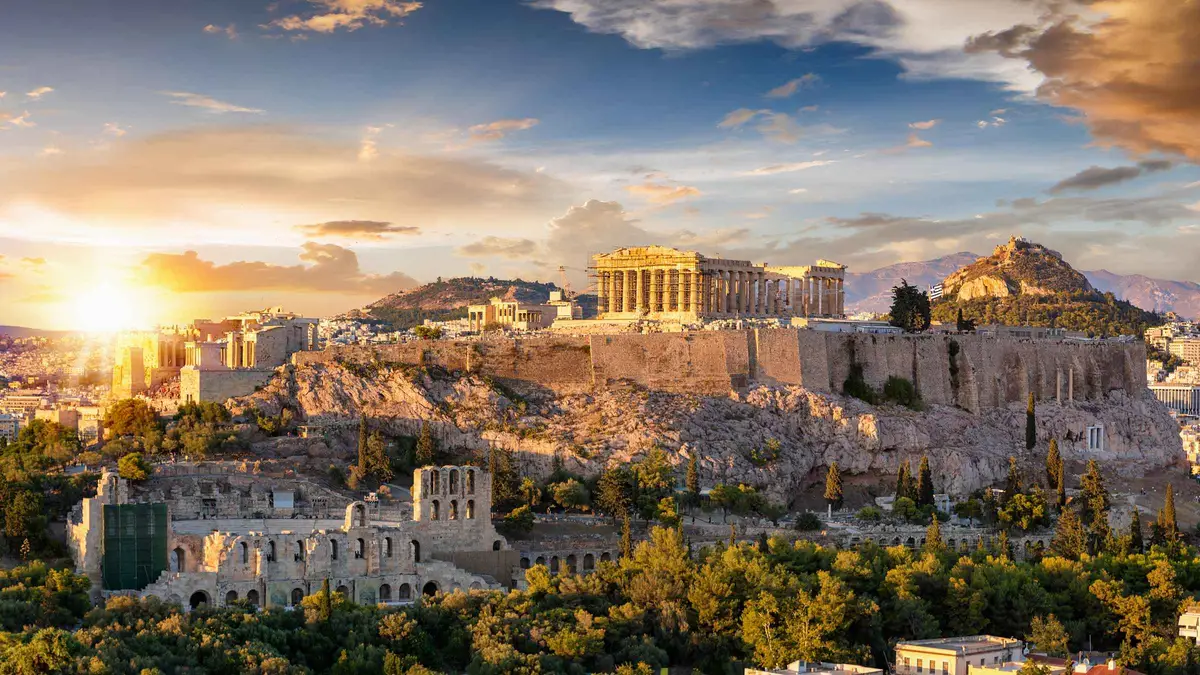 from €36
Athens: Acropolis Ticket & Heritage Sites + Acropolis Audio
The bundle the official shop does not sell: the Acropolis slot plus entry to up to five more archaeological sites, including both Agoras and the Temple of Olympian Zeus.
Check Availability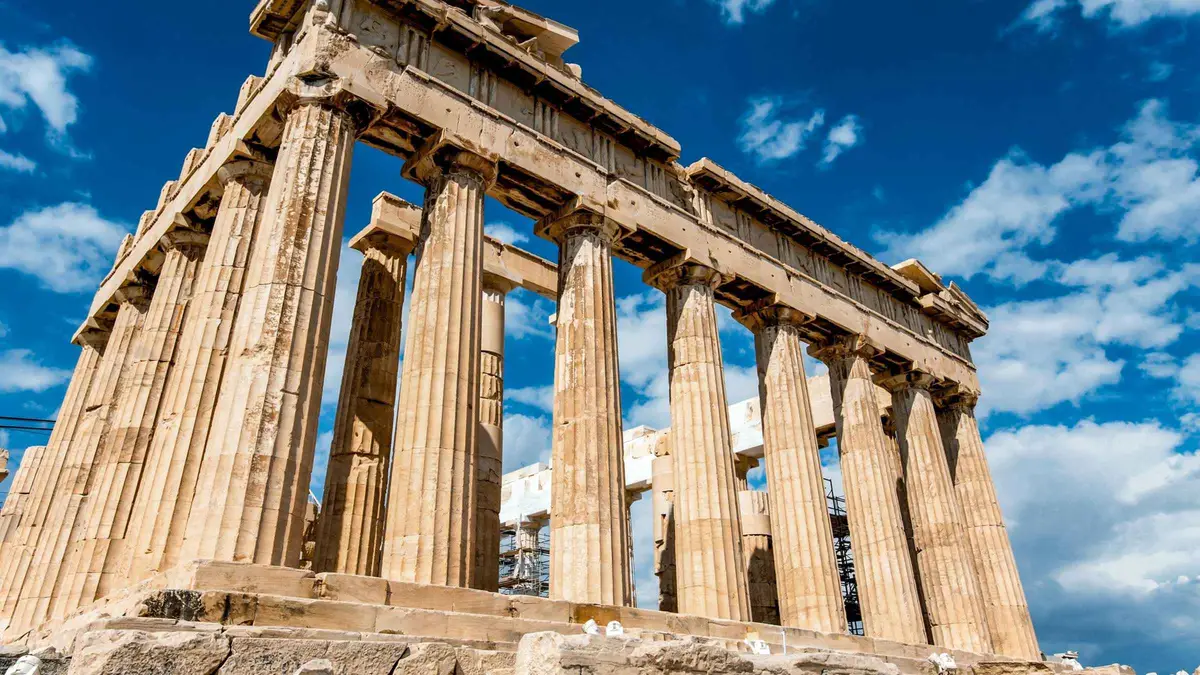 from €36
Athens: Acropolis Ticket & Audio Guide + Free Cancellation
Acropolis e-ticket with free cancellation and optional add-ons for the Acropolis Museum, the two Agoras, Kerameikos, the Temple of Zeus or the National Archaeological Museum.
Check Availability from €45
Athens: Acropolis and Mythology Highlights Small Group Tour
The rock plus the Temple of Olympian Zeus and the Ancient Agora, told through the myths attached to each: a comprehensive first day on foot.
Check AvailabilityPrices, ratings and details are the platform's own. Euro figures are the listed prices. The platform bills in your account's currency.
What to see, in gallery order
The museum is arranged by period and material rather than by fame, so the famous things are scattered. These five are worth walking to directly.
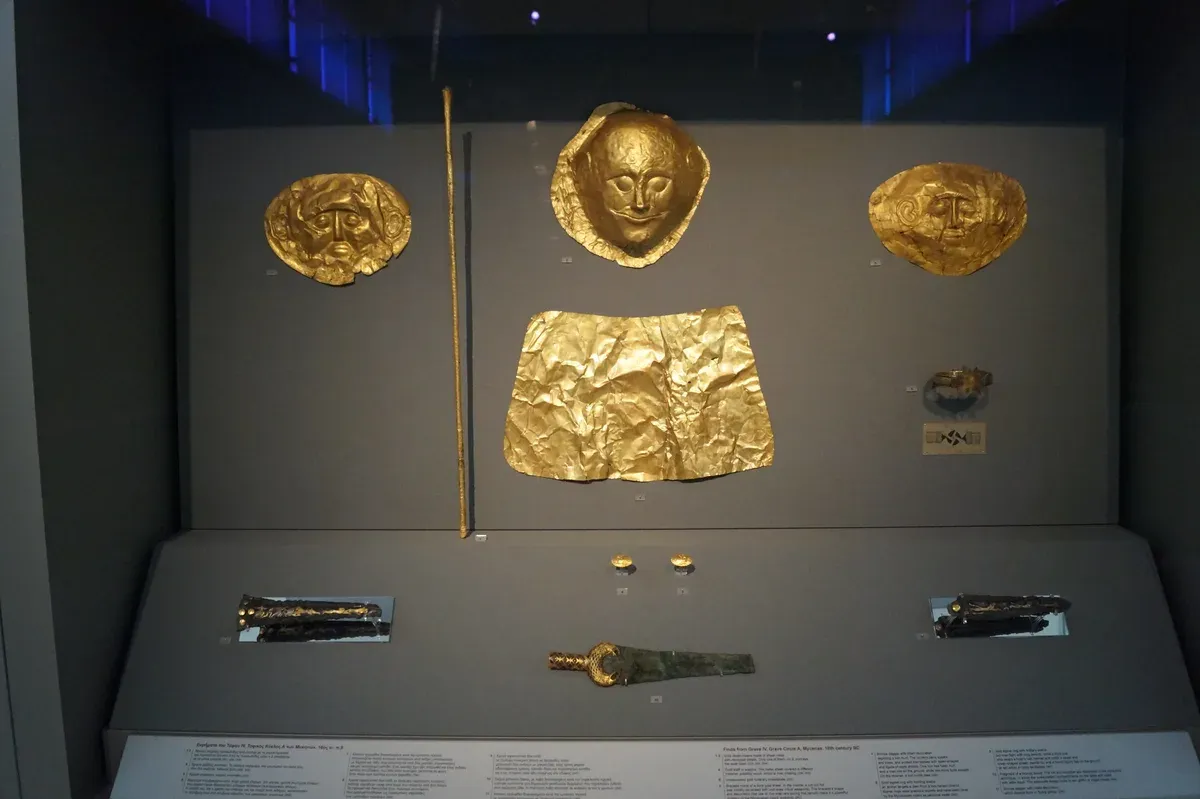
Photo: Schuppi, CC BY-SA 3.0, via Wikimedia Commons
The Mycenaean gold
Straight ahead from the entrance sit the treasures Heinrich Schliemann dug out of the shaft graves of Grave Circle A at Mycenae in 1876. He found five gold masks, and the one he named the Mask of Agamemnon came from Grave V. It was hammered from gold leaf over a wooden form and dates to about 1525 BC, three or four centuries before any plausible Trojan War, so the name is a showman's label rather than an identification. The room also holds inlaid daggers and rock-crystal, and it is the most concentrated display of Bronze Age wealth anywhere.
Come early in the day, because groups gather here quickly and the case fills. The museum opens at 13:00 on Tuesdays all year, so plan any Tuesday visit around that.
The Antikythera mechanism
Corroded bronze fragments in a case, recovered in 1901 from a Roman-era shipwreck off Antikythera. Study of the gears showed it was an analogue computer for predicting the positions of the sun and moon and the dates of eclipses and games. Nothing of comparable mechanical complexity survives from anywhere for another thousand years, which is why researchers keep returning to it.
The case labels explain the gearing, so read them before deciding what you are looking at, because the object itself looks like lumps of stone until you understand it. The same wreck produced the Antikythera Youth, a bronze that stands nearby, and the two together make this gallery worth a slow half hour. The entrance is included in the €20 full ticket.
The Thera wall paintings
Upstairs hang the frescoes lifted from Akrotiri on Santorini, buried under volcanic ash in the sixteenth century BC and preserved by it. Look for the boxing boys, the antelopes and the fleet fresco, each lifted from a house wall and remounted here. These are the only substantial body of Aegean Bronze Age painting that survives anywhere, which makes the gallery a singular record rather than a selection.
They were painted before the Mycenaean gold downstairs, so visiting them after the ground floor puts the collection in date order. The rooms sit on the upper floor, reached by the main stair, and benches make it a sensible place to rest mid-visit. Photographs are permitted without flash, though the light on some cases makes reflections hard to avoid.
For travelers tracing these frescoes back to the island that preserved them, the museum pairs naturally with a day spent on tours in Athens that set the collection in its wider setting.
The bronzes
The Artemision Bronze is a two-metre god poised to throw, raised from the sea off Cape Artemision. Nobody agrees whether it is Zeus with a thunderbolt or Poseidon with a trident, because whatever he held is missing, and scholars still argue both cases. In the same gallery stands the Horse and Jockey of Artemision, from the same wreck, a small boy riding flat out.
It is one of very few surviving ancient bronzes with real movement in it, since most ancient bronze was melted down long ago for its metal. Give the horse a full circuit, because the straining legs read differently from each side. Both pieces are on the museum's short list, so expect company around the cases even in quieter months.
The kouroi and the grave stelae
The long halls of Archaic kouroi hold rigid, smiling, life-size young men, and set side by side they let you watch Greek sculpture learn to move across a century and a half. The poses barely change, the anatomy does, and the sequence rewards standing at one end and walking the line. Beyond them hang the classical grave reliefs, many brought from Kerameikos, the potters' quarter that served as the city's main cemetery.
The handshake between the dead and a living relative does more with less than almost anything in the building. If the reliefs draw you in, the Kerameikos site itself costs €10 full or €5 reduced, though its official page has printed temporarily closed under summer hours, so check before going.
Hours, the Tuesday, and getting there
Read on the official page on 1 September 2026. This is the one state museum with a per-weekday timetable.
The week
From 1 May to 31 October the museum runs Monday and Wednesday to Sunday 08:00 to 20:00, and on Tuesday from 13:00 to 20:00. In April, and from 1 November to 31 March, it runs Monday and Wednesday to Sunday 08:30 to 15:30, while Tuesday stays 13:00 to 20:00 all year. Last admission is thirty minutes before closing.
The Tuesday late opening is the useful quirk. Morning crowds peak in summer, so a Tuesday afternoon works well, and in winter the short 15:30 close means you should arrive by early afternoon. Two hours covers the five highlights above without hurrying, and a full visit runs to half a day.
Decide before you enter which galleries you are skipping, because the building is large.
Why the Tuesday matters
It is the same in both seasons and it catches people every week: the museum is shut until one in the afternoon while every archaeological site in the city has been open since eight. It is also the one day in winter when the museum is open in the evening, so a Tuesday is a good museum afternoon and a wasted museum morning. The opening-hours page lines this up against everything else.
Getting there
The museum stands on 28is Oktovriou, also called Patission, at number 44. Victoria station on Line 1 is about seven minutes away on foot, and Omonia on Lines 1 and 2 about ten. From Monastiraki it is roughly a twenty-five minute walk.
A single metro ticket costs €1.20 for 90 minutes, so you can ride in and walk back. The neighbourhood is workaday rather than picturesque, which is part of why the museum is quieter than its collection deserves. Keep to the main streets around Patission and you will have no trouble.
Buses along Patission also stop nearby, though the metro is the simplest option. Entry costs €20 full or €10 reduced.
Inside
There is a shop, a café that hosts changing displays of contemporary art, and a garden courtyard, so a mid-visit break needs no exit and re-entry. Two hours covers the five highlights without hurrying. A full visit is half a day, and the building is large enough that it is worth deciding in advance which halves you are skipping.
The ground floor carries the Mycenaean gold and the bronzes, the upper floor the Thera frescoes, which gives you a natural split if time runs short. Tickets cost €20 full and €10 reduced. Unlike the Acropolis Museum, this is a state museum, so a public-sector strike can close it, and free-entry days draw the largest crowds of all.
The café is the sensible place to regroup.
National Archaeological Museum map
The entrance, the nearest stations, and what is within a short walk.
Next stop from the National Archaeological Museum
Walk minutes are our estimates from the GPS distances.
Exarchia
The student and political quarter, and where to eat cheaply near the museum. Exarchia is described badly by most guidebooks.
6 min walkAcropolis Museum
The other big museum, and a completely different one. The Acropolis Museum is €20 and open to 22:00 on Fridays.
25 min walk or metroLycabettus Hill
East and uphill for the wide city view. Lycabettus has a funicular if the climb is not appealing.
25 min walkNational Archaeological Museum questions
Is the National Archaeological Museum worth it?
For anyone with more than two days, yes — it holds the Mycenaean gold, the Antikythera mechanism and the Thera frescoes, none of which is anywhere else. What to see routes the five things that carry a visit.
How much time do you need there?
Two hours for the highlights, half a day for a full visit. The collection runs to about eleven thousand exhibits, so deciding what to skip is part of the plan.
How does this differ from the museum below the rock?
This is the national collection from all over Greece, from 7000 BC to AD 500, in a nineteenth-century building twenty minutes north of the centre. The Acropolis Museum is a single-site museum holding what was found on and around the rock, in a modern building ten minutes below it. Different tickets, different organisations, different free days.
Is there free entry?
Yes, on the state free-entry days: five fixed dates and the first and third Sunday of each month from November to March. The free-entry page has the list and which dates are worth it.
What time does it open on Tuesday?
13:00, all year, in both the summer and winter timetables — and it then stays open until 20:00. Put a site in that morning instead; the hours section has the week.
Where is the Mask of Agamemnon?
In the Mycenaean gallery, straight ahead from the entrance, with the rest of the shaft grave material Schliemann excavated in 1876. The name is his; the mask is about three centuries earlier than any Trojan War date.
National Museum on Video
Two filmed visits that show the distances, the surfaces and the pace — the things a written page cannot carry. Every id was checked against YouTube on 2 September 2026.
What to see at the National Archaeological Museum of Athens | NAMA | Athens Greece
A room-by-room guide to what matters in a museum too big to see whole.
Video: History VictorumAthens Archaeological Museum Guide: A MUST Visit in Greece 🇬🇷🏛️
A shorter visitor's view of the same museum, with the practical timing.
Video: Life Out of the BoxPrices, hours and terms are set by the venue or operator and confirmed at checkout.
We may earn a commission if you book through one of our links, at no extra cost to you. Full affiliate disclosure