 Visit Athens Guide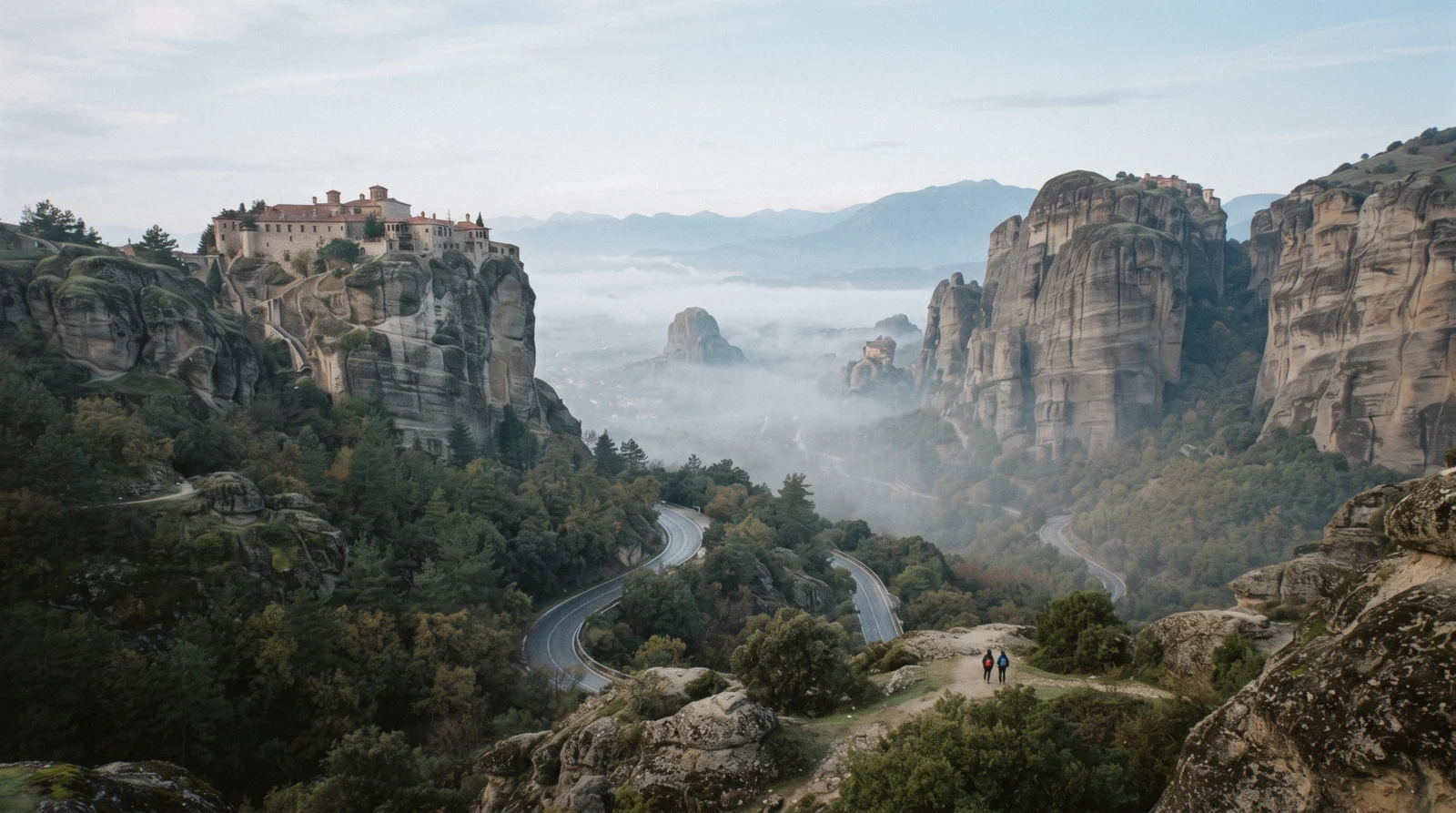
Meteora from Athens: Fourteen Hours, and How to Spend Them
Meteora from Athens is the longest day trip anyone sensibly takes: about fourteen hours, with the monasteries perched on sandstone pillars three hundred metres above the plain at the end of it. Whether it is worth that depends almost entirely on how you cover the distance — ten hours in a coach and five in a train seat are not the same day. Checked in Q3 2026. The alternatives are on the day trips hub, and for a broader overview see things to do in athens.
Quick answer Coach or train, and how many monasteries you actually see
Meteora as a day trip from Athens is about fourteen hours. By coach that is roughly ten hours of driving; by train it is around five hours each way in a seat with a window. Either way you will visit two monasteries, not six.
Key takeaways
- Coach against train is the only decision that matters on this trip, and we would take the train.
- Each monastery closes on a different day of the week, and the days shift between summer and winter — the closing days explains why that is a problem for independent visitors.
- Two monasteries is what a day allows. Any itinerary promising more is counting car parks.
- There is a dress code and it is enforced: what to wear has it.
- If you have one day out of Athens and want the more important site, Delphi is four hours shorter.
- Only one free day? Delphi or Meteora argues for the shorter trip, and for giving this one an overnight.
Key facts
Opening hours
| Monasteries, roughly, summer | 09:00–17:00 |
|---|---|
| Monasteries, roughly, winter | 09:00–15:00 |
| Each closes one day a week | varies–by monastery |
Closed Every monastery has its own weekly closing day, and the days change between summer and winter
Admission
- Adult
- A small entry charged at each monastery door
- Reduced
- Varies by monastery
- Free
- Not published centrally
Planning it
- Time needed
- Not stated; our routing: 3–4 hours on site, 14 hours door to door from Athens
- Book ahead
- Essential — weeks ahead
- Address
- Kalambaka and Kastraki, 422 00 Trikala
Coach against train
The two ways to cover the distance, as listed on 1 September 2026. The entries at each monastery are small and paid at the door in both cases.
Both versions are fourteen hours, so the question is what you want to be doing for ten of them — sitting in a coach seat, or sitting on a train.
| Way | Price | Travel time | What the day is like | Book |
|---|---|---|---|---|
| Coach day trip, 09:00 departureAnyone who wants the earliest start and the coastal stops on the way | From €84 | About 5 h each way by road | Long, and the driving is the day | Check Availability |
| Rail day tripAnyone who would rather read for five hours than watch a motorway | From €105 | About 5 h each way by train | A seat, a window and a table; the civilised version | Check Availability |
| Monastery entriesEveryone; each house charges at its own door and no figure is published centrally | Small, at each door | — | Paid on arrival at each monastery | Official site |
| Delphi insteadAnyone whose only free day is a first or second one — Meteora belongs to a spare day | From €39 | 3 h each way | Ten hours rather than fourteen | Check Availability |
The price gap between coach and train is about €20, and it buys you five hours of sitting in a seat you can leave rather than five hours in a coach on a motorway. On a fourteen-hour day that is the best €20 in this guide. The last row is there because for many people the right answer to "should I do Meteora?" is "do Delphi".
The Meteora day trips
The cards behind the table, with the operator's own rating and review count.
 from €105
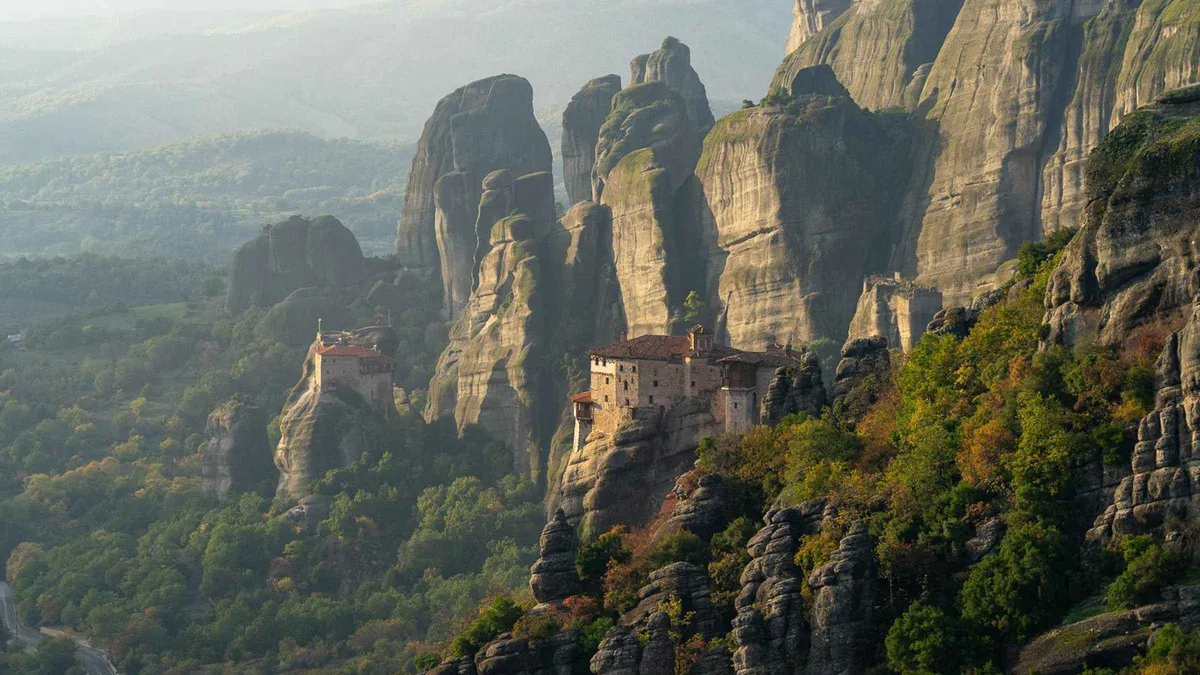
From Athens: Meteora Caves & Monasteries Day Trip by Train
The civilised version of the same day: train through the countryside instead of a coach, then the monasteries and caves.
Check Availability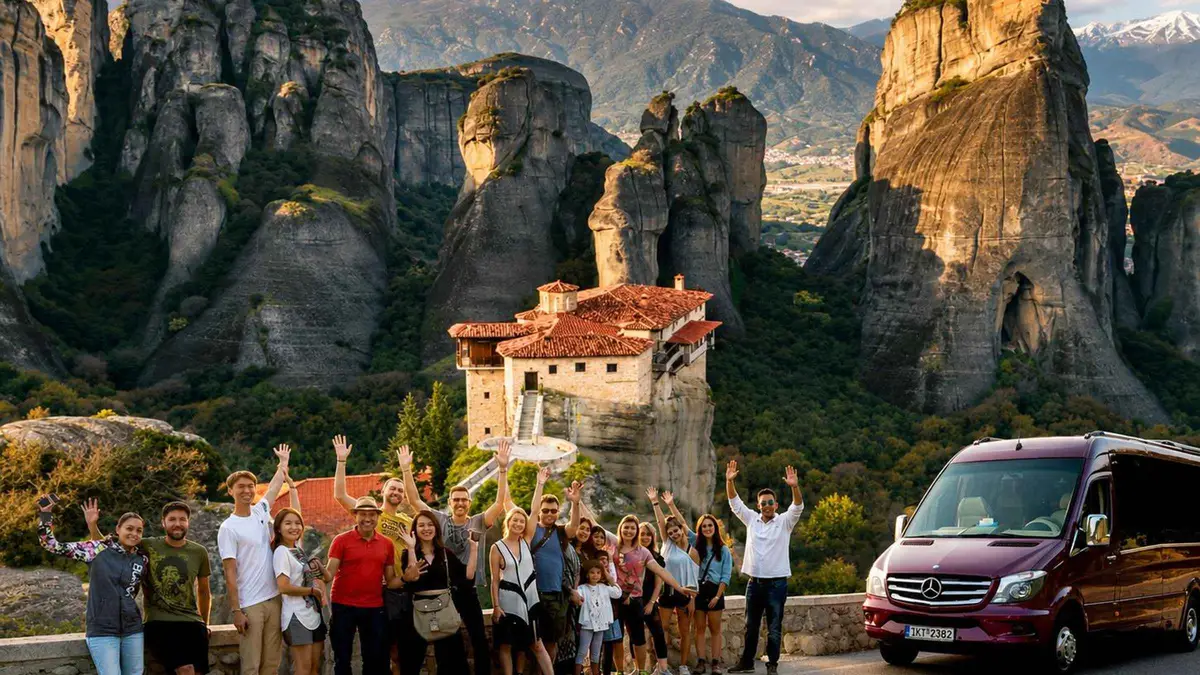 from €84
Meteora Monasteries DayTrip at 9ΑΜ, Sea Stops, Caves & Lunch
Fourteen hours by coach with a 09:00 departure, monastery visits, the hermit caves and a lunch stop, plus stops on the coast.
Check AvailabilityPrices, ratings and details are the platform's own. Euro figures are the listed prices. The platform bills in your account's currency.
What Meteora is
Geology first, then monks.
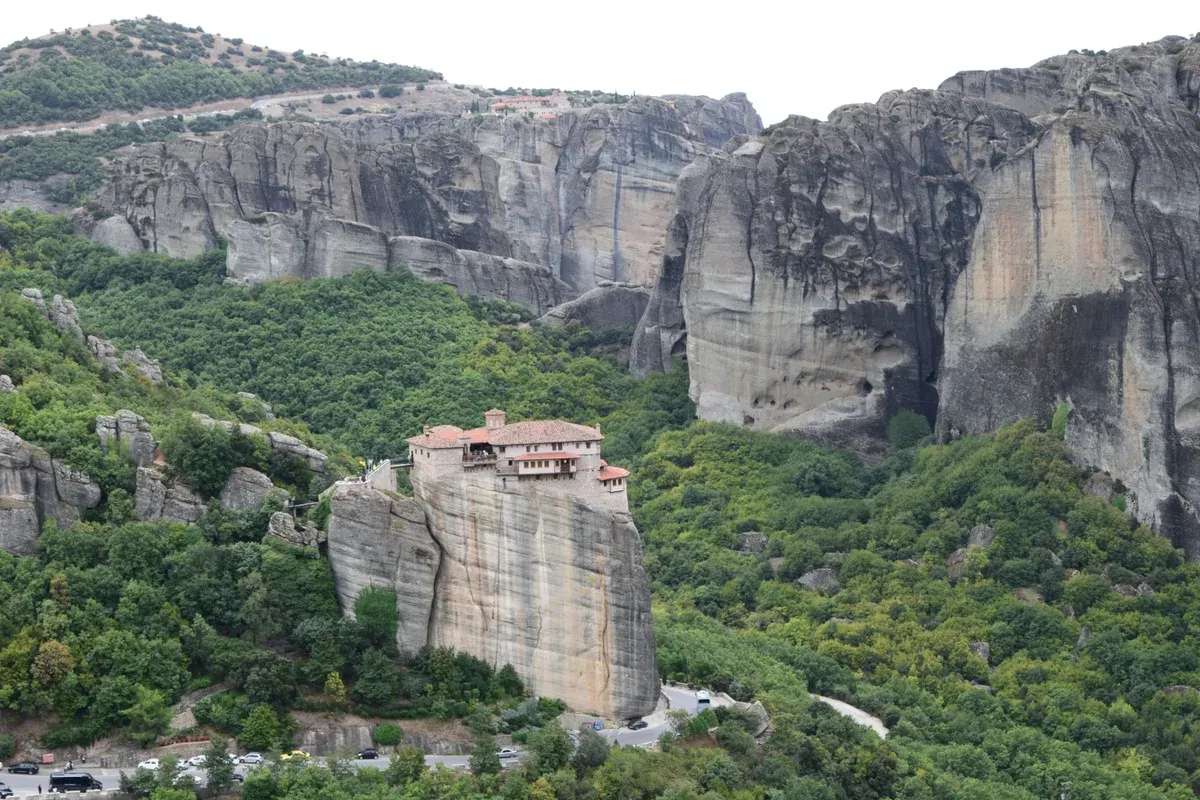
Photo: Patryk Morawiec, CC BY-SA 4.0, via Wikimedia Commons
The rocks
The pillars are sandstone and conglomerate, weathered out of an ancient river delta and standing up to about three hundred metres above the Thessalian plain. Nothing else in Europe looks like this. The tops were unreachable, and that is the whole point of the monasteries.
Monastic building began in the 14th century, when Saint Athanasios founded the Monastery of the Transfiguration on the highest rock. Monks went up by rope ladders and in nets on hooks, which explains why anyone would choose a summit as a building plot. Height was the defence and the discipline.
Of about thirty monasteries raised on the pillars over the centuries, six are still active. UNESCO put Meteora on the World Heritage list in 1988. The rocks come first.
The buildings are a consequence of them. Seeing the pillars in a single day means a very early start, and the guided tours from Athens handle the long drive so you can save your energy for the climb among the monasteries.
The monasteries
Hermits were living in the caves by the eleventh century and building on the summits from the fourteenth. Twenty-four were founded; six are still in use. Access was originally by removable ladders and by net — visitors were hauled up in a rope basket, and the rope, according to the standing joke, was replaced when the Lord let it break.
Steps were cut in the 1920s, which is why you can walk up now.
Which six are open
Six of the roughly thirty monasteries built on the pillars are active today. Great Meteoron is the largest and the highest, and the oldest of the working communities, tracing back to the 14th century. Varlaam sits next to it and is usually paired with it in a single visit.
Roussanou is low on its pillar and photogenic. St Nicholas Anapafsas is small and carries the best frescoes. Holy Trinity stands on the most dramatic pillar.
St Stephen is the only one reachable without climbing steps, which makes it the accessible option for anyone who cannot manage the rock stairs. Plan at least the two big ones together, since they sit close enough to walk between. Decide in advance which of the remaining four fit your route, because each closes a different day of the week.
Inside
The interiors are painted katholika, dark and dense with fresco, most of it sixteenth century. Great Meteoron also keeps a museum and an ossuary, so allow more time there than at the smaller houses. These are working monasteries with living communities, and behaviour is expected to reflect that.
That means the dress rules apply inside as much as at the gate, voices stay low, and photography is treated with less tolerance than on the terraces. The reward is the reason the monks climbed here in the first place, since the 14th century, when Saint Athanasios founded the Transfiguration on the highest rock. The view from a monastery terrace over the pillars at mid-morning, before the coaches arrive, is the single best hour of a Meteora day.
Build your timing around it.
The closing days, and why they catch people
The single practical thing that ruins independent Meteora days.
Each one closes on a different day
The six monasteries stagger their weekly closing days between them, so at least some are open on any given day. That helps in principle and traps people in practice. The days differ from monastery to monastery, and they change between the summer and winter timetables, so a list you read once may be wrong by the time you travel.
A visitor who drives up planning Great Meteoron on the wrong weekday has driven five hours from Athens for a locked gate. The two big names, Great Meteoron and Varlaam, are the ones people most often find shut, because most itineraries put them first. St Stephen, reachable without steps, runs on its own schedule like all the rest.
There is no single day when everything closes, but there is no day when everything opens either.
How to handle it
Check the current closing days for the specific monasteries you want, for your date, before you leave Athens. Check them again in the week you go, because the days are adjusted between the summer and winter timetables. Each monastery publishes its own days, and the tourist office in Kalambaka can confirm them on the ground.
A wrong guess costs you the best part of a five-hour drive each way, which is why this is the one piece of planning that Meteora punishes you for skipping. This is also the strongest argument for an organised trip from Athens. The operator routes around the closures for you, which is a real service rather than a convenience.
Independent travellers can manage perfectly well, but only if they do the checking themselves, twice.
Hours, roughly
Most monasteries open around 09:00 and close in the middle of the afternoon, with longer hours in summer and shorter ones in winter, matching the seasonal change in closing days. We are not printing a per-monastery table here because the figures move, and a stale table is worse than none. Each monastery publishes its own hours, and the Kalambaka tourist office keeps the current list.
Two practical consequences follow. First, a day trip from Athens arrives late in the morning at best, so the big pair of Great Meteoron and Varlaam need to go first, before the afternoon close. Second, winter visits lose the last hours you would spend on a terrace at sunset.
If hours matter to your plan, confirm them the week you travel rather than trusting anything printed months ahead.
The practicalities
Dress, steps and how many you can actually do.
Photo: Patryk Morawiec, CC BY-SA 4.0, via Wikimedia Commons
Dress code, enforced
Shoulders and knees covered, for everyone, men included. Women are required to wear a skirt below the knee, and trousers do not substitute. Most monasteries lend wraparound skirts at the door, but the queue for them is a real thing in August, when several coach parties arrive together at a small entrance.
Bringing your own skirt or a long pair of lightweight trousers is quicker and saves standing in the sun at the busiest gates. The rule is enforced by monks and nuns at the door, and they do turn people away. This is a working monastery culture that has been continuous since the 14th century, when the first monks climbed the pillars, and the dress rules are not a show for visitors.
Build the packing around them and you will never think about it again.
Steps
Most monasteries are reached by flights of steps cut into the rock. The count runs from around 150 up to about 300 depending on which one, cut at varying gradients, some of them exposed. St Stephen is the exception, reached across a small bridge from the plateau with no stairway, which makes it the one to plan for anyone who cannot manage stairs.
The original access was harder still. Monks went up by rope ladders and in nets on hooks until the stairs and bridges were cut, and the ones they used were hauled up after them. Wear real shoes, carry water in summer, and count the climb down as part of the effort, because knees notice these stairs on the way back.
Anyone with limited mobility should build the day around St Stephen and the viewpoints.
How many in a day
Two monasteries in a day, comfortably, allowing for the drives between them and the walking. Three is possible and unpleasant, because each visit means stairs, queues at the entrance, and the heat off the rock in summer. Any itinerary listing four or more is counting viewpoints and car parks rather than interiors.
The sensible pattern for a day trip from Athens, which arrives late in the morning, is Great Meteoron and Varlaam first, since they sit next to each other and dominate the timetable, then a third only if hours allow. If you want more, that is the argument for staying overnight in Kalambaka or Kastraki and splitting the six across two days. Remember also that each monastery closes a different weekday, so your realistic list is whatever happens to be open.
Staying the night instead
Kalambaka and Kastraki, the two settlements at the foot of the rocks, have hotels, and an overnight turns a punishing day trip from Athens into a good two-day visit. You gain the early morning and the evening, when the coaches are gone and the light sits on the pillars, and you can spread the six monasteries across two days instead of racing three. Since the houses stagger their closing days and shift them between summer and winter, two days roughly doubles your chance of getting inside the ones you actually want.
Kastraki sits closer to the rocks, Kalambaka has the station and more of the services. The full overnight guide is outside the scope of this day trip page, but if your schedule allows a night, that is the better version of Meteora.
Meteora map
The six working monasteries and the two towns below them.
Where this fits
The other long days out of Athens.
Delphi
Four hours shorter and the more important site. Delphi is the one to pick if you only do one.
10–11 hoursMeteora questions
Can you do Meteora as a day trip from Athens?
Yes, at about fourteen hours. By coach roughly ten of those are driving; by train it is about five hours each way in a seat. Coach against train prices both.
Is Meteora worth a day trip?
If the landscape is what you want, yes — there is nothing like it in Europe. If you have one day out of Athens and want the more significant site, Delphi is four hours shorter. Staying a night at Kalambaka is better than either.
How much time do you need at Meteora?
Three to four hours on site covers two monasteries and the viewpoints between them. Two is what a day trip realistically allows; six in a day is not a thing anyone does.
Which monasteries are open?
Six of the original twenty-four are still in use, and each closes on a different day of the week, with the days changing seasonally. Check for your date before travelling — the closing days explains the trap.
Is there a dress code?
Yes, and it is enforced: shoulders and knees covered, and skirts below the knee for women. Wraparound skirts are lent at most doors, with a queue in August.
Is Delphi or Meteora better?
Delphi for the history and the shorter day; Meteora for the landscape. Delphi's page makes the same comparison from the other side.
Meteora on Video
Three filmed visits that show the distances, the surfaces and the pace — the things a written page cannot carry. Every id was checked against YouTube on 2 September 2026.
METEORA : Day Trip from Athens [Full Guide]
The full Meteora day from Athens, which is the fourteen hours this page describes.
Video: Greece ExplainedBest Meteora Day Tour from Athens | Full Review + Tips from a Greek Local
A Greek local reviewing the coach tour, including what it does not include.
Video: Greece and BeyondVisit Meteora from Athens
An older film of the same trip, kept because the monasteries have not changed.
Video: Peter RenfrewPrices, hours and terms are set by the venue or operator and confirmed at checkout.
We may earn a commission if you book through one of our links, at no extra cost to you. Full affiliate disclosure