 Visit Athens Guide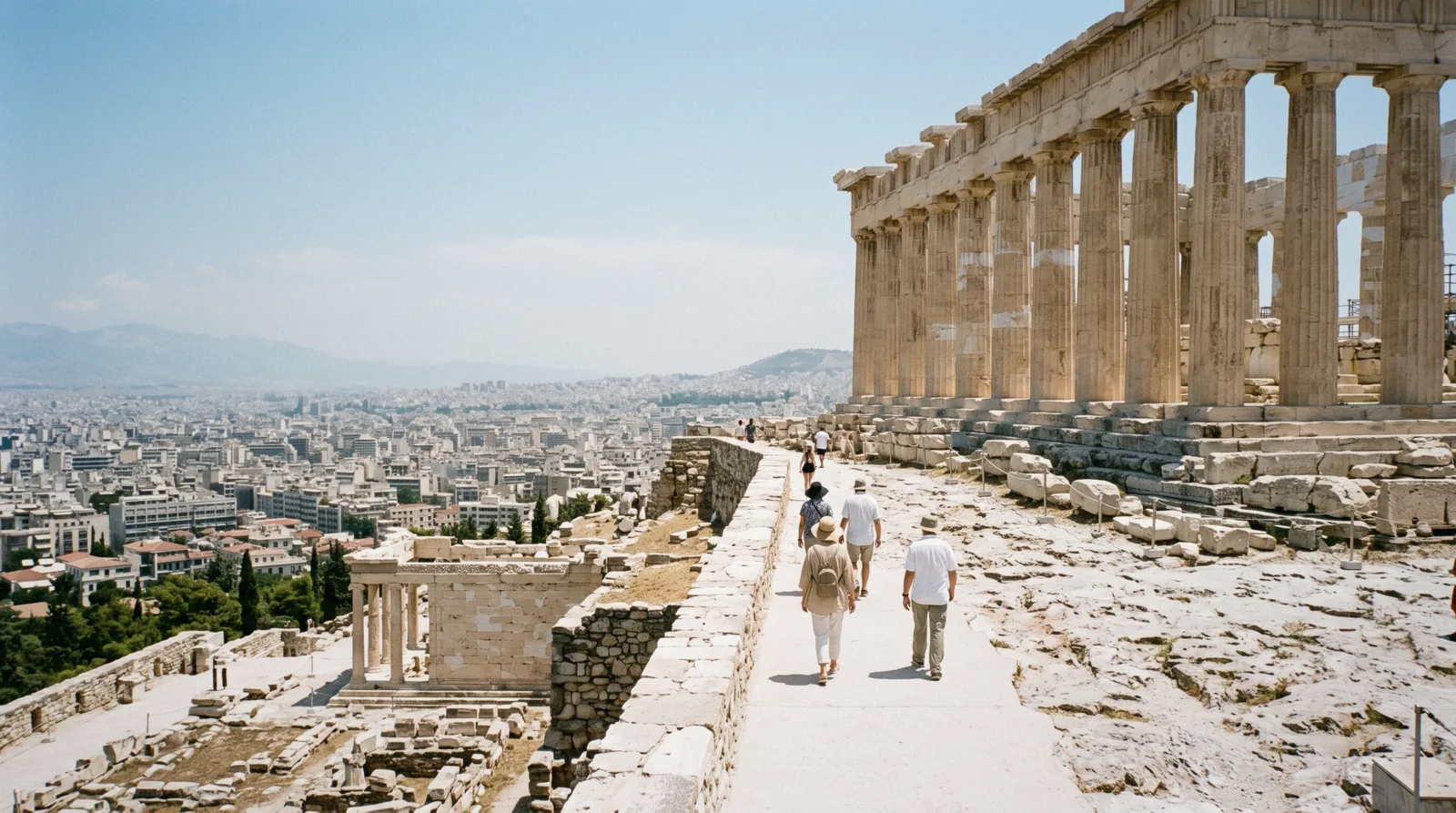
Athens in the Heat: July, August and the Shape of the Day
Athens in August is not impossible; it is a different shape. The mean daily temperature in July is close to 29°C and in August close to 28°C, the Acropolis has no shade whatsoever, and the marble on top of it reflects heat back at you by the middle of the morning. A summer day here works if you accept two windows and give the middle to something with air-conditioning. Checked in Q3 2026. The month-by-month picture is on the best time to visit; the wider plan is on our guide to things to do in Athens.
Quick answer The two windows, and what goes in the middle
In July and August the useful hours are roughly 08:00 to 10:30 and after 17:30. The archaeological sites belong in those two windows; the middle of the day belongs to the museums, lunch and shade.
Key takeaways
- Book the 08:00 Acropolis hour. In summer it goes first, and it is the difference between a good visit and a short one.
- The shape of a summer day puts everything in one of the two windows and gives the middle away.
- What closes in a heatwave is a real thing: sites can shut at midday at short notice when the temperature is high enough.
- The cool places are the two big museums, the National Garden and the Varvakios market hall — where to be at two in the afternoon.
- Water, flat soles and a hat. There is a fountain at the Acropolis entrance and nothing on top.
The shape of a summer day
Built around the two windows. Times are what we would actually do; the closing times are from the official pages, read on 1 September 2026.
| Hour | What | Why |
|---|---|---|
| 08:00–10:00 | The Acropolis | The only comfortable hour on the rock; sun is on the marble by nine |
| 10:00–11:00 | Coffee on Dionysiou Areopagitou | Shaded, flat, pedestrianised — the recovery hour |
| 11:00–13:00 | The Acropolis Museum | Air-conditioned, two hours, and the excavation below is cooler still |
| 13:00–15:00 | Long lunch, two streets back | This is the hour to be sitting down and indoors |
| 15:00–17:00 | The National Garden or a second museum | Shade, or air-conditioning; not a site |
| 17:30–20:00 | The Ancient Agora or a hill | Sites reopen to usefulness; the Agora shuts at 19:30 |
| 20:30–21:00 | Philopappos for sunset | The best hour of a summer day in Athens |
| 21:30 on | Dinner in Psyri | The city eats when it cools; this is not a compromise |
The middle five hours of that table are the whole trick. Visitors who try to hold a normal sightseeing rhythm from ten to five in August see less, not more, because they spend the hot hours walking between things instead of inside one. The Greek day is built the other way round for a reason.
What to book for a summer trip
Early access and indoor options, with the operator's own rating and review count.
 from €27
Athens: First Access Acropolis and Parthenon Guided Tour
An early-morning guided walk that goes to the Parthenon before the coach groups, then the Theatre of Dionysus on the south slope. Two to four hours depending on the option.
Check Availability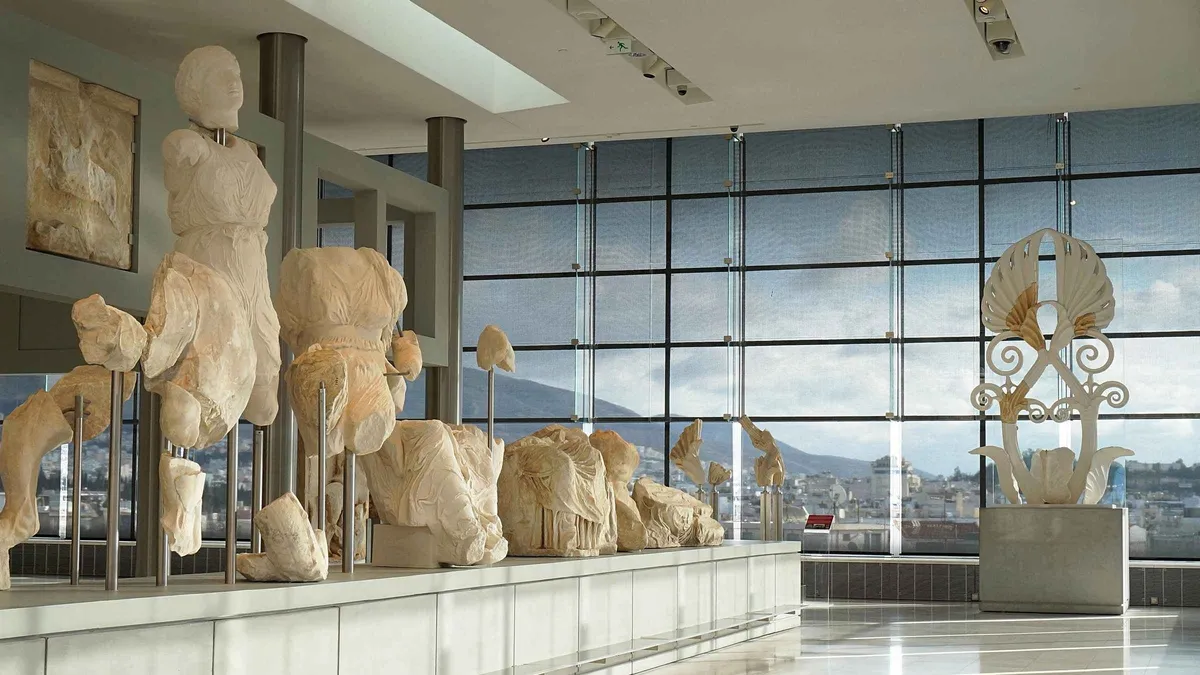 from €26
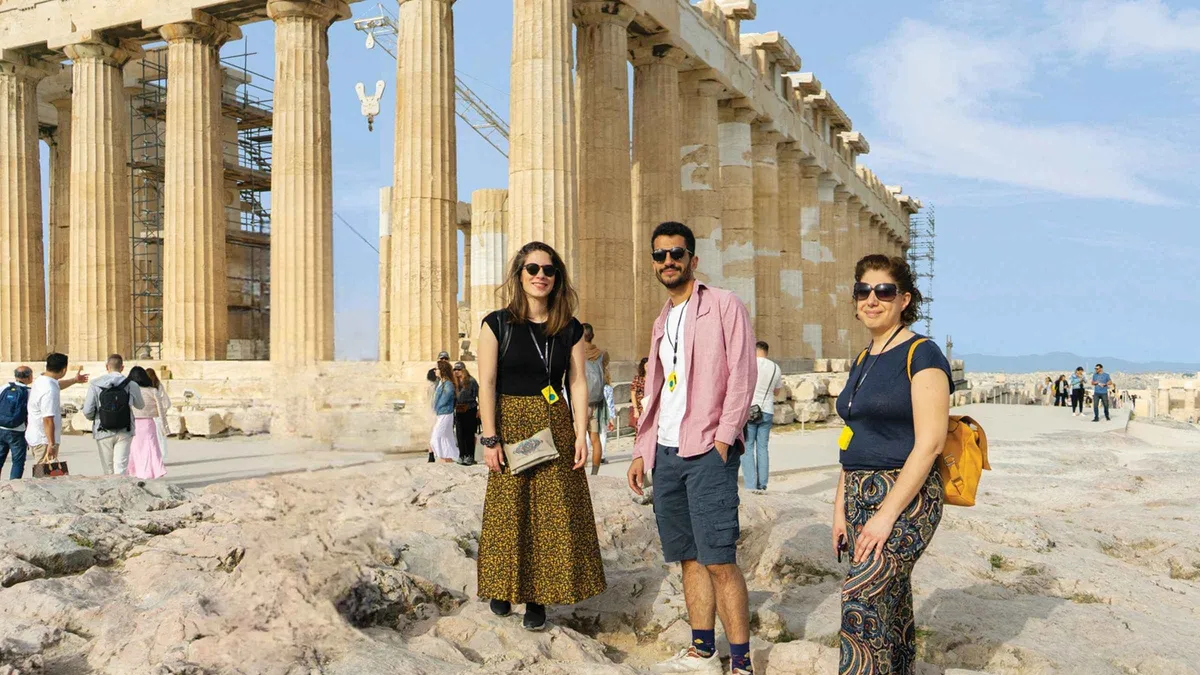
Athens: Acropolis Museum Ticket with optional Audio Guide
Entry to the Acropolis Museum with optional audio guide. The official price is €20; reduced tickets are only issued at the museum desk, never online.
Check Availability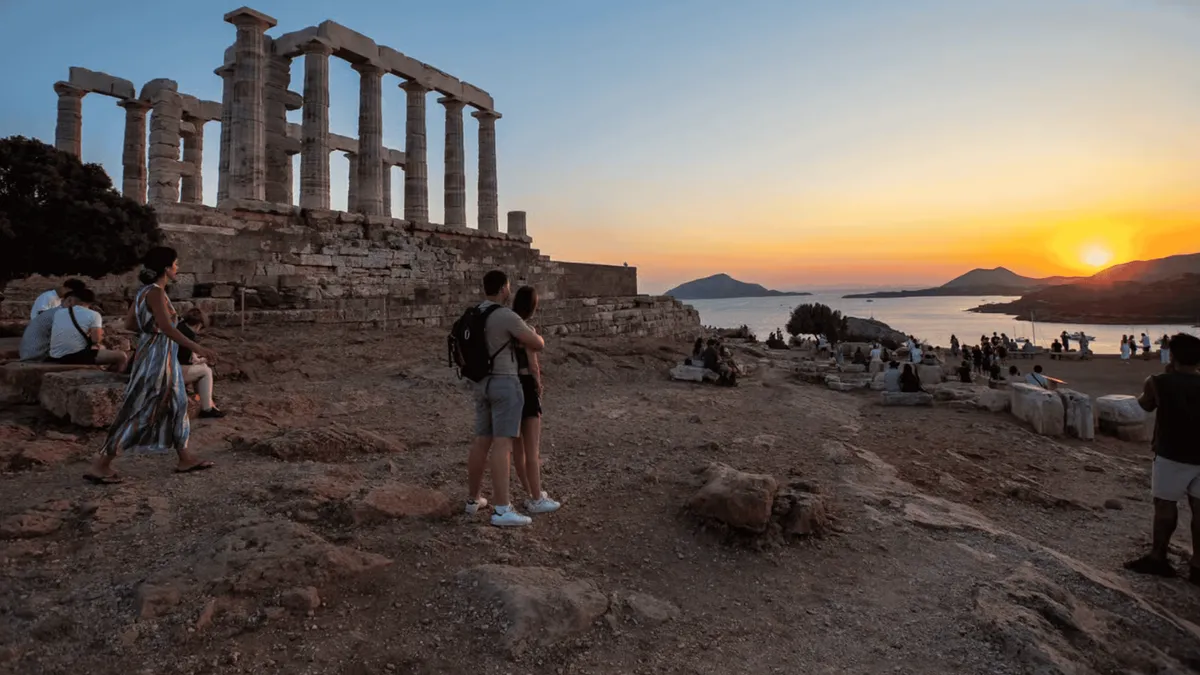 from €28
Athens: Cape Sounion & Temple of Poseidon Sunset Experience
A four-hour evening run down the coast to the Temple of Poseidon for sunset. The site itself opens at 09:30 and closes at sunset year-round.
Check Availability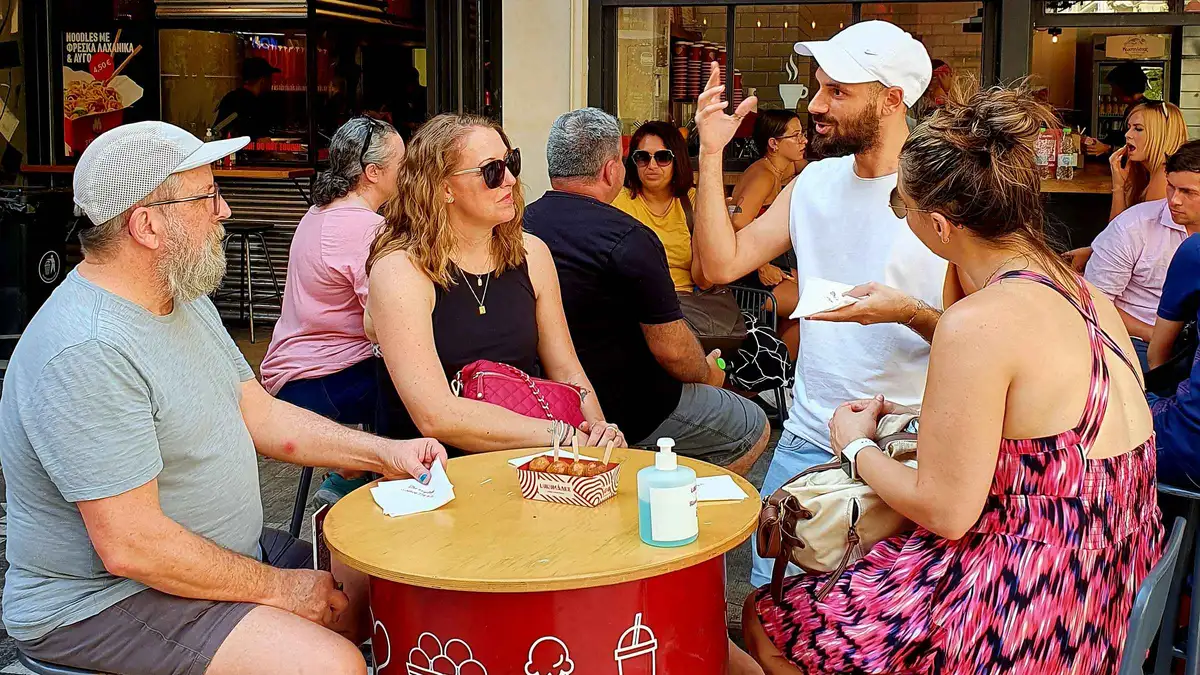 from €59
Athens: Street Food Tasting Tour
Three hours of Athenian street food with beer or wine, moving between the counters locals use rather than the ones on the tourist lanes.
Check AvailabilityPrices, ratings and details are the platform's own. Euro figures are the listed prices. The platform bills in your account's currency.
What closes in a heatwave
Greece has a formal response to extreme heat, and it reaches the archaeological sites.
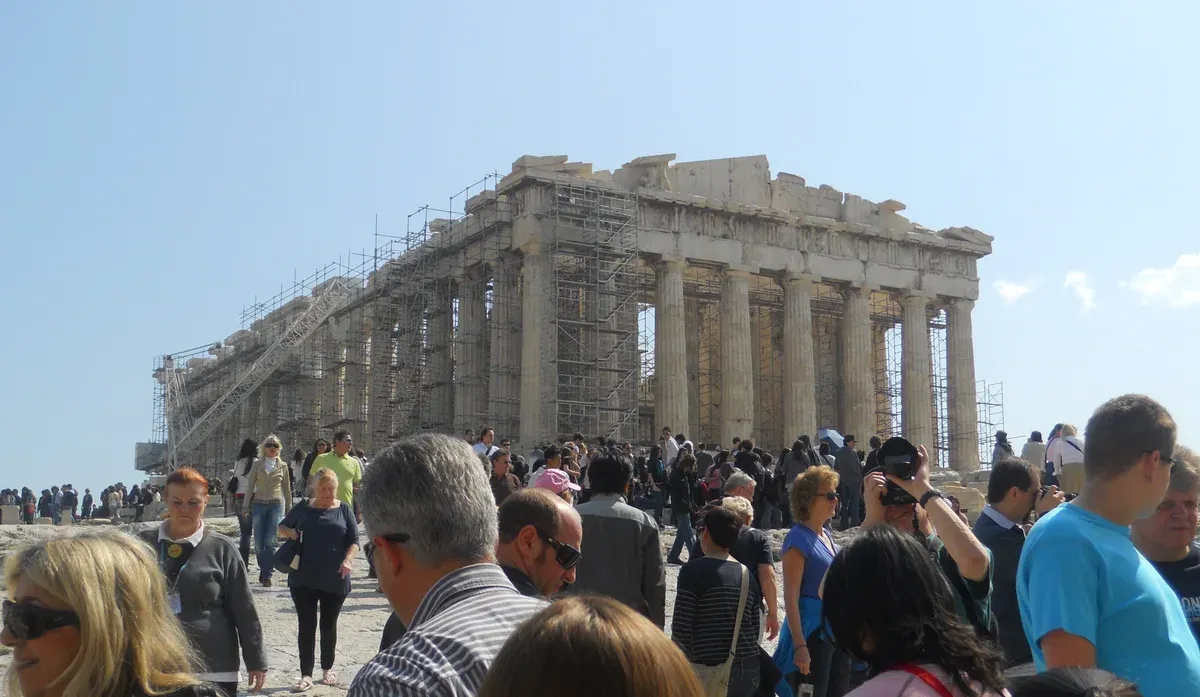
Photo: Erik Drost, CC BY 2.0, via Wikimedia Commons
Midday closures at the sites
During official heatwaves the culture ministry has repeatedly closed the Acropolis and other open-air archaeological sites through the hottest hours, roughly from midday to 17:00. The announcements come a day or less in advance, which makes planning difficult. This is a protective measure for visitors and staff rather than an exceptional event, and it has happened in successive summers.
Because state sites are staffed by ministry employees, a public-sector strike can produce a similar full shutdown for a different reason, so the two risks compound in summer. The practical consequence is that a midday or early afternoon slot on a very hot day is the one most likely to be lost. Book early, go early, and treat anything after noon as uncertain until you have checked that morning.
Once you have shifted your sightseeing to the early hours, Athens guided tours make it easier to lock in a morning slot that is unlikely to be lost to a heat closure.
What that means for your ticket
Hellenic Heritage tickets are non-refundable by their own terms, so a closed afternoon could look like money thrown away. The defence is the change rule. You get two changes per ticket, and you must make them up to two hours before the booked slot.
If a closure is announced for the afternoon and you hold a 13:00 slot, move it to the following morning immediately, because that two-hour window is what stands between you and the loss. The ticket page has the mechanism for making the change. Do it from your phone the moment the announcement appears rather than waiting to see whether the closure is confirmed. The rule exists for exactly this situation, and it expires fast, so use it early.
How you find out
Announcements go out through the culture ministry and the site's own channels, and Greek media report them quickly. There is no single English feed that collects them. The practical habit is to check the morning of a very hot day before you set out, and to check again before the afternoon if your slot falls then.
It is the same habit that the strikes page recommends for a different reason, and the two overlap, because a public-sector strike can shut the Acropolis as thoroughly as a heatwave can. Official strike notices run on Greek-language lists such as apergia.gr, with service notices from OASA, so a Greek-capable friend or a translation app is worth having on the hottest days.
Other hot-weather measures
Municipalities open air-conditioned public rooms during heatwaves, and outdoor work is restricted by ministerial decision. Neither measure affects a visitor directly, and neither closes a museum, but both are a signal that the day is one to spend indoors through the peak hours. Read them alongside the site closures rather than instead of them.
If the ministry has shut the open-air sites for the afternoon and the municipality has opened cooled rooms, the shape of the day is settled: galleries, markets and shaded streets until the heat eases, then the rock or the hill in the late afternoon or early evening. Treat these announcements as the city telling you its plan, then build yours to match it.
Where to be at two in the afternoon
Five places, all of them cool and none of them a compromise.
The Acropolis Museum
The museum opened in June 2009 on the Makriyianni plot, designed by Bernard Tschumi with Michalis Photiadis. It stands over an excavated ancient Athenian neighbourhood, visible through the glass floor at the entrance and included in the ticket, and that level is cooler than the galleries above. Two hours of strong material, all under air conditioning.
In the Parthenon gallery, white plaster casts stand where the original blocks would be, because those blocks are in London. It runs on its own hours and free days as a separate legal entity from the state sites, so a state-site closure does not close it. On a Friday it is open to 22:00, which makes it the obvious late option too. The museum page has the floors.
The National Archaeological Museum
Cool, enormous and open to 20:00 from May to October, which makes half a day here the single best use of the hot afternoon hours in the city. Start with the Mycenaean rooms. Heinrich Schliemann dug the shaft graves of Grave Circle A at Mycenae in 1876 and found five gold masks, and the one he called the Mask of Agamemnon was hammered from gold leaf over a wooden form around 1525 BC, three or four centuries before any Trojan War could have happened.
The building is not on the hill, so it works on the days the rock defeats you. One warning: on Tuesdays it opens at 13:00 all year, which in August is arguably a feature. The museum page has the week.
The National Garden
Queen Amalia commissioned this garden in 1838 and it was finished by 1840, designed by the agronomist Friedrich Schmidt, who imported over 500 plant species along with peacocks, ducks and turtles. The animals are still part of the deal. It covers 15.5 hectares of dense old planting behind Parliament, it is free, and it runs several degrees cooler than the pavement outside, which is the whole point on a hot afternoon.
It is also the only shaded way to cross from Syntagma to the Panathenaic Stadium, so you can route your day through it rather than treating it as a destination of its own. Take the longest path you can find and walk slowly. The garden page has the routes.
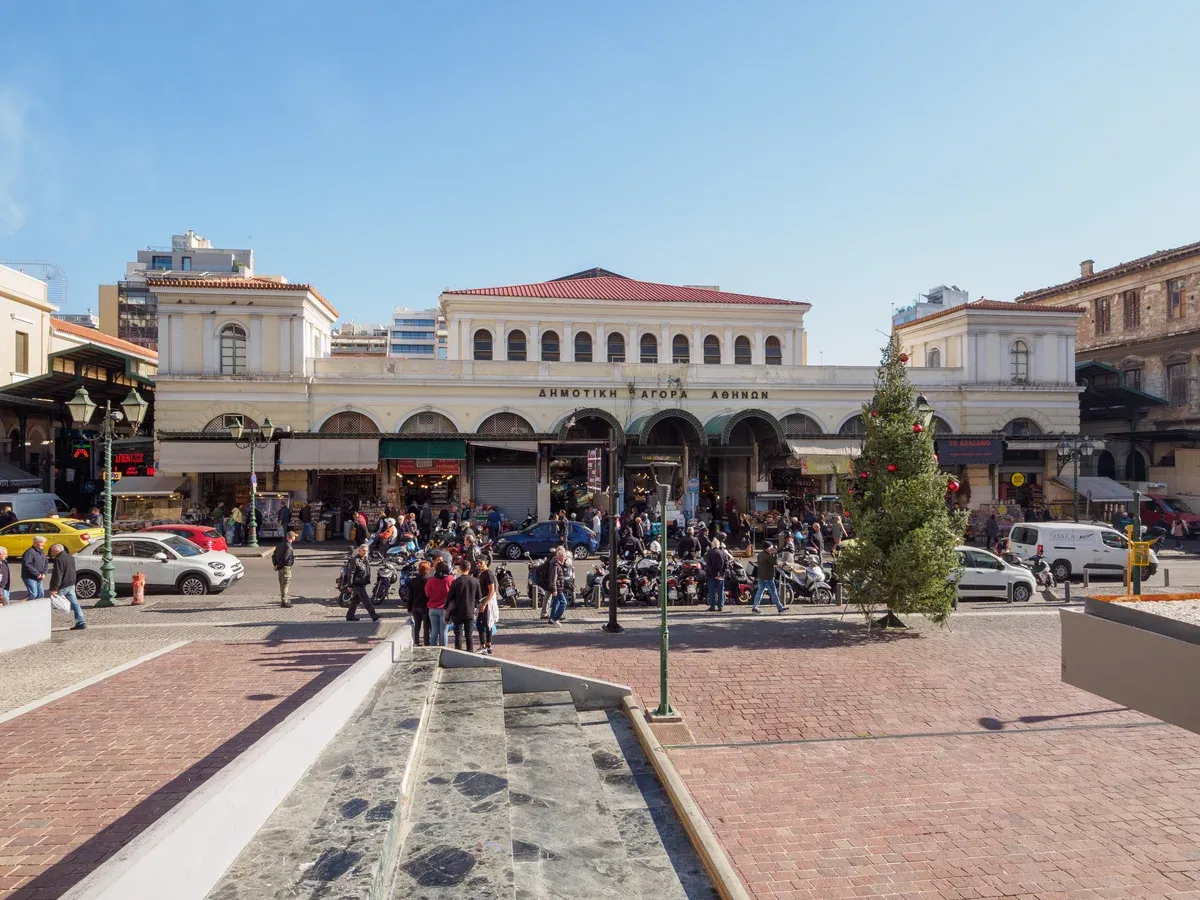
Photo: C messier, CC BY-SA 4.0, via Wikimedia Commons
The Varvakios market hall
The covered central market on Athinas was built about 1886, paid for by a bequest from Ioannis Varvakis, a fighter of the War of Independence who made his fortune in caviar. It is cool, loud and open to mid-afternoon Monday to Saturday, closed Sundays, so plan around that. The cook-shops inside serve at hours no restaurant keeps, and a bowl of soup at two in the afternoon in August is a more Athenian thing to do than it sounds.
Fish and meat counters run the length of the hall, the noise is part of it, and the whole visit costs you nothing but what you eat. Come mid-morning if you want the stalls at their fullest, come at two if you want the heat beaten.
A long lunch, two streets back
The most underrated option, and the one the city itself is built around. Athens eats late and does not expect you to leave, so a taverna table from one to three in a side street off Koukaki or Psyri is what the locals are actually doing while the visitors stand in the sun. Koukaki grew around the iron bed factory Georgios Koukakis opened at the turn of the twentieth century, and Psyri was once the rough quarter of 19th-century Athens, ground of the knife-carrying koutsavakides.
Both now eat and drink very well. Order slowly, order more salad than you think you need, and let the hottest hours pass over the table. Where to eat has the vocabulary.
The practical bits
Four things that matter more in August than in April.
Water
Tap water is safe in Athens, so there is no need to buy bottles for the hill. There is a fountain at the Acropolis entrance and nothing on the summit, which is the mistake people make. Fill up before you go through the entrance, because once you are on the rock there is no going back down for water without giving up your slot and climbing the path again.
Two litres a person for a morning on the rock is not excessive in summer, and on a day when the ministry has kept the site open through the heat it is closer to the minimum. Drink before you feel thirsty, keep a bottle in the bag even for short visits, and refill at every working fountain you pass in the city.
Shoes and the marble
The rock is polished stone and worn marble, and it is slippery whatever the weather, in dry heat as much as after rain. In heat it also radiates, and thin soles feel that directly, because the marble underfoot warms through and turns uncomfortable long before the air feels unmanageable. So flat, closed and grippy is the rule, with soles thick enough to cut the heat off the stone.
This is not the city for new sandals or for anything with a smooth leather sole, and the climb is short enough that a bad shoe choice gains you nothing and costs you the whole morning. Break in whatever you plan to wear before you arrive, and check the grip on the way down as carefully as on the way up.
Photo: Jorge Láscar from Australia, CC BY 2.0, via Wikimedia Commons
Shade, and where there is none
There is no shade on the Acropolis, at the Olympieion, at Mycenae or on the Panathenaic Stadium tiers, where the marble seating throws heat back up at you. Plan those for early morning or the end of the day, and carry a hat rather than trusting to find cover. There is shade at the Ancient Agora among the trees, on the Philopappos paths and in the National Garden, so those are the right midday calls.
The Agora has the added advantage of the Temple of Hephaestus, which survives almost complete because it served as a church from the 7th century until 1834. The Philopappos paths, laid in broken salvaged marble in the 1950s, stay cooler than the road.
August in Greece
The country goes on holiday, and 15 August is a national holiday at the centre of it. Some family-run restaurants and small shops close for two or three weeks around that date, so a favourite taverna from a previous trip may simply be shut. The sites and museums do not close, and the free-admission Sundays at state sites continue through the winter months from 1 November.
Athens is emptier of Athenians in August than at any other time, which is why the centre can feel like it belongs entirely to visitors, and why queues at the Acropolis are at their worst. Book timed slots well ahead, do your hill and marble walking before ten, and give the afternoon to the museums or a long table in the shade.
Athens in the heat: questions
Is August too hot for Athens?
The daily mean is close to 28°C and the Acropolis has no shade, so the middle of the day is genuinely unpleasant. The trip works if you use the two windows — early morning and after half past five — and give the middle to a museum. The shape of a summer day sets it out hour by hour.
What time should I visit the Acropolis in summer?
The 08:00 hour, and book it early because it goes first in July and August. By ten the sun is on the marble and by noon the rock is a fifty-minute visit rather than a morning.
Do the sites close in a heatwave?
They can. During official heatwaves the ministry has closed the Acropolis and other open-air sites through the hottest hours, announced a day or less ahead. Your ticket is non-refundable but changeable twice up to two hours before — what closes in a heatwave explains the mechanism.
Where can I go in the middle of the day?
The Acropolis Museum, the National Archaeological Museum, the National Garden, the Varvakios market hall, or a long lunch. Where to be at two in the afternoon covers each.
Is there shade on the Acropolis?
None. There are pines on the approach paths and nothing at all on the summit. Take water, a hat and flat shoes, and fill up at the fountain by the entrance before you go through.
Should I come in August at all?
If your dates are fixed, yes — it works with the right shape. If they are not, April, May, late September and October are the four months the city is built for.
Where to go from here
The pages a summer trip leans on.
Best time to visit
Ten years of temperature data against the site calendar: the best time to visit.
If your dates are flexibleMuseums
Six museums, what each charges and the Tuesday to avoid: the museums hub.
The middle of the dayAthens in the Heat on Video
Two films on the same subject, useful where a page can only describe. Ids checked on 2 September 2026.
🇬🇷 Visit Greece in Summer, July and August, a Travel Guide, 10 Top Tips
Ten summer tips for Greece, several of which apply directly to a city with no shade on its rock.
Video: Greece Explored 🇬🇷Guide to Greece in the Summer: Surviving the Crowds & the Heat!
Surviving the heat and the crowds, which in Athens is a July and August question.
Video: Jared DillinghamPrices, hours and terms are set by the venue or operator and confirmed at checkout.
We may earn a commission if you book through one of our links, at no extra cost to you. Full affiliate disclosure