 Visit Athens Guide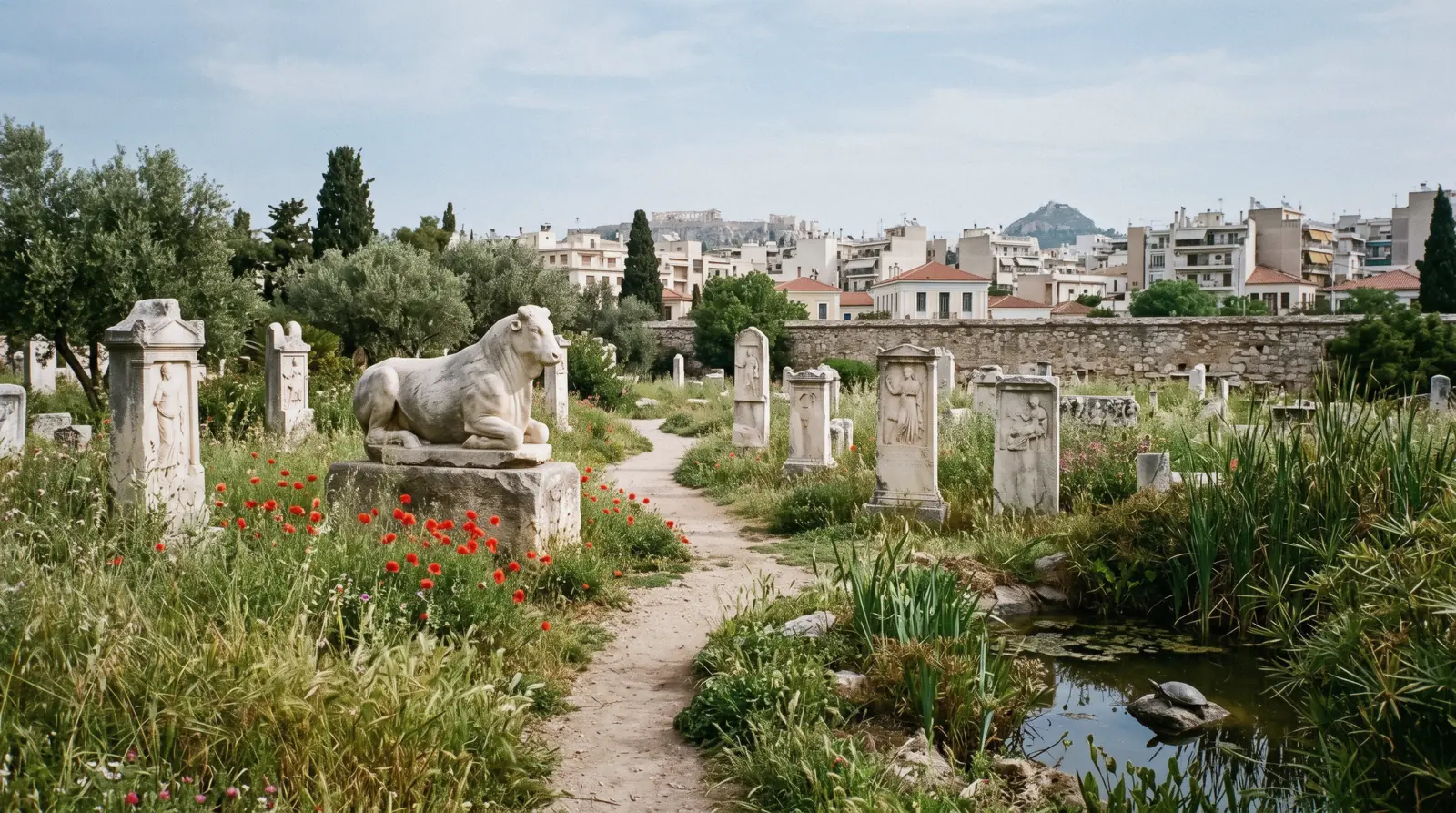
Kerameikos
Kerameikos is the potters' quarter and the state cemetery of ancient Athens, on the north-west edge of the old city where the Sacred Way and the road to the Academy left through the walls. It is also, as checked in Q3 2026, the one central site whose official page prints “the site is temporarily closed” under its summer hours while still publishing winter ones. This page explains what that means, what is there and what to do instead. The other ancient sites are on the ancient sites hub, and for the wider plan see top attractions in Athens.
Quick answer Whether it is open, and what to do if it is not
On 1 September 2026 the official Hellenic Heritage page for Kerameikos printed “the site is temporarily closed” in place of summer opening hours, while still publishing winter hours of 08:00 to 15:00. The ticket price is €10 full and €5 reduced.
Key takeaways
- This is a fact with a short shelf life. Check before you go — the official page is the only source that updates, and no English-language guide tracks it.
- If it is shut, the substitute is the Ancient Agora: same excavated-city feel, open all year, and the Temple of Hephaestus on top of it.
- When open it is a quiet, green, oddly beautiful site — what is there explains why people who like it like it a lot.
- The museum inside holds the grave sculpture, including the bull of Dionysios of Kollytos, and it stands or falls with the site.
- Kerameikos is one of the seven sites the abolished combination ticket used to cover; what replaced that package has the arithmetic.
Key facts
Opening hours
| Summer season | —–listed as temporarily closed |
|---|---|
| 1 November – 31 March, daily | 08:00–15:00 |
| Last admission | —–20 minutes before closing |
Closed 1 January, 25 March, 1 May, Orthodox Easter Sunday, 25 and 26 December
Admission
- Adult
- €10
- Reduced
- €5
- Free
- 6 March, 18 April, 18 May, the last weekend of September, 28 October, and the first and third Sunday from 1 November to 31 March
Planning it
- Time needed
- Not stated by the site; our routing: 45 minutes with the museum
- Book ahead
- Optional — walk-up usually fine
- Address
- Ermou 148, 105 53 Athens
The ways in, priced from hh.gr and GetYourGuide on 1 September 2026. Note that the official page showed no active ticket link while the summer closure notice stood — treat any bundle that counts Kerameikos among its sites with that in mind.
Check the season before the price: the official page prints the site as temporarily closed under its summer hours, so the first question is whether it is open at all.
| Option | Price | Includes | Cancel | Book |
|---|---|---|---|---|
| Official ticketAnyone who wants the cemetery and its museum, and who has confirmed it is open on the day | €10 full / €5 reduced | The site and the museum | Per the platform's terms | Official site |
| Acropolis plus up to five sitesAnyone doing several central sites — this one is among the listed options | Listed at €36 | Kerameikos listed among the options | Per listing | Check Availability |
| Acropolis e-ticket with add-onsFor adding this gate to an Acropolis ticket already in the basket | Listed at €36 | Kerameikos offered as an add-on | Free cancellation per listing | Check Availability |
| Philosophy and democracy walkFor walking the quarter without entering the site, which is what the tour does | From €41 | Passes the quarter on foot; no site entry | Per listing | Check Availability |
Two of the cards above list Kerameikos among the sites they cover. If you are buying a bundle mainly for this site, open the official page first and see whether the closure notice is still there — a pass cannot open a gate the ministry has shut.
Passes that list Kerameikos
The cards behind the table, with the operator's own rating and review count.
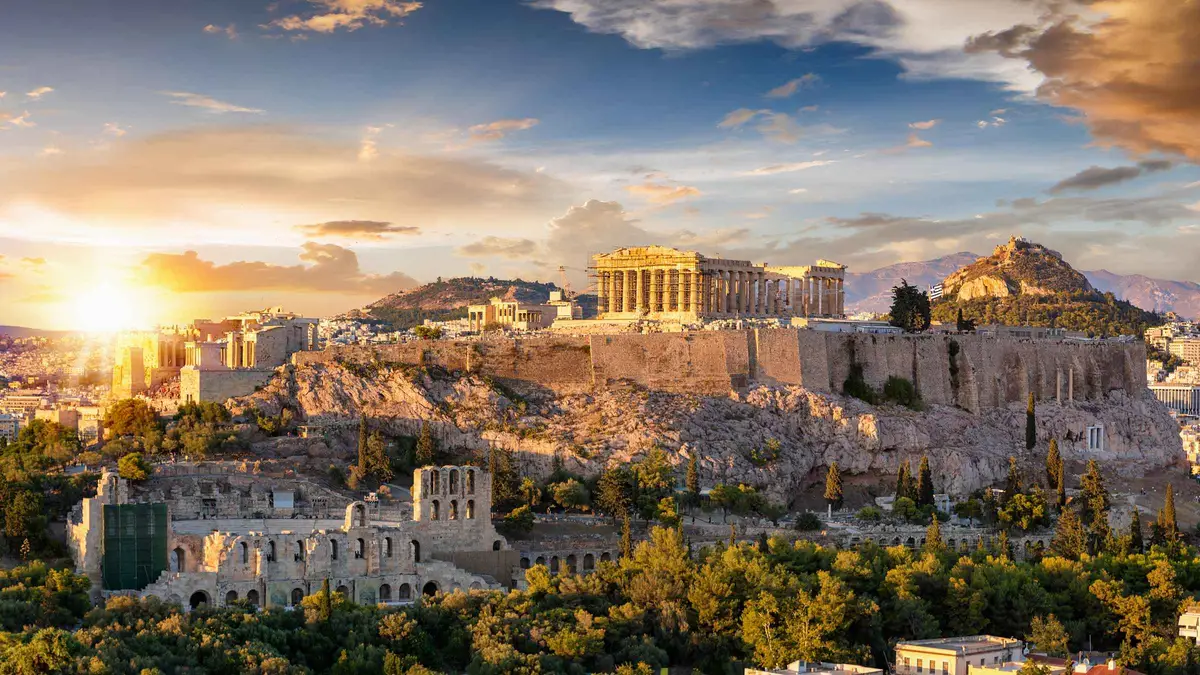 from €36
Athens: Acropolis Ticket & Heritage Sites + Acropolis Audio
The bundle the official shop does not sell: the Acropolis slot plus entry to up to five more archaeological sites, including both Agoras and the Temple of Olympian Zeus.
Check Availability from €36
Athens: Acropolis Ticket & Audio Guide + Free Cancellation
Acropolis e-ticket with free cancellation and optional add-ons for the Acropolis Museum, the two Agoras, Kerameikos, the Temple of Zeus or the National Archaeological Museum.
Check Availability from €42
Athens: Philosophy and Democracy Walking Tour
Three and a half hours on foot through the places where philosophy and democracy actually happened, rather than the places they are commemorated.
Check AvailabilityPrices, ratings and details are the platform's own. Euro figures are the listed prices. The platform bills in your account's currency.
The closure, and how to check it
What the official page actually says, and what it does not say.
What is printed
On the Hellenic Heritage destination page for Kerameikos, under the heading “Summer hours”, the line reads: “The site is temporarily closed.” Under “Winter hours” the page still prints 1 November to 31 March, daily 08:00 to 15:00, with the usual note that last admission is twenty minutes before closing. Ticket prices of €10 and €5 are still listed, along with the standard free-entry dates. We read that on 1 September 2026.
What it does not say
The official page gives no reason for the temporary closure and no end date. There is no works notice, no announcement and no expected reopening, so nobody can tell you when Kerameikos opens its gates again, including us. This is not unusual for the platform.
The Ancient Agora carried a similar dated closure notice for two Sundays of restoration work, and that notice explained itself. Here there is nothing to explain with. The ticket, €10 full and €5 reduced, is sold through the Hellenic Heritage system, and those tickets are non-refundable.
If you booked a slot during the closure, your defence is the two changes allowed per ticket up to two hours before the slot. Treat any reopening date you find elsewhere as unconfirmed.
How to check before you go
Open hh.gr/en/destinations/kerameikos and read the summer-hours block. If the words temporarily closed have gone and real hours stand in their place, the site is open. Two numbers help.
The guardhouse number on the same page is +30 210 3416117, and the Ephorate of Antiquities of the City of Athens takes calls on +30 210 9238724. Bear in mind that state sites are staffed by ministry employees, so a public-sector strike can close Kerameikos with little warning. Unions must give at least 24 hours notice under law 1264/1982, and four days where a public service is involved.
Apergia.gr lists strikes in Greek and OASA posts service notices. Do not rely on a third-party page, this one included, for a fact that changes without notice.
What to do instead
The Ancient Agora is the closest match in feel, an excavated quarter of the ancient city where the assembly's business, the courts and the market of classical Athens all sat. It is open all year, and on the hill above it stands the Temple of Hephaestus, built between 449 and 415 BC. It survives almost complete because it served as the Greek Orthodox church of Saint George Akamates from the 7th century until 1834, which makes it the best-preserved Doric temple in Greece.
Entry is €20 full and €10 reduced. For grave sculpture specifically, the National Archaeological Museum holds the finest collection in the country, including pieces dug out of the Kerameikos itself. Note the museum opens at 13:00 on Tuesdays all year.
To see Kerameikos and the Agora with context, guided Athens walking tours cover both sites on foot.
What is there, when it is open
A cemetery, a city gate and a stream, in the middle of a modern neighbourhood.
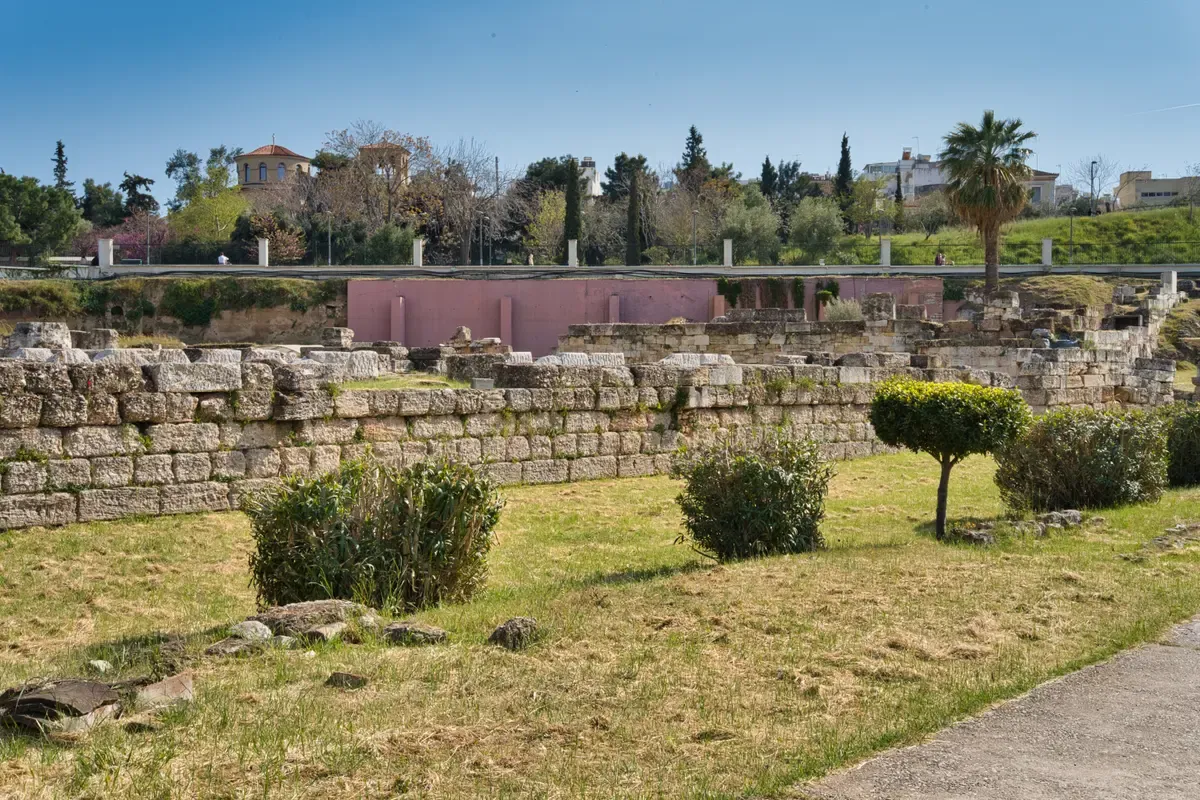
Photo: George E. Koronaios, CC BY-SA 2.0, via Wikimedia Commons
The cemetery
Athens buried its dead outside the walls along the roads out of the city, and this was the grandest of those roads. The grave precincts of prominent families line the Street of Tombs, some with their sculpture still standing: the bull of Dionysios of Kollytos, the horseman Dexileos who died at Corinth in 394 BC and is shown riding down an enemy, stelae with the restrained handshake scenes that Athenian funerary art perfected. Most of what stands outside is cast; the originals are in the site museum.
The Dipylon and the Sacred Gate
The largest gate in the ancient city wall stood here — the Dipylon, where the Panathenaic procession formed up before crossing the Agora to the Acropolis. Beside it the Sacred Gate carried the Sacred Way to Eleusis. The foundations of both are legible on the ground, and so is the line of the Themistoclean wall, thrown up in a hurry after the Persian sack using whatever masonry came to hand, including gravestones.
The potters
Kerameikos was the potters' quarter, the ground of the craftsmen the Greeks called kerameis, and their clay gave English the word ceramic. This is where the Attic black-figure and red-figure vases now in the world's museums were thrown and fired. The quarter also held the city's main cemetery, and the Dipylon, the largest gate of the ancient world, stood here as the starting point of the Panathenaic procession.
The Sacred Way to Eleusis began at the Sacred Gate beside it, and the Eleusinian procession left from there on its walk to the sanctuary of Demeter. Almost nothing of the workshops themselves is visible today. What survives is the name, the gate lines and the graves, so read the site as a cemetery and a road rather than a factory.
And a stream
The Eridanos still runs through Kerameikos in the open. It was one of the two ancient rivers of Athens, and the other streams of the classical city have long since gone under the streets. Here the water stays above ground, which explains why the site is green while every other archaeological site in the centre turns to dust in summer.
Terrapins and frogs live in the channel, and visitors who come once tend to come back for them. Practical notes. Tickets cost €10 full and €5 reduced, and in winter, from 1 November, the site closes at 15:00, earlier than the Acropolis, which runs to 17:00.
The official page has printed temporarily closed under its summer hours, so check hh.gr before setting out.
Kerameikos map
The entrance, the gates inside the fence, and what is within ten minutes.
Next stop from Kerameikos
Walk minutes are our estimates from the GPS distances.
Ancient Agora
South-east along Ermou. €20, open all year, and the closest thing to this site in feel — the Ancient Agora has the hours.
10 min walkPsyri
East into the late-dinner district. Psyri fills after 21:00 and is a short walk from Monastiraki.
10 min walkNational Archaeological Museum
For the grave sculpture, including pieces from this site. The museum opens at 13:00 on Tuesdays.
25 min walk or metroKerameikos questions
Why is Kerameikos closed?
The official page prints “the site is temporarily closed” under its summer hours without giving a reason or an end date, while still publishing winter hours of 08:00 to 15:00. That is all the ministry says. The closure section shows how to check whether the line is still there.
Is Kerameikos open now?
We cannot tell you for your date, and neither can any guide — this changes without announcement. Open hh.gr/en/destinations/kerameikos and look at the summer-hours block, or call the guardhouse on +30 210 3416117.
Is Kerameikos worth visiting?
For a first three-day trip, no — the Acropolis, its museum and the Ancient Agora come first. For a second visit, or for anyone who likes quiet excavated ground, yes: it is green, empty, has a stream running through it and holds the best funerary sculpture in the city. What is there sets out the case.
How much does Kerameikos cost?
€10 full and €5 reduced, and free on the state free-entry days — the free-entry page lists them. It is one of the seven sites the abolished combination ticket covered.
Is the museum included?
Yes, the site museum is on the same ticket, and it holds the originals of the grave sculpture whose casts stand outside. It closes when the site does.
Is Kerameikos safe?
The site itself is a fenced archaeological enclosure with a guardhouse. The surrounding streets at the Metaxourgeio end are scruffier than Plaka and quieter at night; the usual city-centre sense applies, and by day it is unremarkable.
Kerameikos on Video
Two filmed visits that show the distances, the surfaces and the pace — the things a written page cannot carry. Every id was checked against YouTube on 2 September 2026.
1,000 TOMBS discovered in ATHENS at Kerameikos!
On the burials found at Kerameikos, which is what the site is: a cemetery, not a monument.
Video: Tiny EpicsGreece Athens archaeological site of kerameikos walking tour 4k
An unnarrated 4K walk of the site, useful for judging the ground underfoot before you go.
Video: Walking TourPrices, hours and terms are set by the venue or operator and confirmed at checkout.
We may earn a commission if you book through one of our links, at no extra cost to you. Full affiliate disclosure