 Visit Athens Guide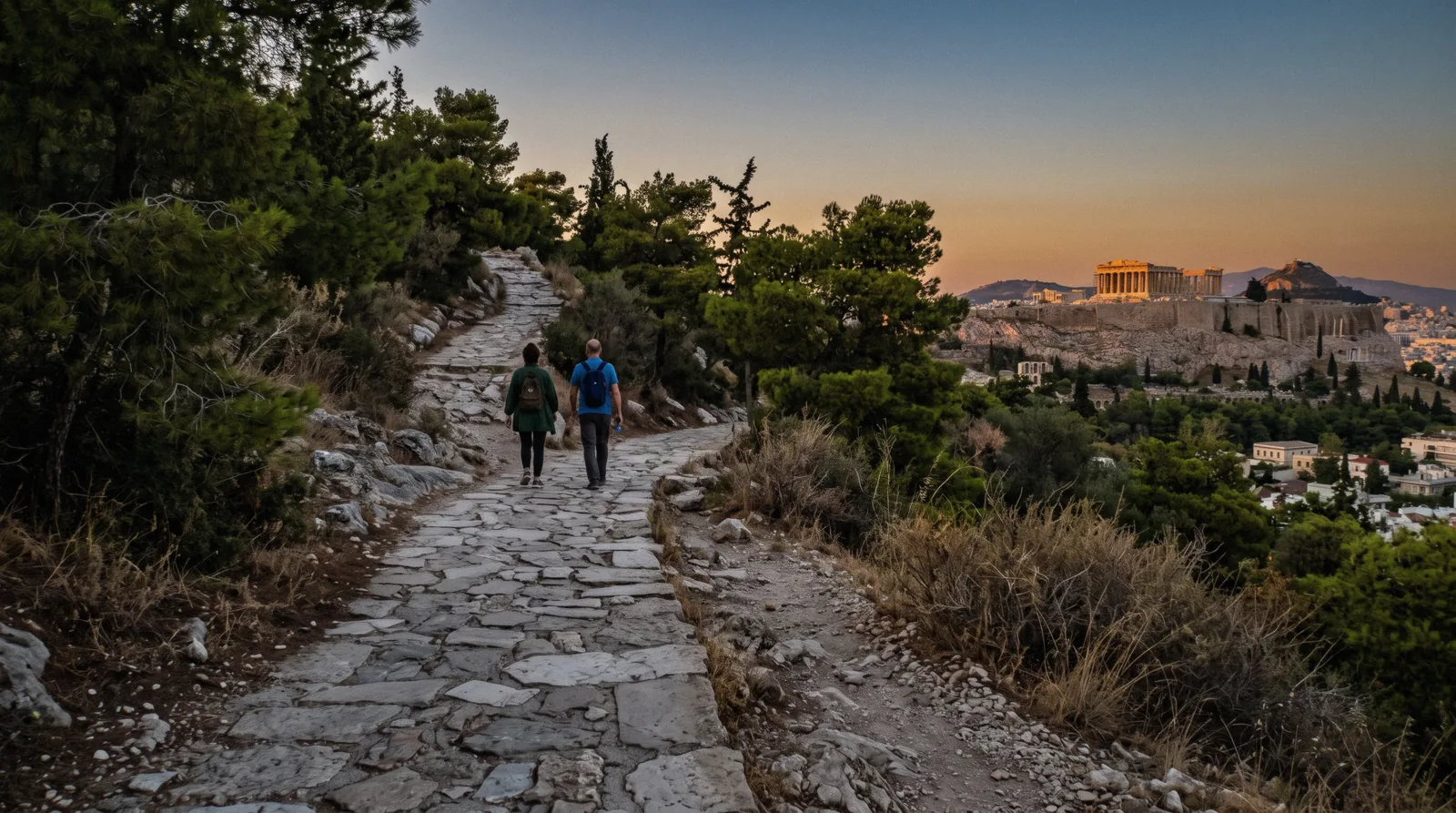
Philopappos Hill
Philopappos Hill is the pine-covered ridge south-west of the Acropolis, free, unfenced and open at every hour, and it is where the photograph of the Parthenon that everyone recognises is taken. It also carries the Pnyx, the terrace where the Athenian assembly voted, and a Roman monument on the summit. This page has the paths, the hour to come and what is up there, as checked in Q3 2026. The rock itself is on the Acropolis page, and the wider plan on what to see in Athens Greece.
Quick answer Free, fifteen minutes away, and the hour to be there
Philopappos Hill costs nothing, has no gate and no closing time, and takes about twenty minutes to walk up from the pedestrian avenue below the Acropolis. The Parthenon view is best in the hour before sunset.
Key takeaways
- This is the best free thing in Athens. The profile view of the rock from the saddle is the one on the postcards — where to stand says exactly where.
- The paths are old marble and polished stone in places and genuinely slippery when wet; flat soles, and a torch if you are coming down after dark.
- The Pnyx is up here too: what else is on the ridge covers the terrace where the Athenian assembly actually voted, which most visitors walk past.
- Compared with Lycabettus Hill, this one is closer, free and better for the Parthenon; the other is higher and better for the city.
- Fifteen minutes from the Acropolis south gate, so it is the natural end of the day after the rock and its museum.
Key facts
Opening hours
| All year, daily | open–no closing time |
|---|---|
| Best light on the Parthenon | one hour before sunset–sunset |
| Coolest in summer | before 09:00–after 19:00 |
Closed None — it is public open ground
Planning it
- Time needed
- Not stated; our routing: 20 minutes up, an hour if you take in the Pnyx
- Book ahead
- Optional — walk-up usually fine
- Address
- Dionysiou Areopagitou / Apostolou Pavlou, 117 41 Athens
What it costs, and what the paid alternatives are
The hill itself takes no ticket at all. This table exists to make the comparison explicit against the other viewpoints in the city, priced on 1 September 2026.
This is the free row on a table of paid views, so the question is what you actually want to photograph: the Parthenon, the city, or the marble underfoot.
| Viewpoint | Price | What you see | Open | Book |
|---|---|---|---|---|
| Philopappos HillAnyone who wants the classic profile of the rock, and the best hour is before sunset | Free | The Parthenon in profile, close and filling the frame | Always | Official site |
| Lycabettus summitAnyone who wants the basin and the sea rather than the temple | Free on foot, €13 return by funicular | The whole city basin and the sea; the rock small | Funicular from 09:00 | Official site |
| The Acropolis itselfAnyone who wants to stand among the buildings rather than look at them | €30 | The buildings up close; the city below | 08:00 to 17:00–20:00 by season | Official site |
| Night walking tourAn evening walk through the centre, which does not climb this hill | From €19 | The centre after dark with a guide; not this hill | Evenings | Check Availability |
Worth stating plainly because so few guides do: the photograph you have seen of the Parthenon, side on, gold, with the Erechtheion beside it and the city out of frame, was almost certainly taken from this hill, and it cost the photographer nothing.
Walks that come this way
The cards behind the table, with the operator's own rating and review count.
 from €18
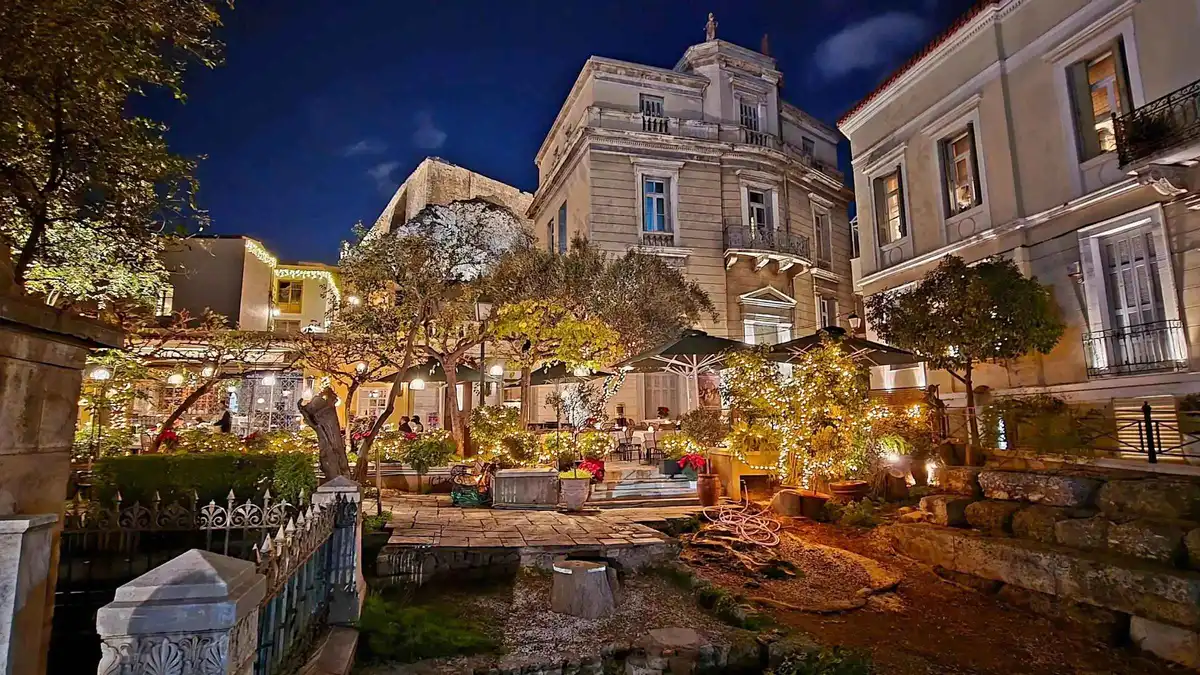
Athens: Night Walking Tour with Local Guide
Two hours after dark through the historic centre, the Cathedral, Anafiotika, Monastiraki and Plaka, with a local guide and no museum entries.
Check Availability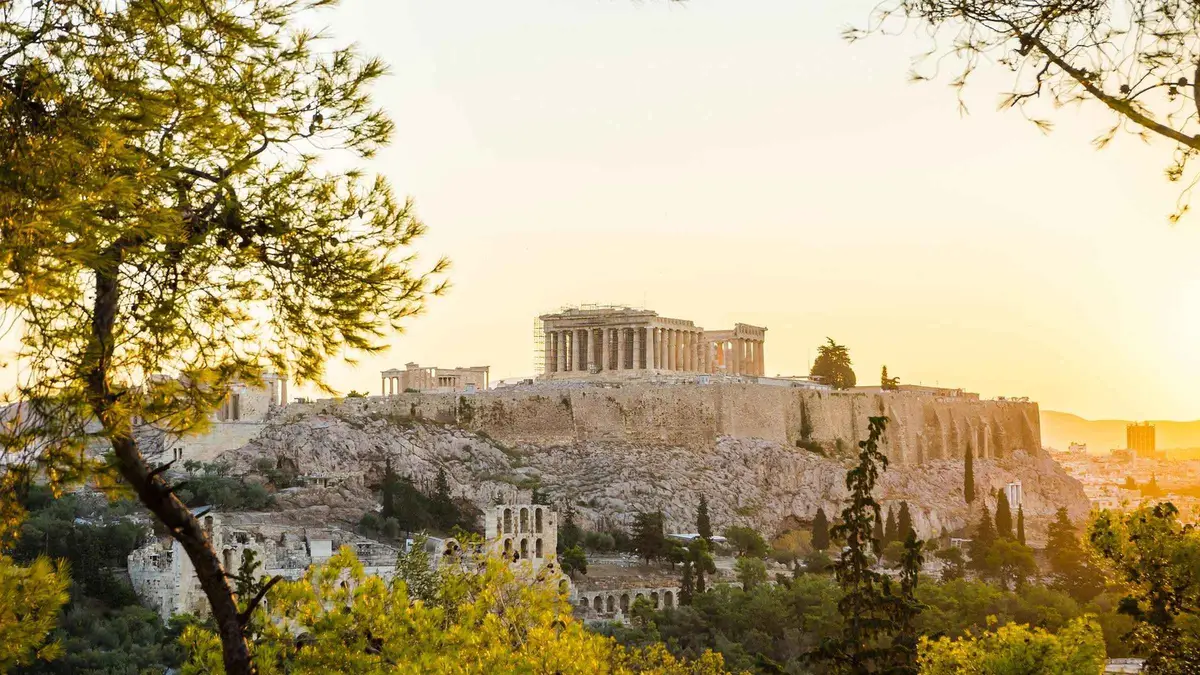 from €42
Athens: Philosophy and Democracy Walking Tour
Three and a half hours on foot through the places where philosophy and democracy actually happened, rather than the places they are commemorated.
Check Availability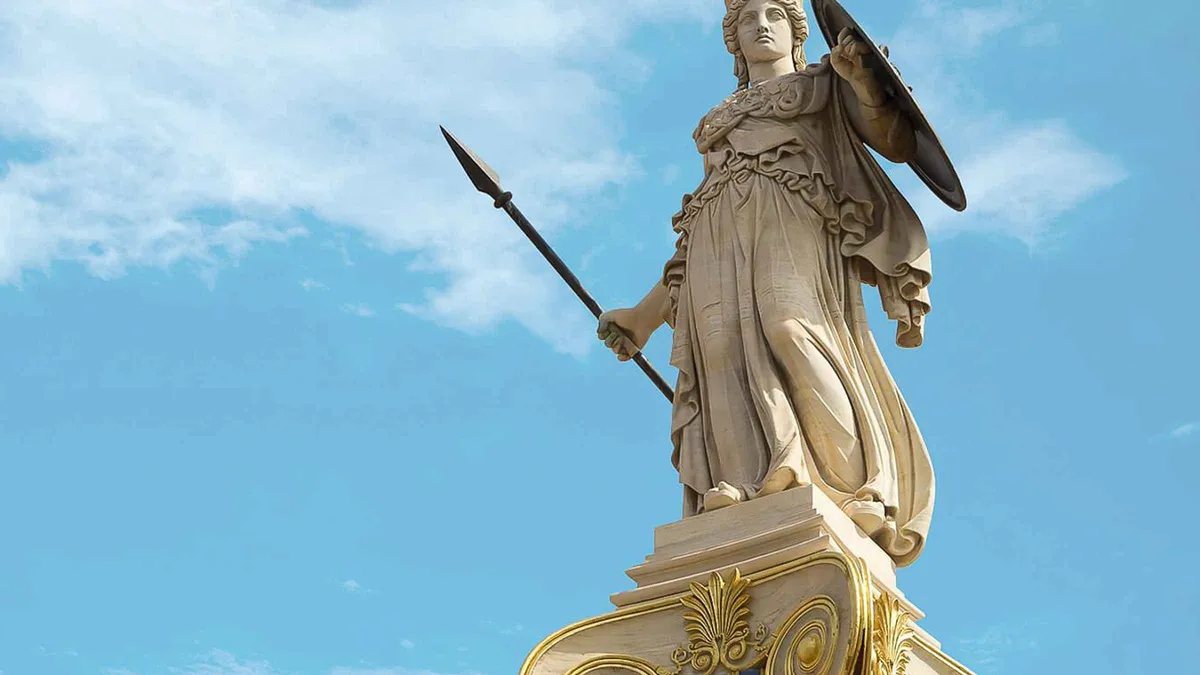 from €45
Athens: Acropolis and Mythology Highlights Small Group Tour
The rock plus the Temple of Olympian Zeus and the Ancient Agora, told through the myths attached to each: a comprehensive first day on foot.
Check AvailabilityPrices, ratings and details are the platform's own. Euro figures are the listed prices. The platform bills in your account's currency.
Where to stand, and when
Three spots on the ridge, in ascending order of how many people will be there.
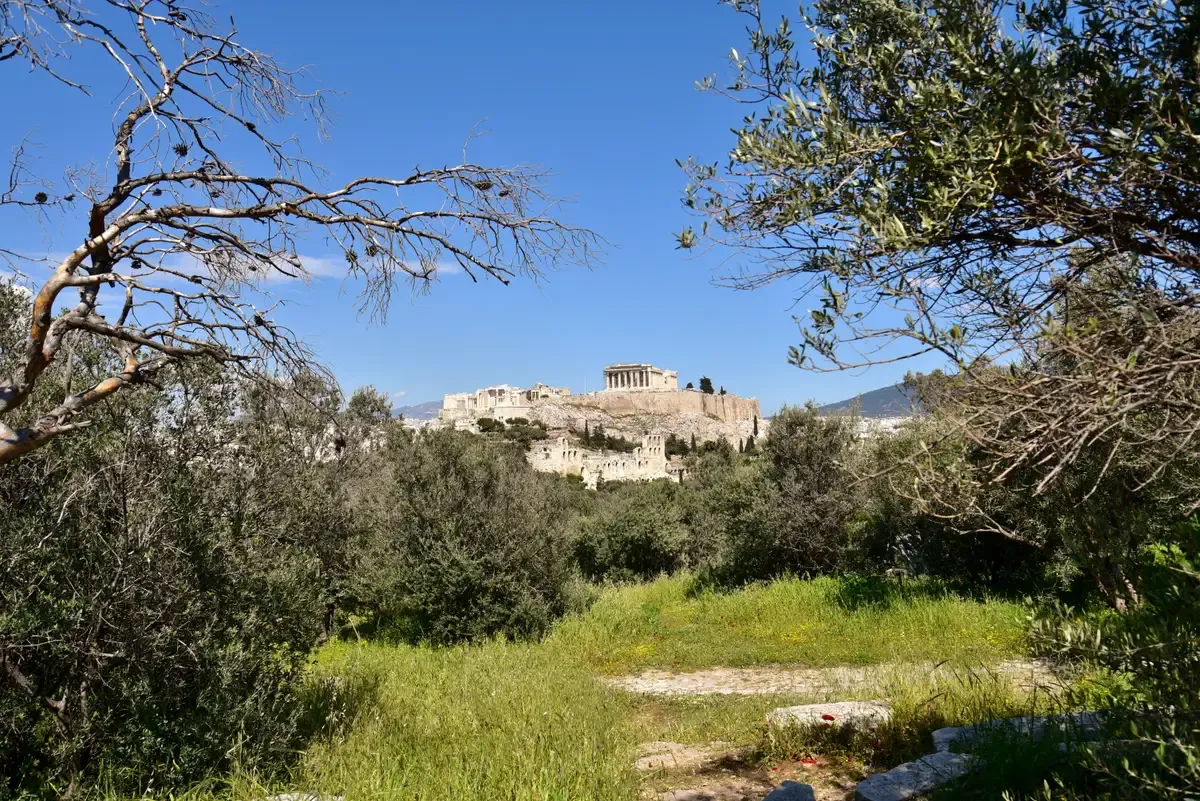
Photo: Bahnfrend, CC BY-SA 4.0, via Wikimedia Commons
The saddle below the monument
The open rocky shoulder between the summit and the Acropolis side is the classic position: the Parthenon sits at eye level across the gap with the Erechtheion to its left and nothing modern in the frame. It is about twenty minutes up from the Dionysiou Areopagitou end. In the hour before sunset there will be thirty or forty people spread along it, which is nothing next to the rock itself.
The Pnyx terrace
This is the hill where the Athenian assembly met and voted, so democracy in Athens was practised on this ground. The bema, the speaker's platform cut into the rock, sits behind you when you face the Acropolis, which is exactly how the crowd once faced the speaker. You stand higher and further north than on Philopappos, looking at the Acropolis from the front rather than the side, and the view is wider.
There are fewer people here than on the main ridge paths. The site is open ground with little shade, so go early or late in summer, and keep an eye on heat announcements, since open-air sites have been closed through the hottest hours during official heatwaves. Combine it with the walk along the south slope.
The Hill of the Nymphs
North of the Pnyx on the same ridge, this hill carries the nineteenth-century Athens Observatory and sees almost nobody. The view of the Acropolis is more oblique than from the Pnyx, but the light in the last twenty minutes of the day is the best on the ridge. It is also the quietest place within fifteen minutes of the Acropolis, which counts for a lot at the end of a day of site-hopping.
The paths up here are part of the same network of walkways built on the ridge, so wear shoes with grip, as the surfaces turn slippery in rain. There is no ticket and no formal entrance. Bring water, since there is nothing to buy on the hill.
The hour
An hour before sunset for the gold on the marble, and stay through it: the ten minutes after the sun goes are when the rock is floodlit and the sky is still blue, which is when the picture actually works. In summer that is around 20:30 and in winter around 17:30 — and in winter the Acropolis itself has already closed, so this is the way to see it lit.
What else is on the ridge
Three things people walk past on the way to the view.
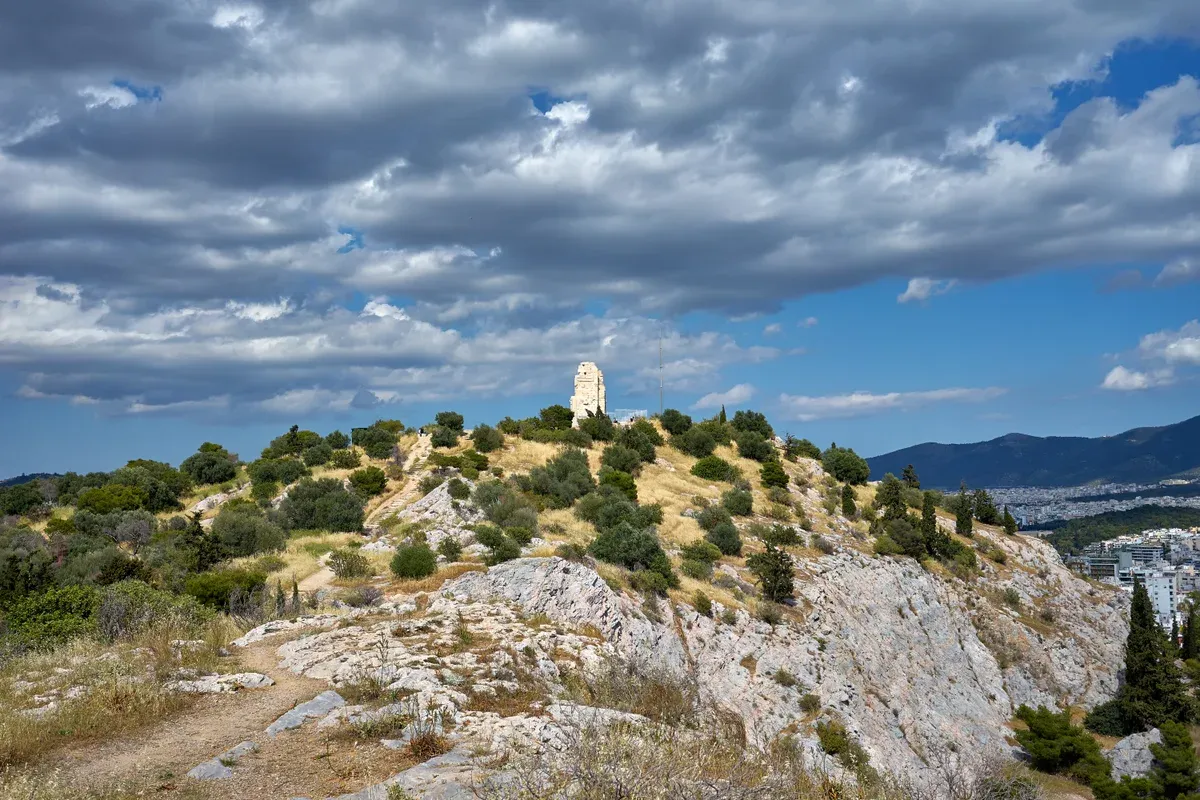
Photo: George E. Koronaios, CC0, via Wikimedia Commons
The Philopappos Monument
The white marble tomb on the summit, built between AD 114 and 116 for Gaius Julius Antiochus Philopappos, a prince of the royal house of Commagene who ended up a Roman consul and an Athenian benefactor. Half of it survives, with the seated figure of Philopappos in the central niche and a relief of him in a consular chariot below. It is a Roman answer to the Greek buildings across the valley, and it was deliberately placed where they would have to look at it.
The Pnyx
A semicircular terrace cut into the north slope, where the assembly of Athenian citizens met to vote from about 500 BC. Six thousand men stood on this ground and the speaker stood on the bema, a block of living rock left standing at the front, with the Acropolis behind him. There is no fence, no ticket and usually nobody there, which for the birthplace of the show of hands is a strange thing to be able to say.
The Prison of Socrates
Three chambers cut into the rock on the lower slope of Philopappos, closed behind iron bars and labelled as the prison where Socrates was held. The identification is traditional rather than proven. Most archaeologists think the chambers are a rock-cut house or storage rooms, not a prison at all.
Socrates died in 399 BC, but no source ties this specific cave to him. Come for two minutes on the way past rather than as a detour, since there is nothing to enter and no interpretation beyond the label. The paths here are part of the Pikionis walkways laid in the 1950s, and they are steep and slippery in rain.
Photograph through the bars and carry on up towards the summit monument.
The paths themselves
The architect Dimitris Pikionis laid out the paths up Philopappos and along its south slope between 1954 and 1957. He built them from broken marble and stone salvaged from demolished Athenian houses, fitting old paving and fragments into a landscape that looks accidental and is entirely designed. They are considered one of the finest works of modern Greek architecture, and they are the reason the hill feels older and quieter than it is.
Look down as you walk and you will see carved fragments set into the surfaces like pavement archaeology. One practical consequence of all this hand-laid stone: the surface is slippery in rain, so watch your step on the slopes, especially coming down towards the Acropolis side near dusk.
Philopappos map: paths, viewpoints and the Pnyx
The two ways up, the three places to stand, and the rock across the valley.
Next stop from Philopappos
Walk minutes are our estimates from the GPS distances.
The Acropolis
Down and across to the south gate. €30 with a declared hour — the Acropolis has the seasonal closing times.
15 min walkAcropolis Museum
East along the pedestrian avenue. €20, open to 22:00 on Fridays — the museum is the winter evening option.
15 min walkKoukaki
South into the residential streets for dinner. Koukaki is quieter and cheaper than Plaka and closest to the rock.
10 min walkPhilopappos questions
Is there an entrance fee for Philopappos Hill?
No. It is public open ground with no gate, no ticket and no closing time, including the Pnyx and the monument at the top.
How long does it take to walk up?
About twenty minutes from the Dionysiou Areopagitou end at a normal pace, on stone paths that climb steadily. An hour covers the summit, the saddle viewpoint and the Pnyx without hurrying.
Is Philopappos Hill worth it?
It is the best free hour in Athens. The Parthenon photograph everyone recognises is taken from here, and the Pnyx on the same ridge is the ground the Athenian assembly stood on. Where to stand has the three positions.
Which is the better of the two hills for a short trip?
Different pictures. This one is closer and lower, so the Parthenon fills the frame in profile; Lycabettus is higher and further, so you get the whole city with the rock as one small element. On a short trip, this one — it is free and it is next door.
Is it safe after dark?
The main path from Dionysiou Areopagitou is busy through sunset and for a while after, and lit in stretches. The upper ridge and the far side are dark and empty; take a torch and come down the way you went up rather than exploring.
Can you see the Acropolis lit up from there in winter?
Yes, and it is the main reason to come in winter: the site itself closes at 17:00 from November to March, so the floodlit rock at 17:45 from this hill is the only way to see it lit. The opening-hours page has the seasonal times.
Philopappos Hill on Video
Three filmed visits that show the distances, the surfaces and the pace — the things a written page cannot carry. Every id was checked against YouTube on 2 September 2026.
Don't Miss This Amazing View of the Acropolis from Philopappos Hill | Living4theJourney
The view this page is about, filmed at the hour we recommend.
Video: Living4theJourneyPhilopappos Hill hike, Greece (Travel vlog)
The walk up, filmed continuously, so you can see the path and the surface.
Video: whatChef?Athens : Guided Walking Tour of the Birthplace of Democracy (Pnyx & Philopappou Hill)
A guided walk of the Pnyx and Philopappos with the democracy history attached.
Video: Greece ExplainedPrices, hours and terms are set by the venue or operator and confirmed at checkout.
We may earn a commission if you book through one of our links, at no extra cost to you. Full affiliate disclosure