 Visit Athens Guide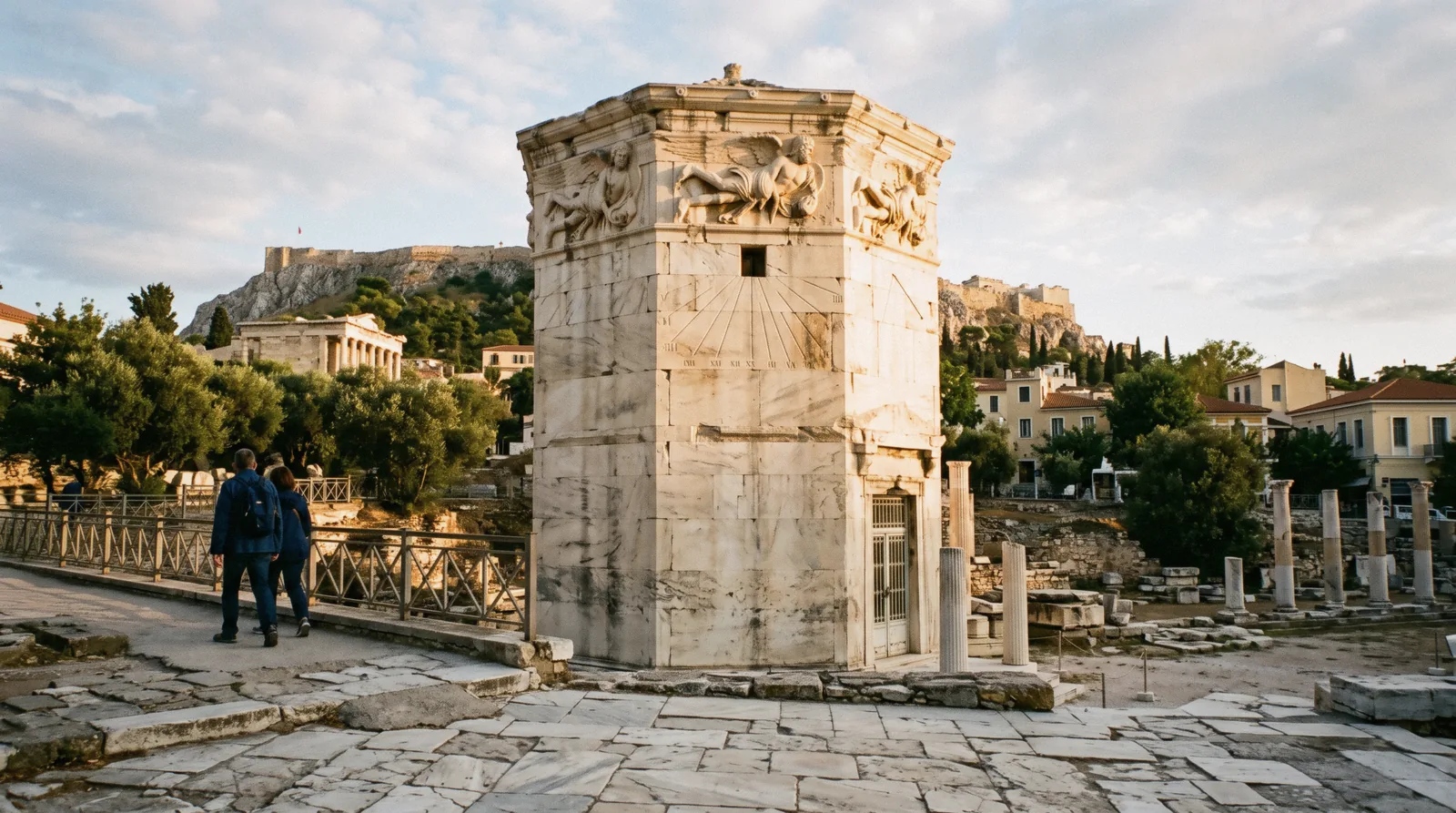
The Roman Agora and the Tower of the Winds
The Roman Agora athens visitors walk past on the way to Monastiraki is a small walled square two minutes from the metro, and it holds one exceptional building: the Tower of the Winds, an octagonal marble clock tower that still has its sundials, its frieze of eight wind gods and its roof. This page has the hours, the price and what to look at, as checked in Q3 2026. The Greek civic square five minutes away is on the Ancient Agora page, and the wider plan on what to see in Athens Greece.
Quick answer What it is, what it costs, and whether twenty minutes is enough
The Roman Agora costs €10 full and €5 reduced, takes twenty to thirty minutes, and is two minutes on foot from Monastiraki station. The Tower of the Winds is inside the fence.
Key takeaways
- Come for the tower. The Tower of the Winds is the best-preserved building of its kind anywhere and still carries its sundial lines on the outside walls.
- It is a different site and a different ticket from the Ancient Agora, which is six minutes away, costs €20 and takes three times as long.
- The monumental Gate of Athena Archegetis stands on the west side and is visible from the street without a ticket, lit at night.
- Winter closing is 15:00 — earlier than the rock, like most of the small central sites. The opening-hours table lines them up.
- The two-Agora card with audio is the only product that pairs this site with the Greek one; at official prices the pair is €30.
Key facts
Opening hours
| 1 April – 31 August, daily | 08:00–20:00 |
|---|---|
| 1–15 September, daily | 08:00–19:30 |
| 16–30 September, daily | 08:00–19:00 |
| 1–15 October, daily | 08:00–18:30 |
| 16–31 October, daily | 08:00–18:00 |
| 1 November – 31 March, daily | 08:00–15:00 |
Closed 1 January, 25 March, 1 May, Orthodox Easter Sunday, 25 and 26 December
Admission
- Adult
- €10
- Reduced
- €5
- Free
- 6 March, 18 April, 18 May, the last weekend of September, 28 October, and the first and third Sunday from 1 November to 31 March
Planning it
- Time needed
- Not stated by the site; our routing: 20 to 30 minutes
- Book ahead
- Optional — walk-up usually fine
- Address
- Dioskouron Street, 105 55 Athens
The ways in, priced from hh.gr and GetYourGuide on 1 September 2026. At €10 this is the cheapest ticketed site in the ancient centre after Aristotle's Lyceum.
At $11.62 (€10) this is the cheapest gate in the centre, so the question is not price but whether you will use a bundle you have already bought.
| Option | Price | Includes | Cancel | Book |
|---|---|---|---|---|
| Official ticketAnyone who wants the Tower of the Winds close up rather than through the railings | €10 full / €5 reduced | The square and the Tower of the Winds | Per the platform's terms | Official site |
| Both Agoras with audioFor seeing both Agoras in one afternoon on a single product | Listed at €46 | Time-slotted entry here and at the Ancient Agora, two audio tours | Per listing | Check Availability |
| Acropolis plus up to five sitesFor anyone already buying the rock plus several sites | Listed at €36 | This site among them | Per listing | Check Availability |
| Night walking tourFor an evening walk that passes the gate without entering anything | From €19 | Passes the gate and the tower from the street, no entry | Per listing | Check Availability |
The two-Agora card lists at more than the €30 the two official tickets cost, so it is buying you the audio commentary rather than a discount. On a site this small with almost no interpretation, that is a more defensible purchase than it sounds.
Ways in to the Roman Agora
The cards behind the table, with the operator's own rating and review count.
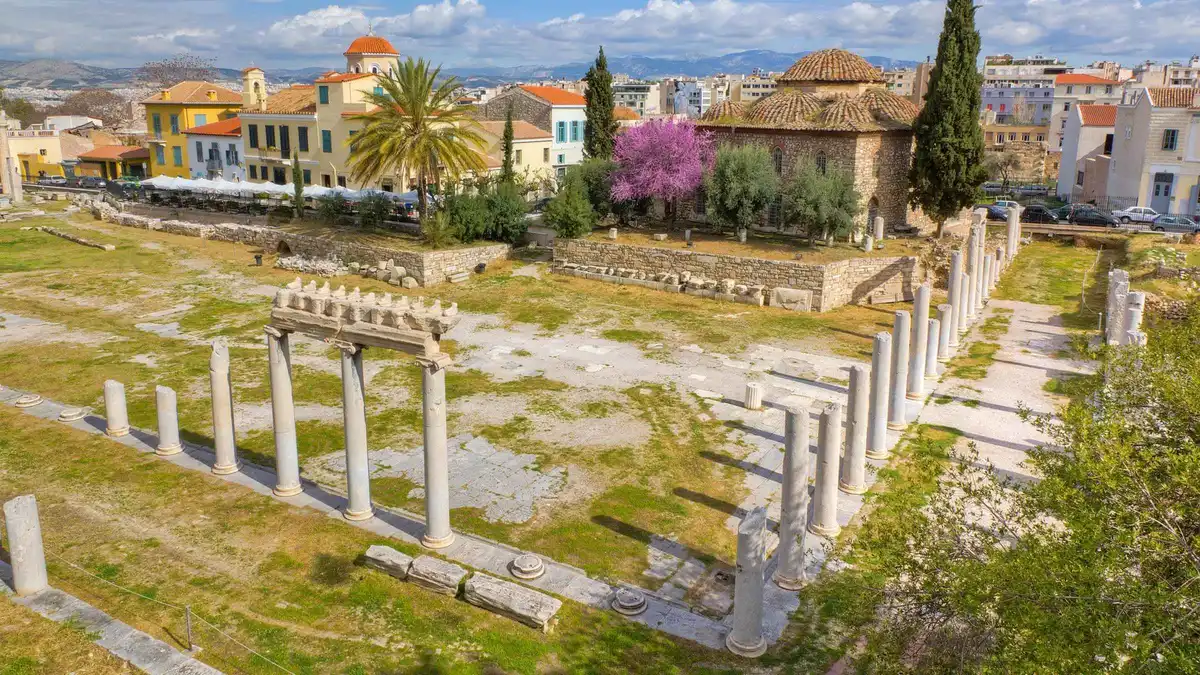 from €44
Athens: Roman Agora & Ancient Agora E-ticket & 2 Audio Tours
Time-slotted e-tickets for both Agoras with two smartphone audio tours, which is the only bundle of the two sold as one product.
Check Availability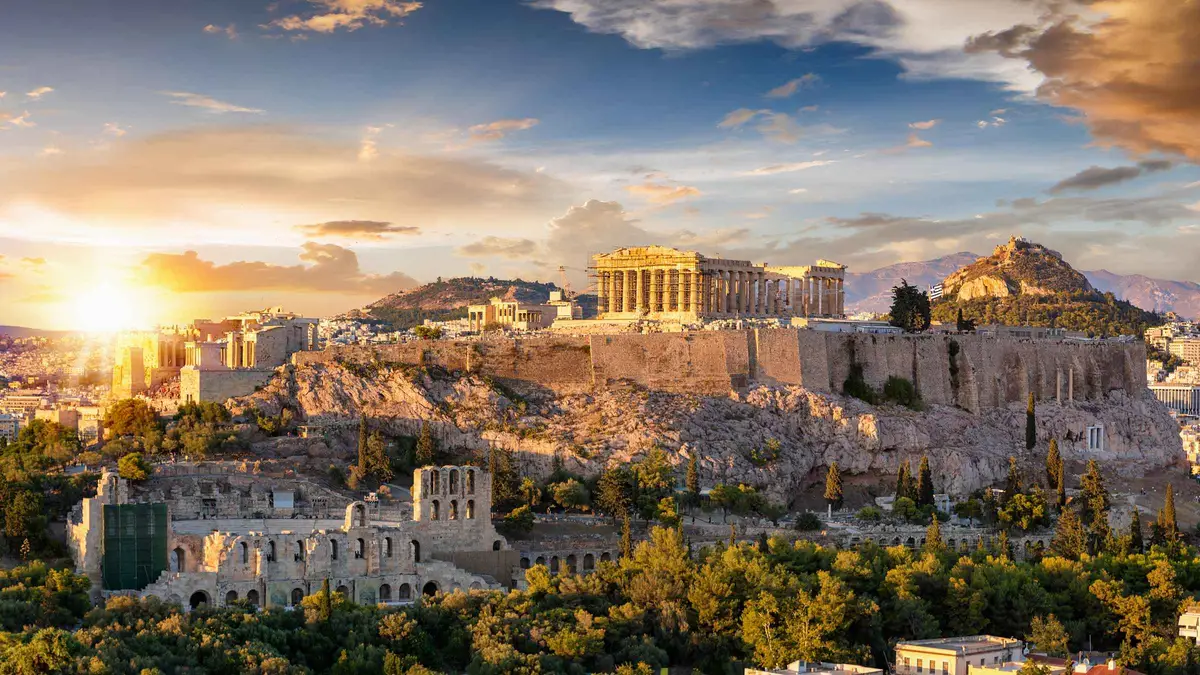 from €36
Athens: Acropolis Ticket & Heritage Sites + Acropolis Audio
The bundle the official shop does not sell: the Acropolis slot plus entry to up to five more archaeological sites, including both Agoras and the Temple of Olympian Zeus.
Check Availability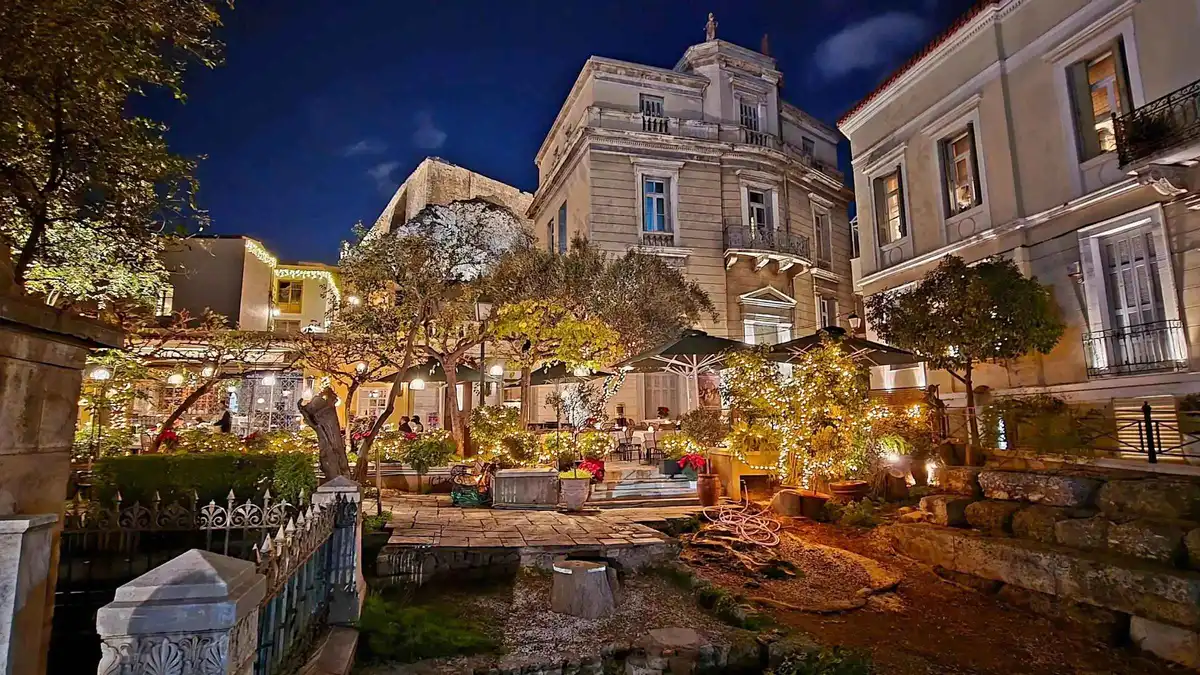 from €18
Athens: Night Walking Tour with Local Guide
Two hours after dark through the historic centre, the Cathedral, Anafiotika, Monastiraki and Plaka, with a local guide and no museum entries.
Check AvailabilityPrices, ratings and details are the platform's own. Euro figures are the listed prices. The platform bills in your account's currency.
The Tower of the Winds
The reason the €10 is worth paying.
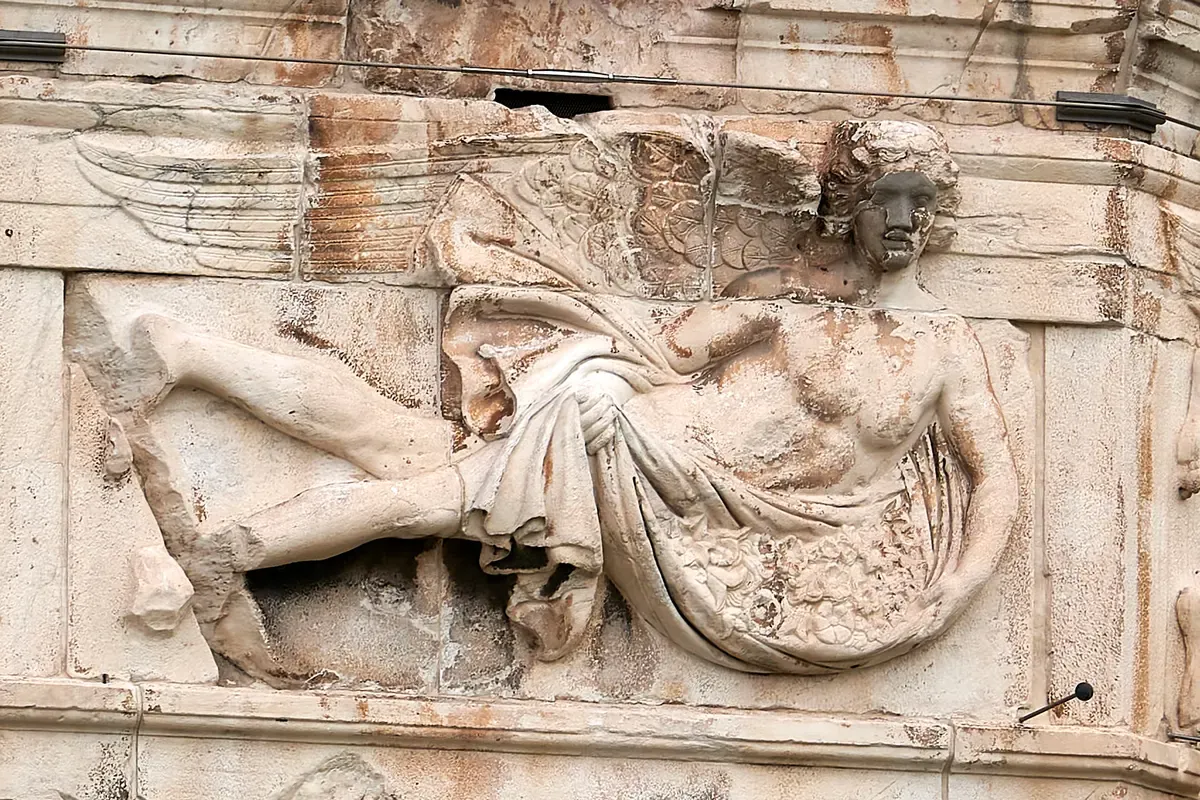
Photo: George E. Koronaios, CC BY-SA 4.0, via Wikimedia Commons
What it is
The Tower of the Winds was built in the 2nd or early 1st century BC by Andronicus of Cyrrhus, a Syrian astronomer. It is an octagonal marble tower about twelve metres high, and each face carries a relief of one of the eight wind gods with the weather he brings. Boreas from the north with his conch, Zephyros from the west scattering flowers.
Below each relief the sunlit marble is scored with the lines of a sundial, so the tower told the hour twice over from outside. Inside there was a water clock, which mattered in a city where public business ran by daylight. It stands at the edge of the Roman Agora, which costs €10 with a €5 reduced ticket, and it is the best-preserved building on the site.
Give the reliefs ten minutes of daylight, since the north faces sit in shadow for much of the day.
It was a clock
Inside it there was a water clock, fed from the springs on the Acropolis slope, and on the roof a bronze weathervane in the shape of a Triton. Sundials outside for sunny hours, water clock inside for the rest: it is the most complete ancient timekeeping building that survives anywhere, and it survives because, like the Temple of Hephaestus, it spent centuries in religious use — as a Christian baptistery and later as a Sufi lodge under Ottoman rule.
What else is in the square
The Gate of Athena Archegetis on the west side, four Doric columns of Pentelic marble with a pediment, financed by Julius Caesar and Augustus; the marble paving Hadrian laid, some of it inscribed with texts by Marcus Aurelius on the tax duties of oil merchants because the slabs had been used for something else first; and the foundations of the colonnades, shops and warehouses that made this a commercial square rather than a civic one.
Half of it is still under the neighbourhood
The Roman Agora disappeared so completely under later Athens that until the nineteenth century only the gate stood above ground, and most observers took it for a temple. Houses and lanes had grown over the square over the centuries, so digging it out meant demolishing homes and closing a street in Plaka, which was slow and contentious work. Even after all that, what you can walk through today is roughly half the original enclosure.
The other half remains under the buildings of Plaka, so the site reads as an excavation cut into a living quarter rather than a cleared ruin. This shapes a visit in a practical way. The visible ground is compact, and a careful circuit of the paved part, the tower and the gate takes well under an hour, so pair it with nearby sites rather than budgeting a morning for it alone.
Visiting: hours, gate and how long
A twenty-minute site with one seasonal trap and an excellent free view from outside.
The hours
The Roman Agora opens daily at 08:00. From 1 April to 31 August it closes at 20:00, then the closing time steps down through autumn until it reaches 15:00 from 1 November to 31 March. Last admission is twenty minutes before closing.
In winter that means the site is shut by mid-afternoon while the Acropolis stays open another two hours, so plan the tower for the morning or early afternoon between November and March. Admission is €10 full and €5 reduced, which is half the price of the Ancient Agora, and it is one of the smaller state sites so a short visit is normal. Note the standard closure dates for Greek state sites: 1 January, 1 May, Orthodox Easter Sunday, 25 March and 25 and 26 December.
On hot afternoons during official heatwaves the ministry has closed open-air sites through the hottest hours, sometimes announced only a day ahead.
Getting there
The entrance is on Dioskouron Street, about two minutes on foot from Monastiraki station, which is served by Line 1 and Line 3 of the metro. Buses 025 and 026 stop at Monastiraki as well. By car it is roughly nine minutes from Syntagma, but there is nowhere to leave a car near the site, so driving gets you no further than the metro would.
If you use the metro, a single ticket costs €1.20 and is valid for 90 minutes, a day ticket is €4.10 and a five-day ticket €8.20. Coming from the airport, Line 3 runs straight to Monastiraki for €9 one way or €16 return, which drops you closer to the gate than any other option. The walk from Monastiraki square is short but the lanes of Plaka around the entrance are narrow and easy to misread, so watch the street signs on Dioskouron rather than following the fence.
If the gate is shut
A closed gate at the Roman Agora costs you less than you might fear. The Gate of Athena Archegetis stands on the street line at the west end of the site, and it is visible and lit from the pavement at any hour, so you can study its columns and inscription without a ticket. The Tower of the Winds can also be seen over the fence from the lanes on the Plaka side, including its octagonal faces and the reliefs near the top.
What you lose when the gate is shut is the interior of the enclosure: the paving, the foundations and the water clock chamber. Sites shut on the fixed closure days such as 1 January, 1 May, Orthodox Easter Sunday and 25 and 26 December, and public-sector strikes can close state sites with little warning, so a locked gate is not always a schedule problem. Come back the next morning at 08:00.
Roman Agora map
The gate, the tower, and the sites within ten minutes on foot.
Next stop from the Roman Agora
Walk minutes are our estimates from the GPS distances.
Ancient Agora
West along Adrianou. €20 and about seventy-five minutes — the Ancient Agora closes half an hour before the Acropolis in summer.
6 min walkMonastiraki
Two metro lines, the flea market and the grill streets. Monastiraki is where to eat afterwards.
2 min walkPlaka
The stepped lanes under the rock start on the other side of the fence. Plaka is the postcard, at the postcard price.
4 min walkRoman Agora questions
How long does it take to see the Roman Agora?
Twenty to thirty minutes. It is a single walled square with the tower at one end and the gate at the other, and there is very little interpretation on site.
What is the Roman Agora in Athens?
A commercial square built between 19 and 11 BC with money from Augustus and the family of Herod Atticus — shops, warehouses and colonnades around a marble courtyard. It replaced the Greek Agora's market functions while the older square kept the civic ones.
How does this square differ from the Greek one nearby?
Five centuries and six minutes' walk. The Greek one, five minutes west, is the civic centre where the democracy met, costs €20 and takes over an hour. This one is a Roman market square, costs €10 and takes twenty minutes. The Ancient Agora page covers the other.
Is the Tower of the Winds inside the ticket?
Yes — it stands inside the fenced square and needs no separate ticket. The tower section explains what to look at on it.
Can I see anything without paying?
The Gate of Athena Archegetis stands on the street line and is lit at night, and the tower is visible over the fence from the Plaka lanes. For €10, though, standing under the tower is worth it.
What time does it close in winter?
15:00 from 1 November to 31 March, last admission 14:40. The opening-hours table shows which central sites shut at three and which at five.
Roman Agora on Video
Three filmed visits that show the distances, the surfaces and the pace — the things a written page cannot carry. Every id was checked against YouTube on 2 September 2026.
Athens’ Hidden Gem: Exploring Roman Agora of Athens | Athens | Things To Do In Greece
The Roman Agora and the Tower of the Winds, the part of the ancient centre most visitors walk past.
Video: ConnollyCoveThe Agora of Athens Explained
The Agora explained as a working civic space rather than as ruins.
Video: Scenic Routes to the PastThe Best Way to Visit the Acropolis & Ancient Agora in 2026
How the rock and the Agora fit together in one morning, filmed on the current ticket rules.
Video: Greece ExplainedPrices, hours and terms are set by the venue or operator and confirmed at checkout.
We may earn a commission if you book through one of our links, at no extra cost to you. Full affiliate disclosure